
On This Page
Description
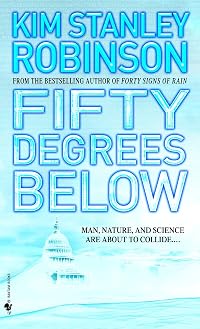
Set in our nation’s capital, here is a chillingly realistic tale of people caught in the collision of science, technology, and the consequences of global warming.When the storm got bad, Frank Vanderwal was in his office at the National Science Foundation. When it was over, large chunks of San Diego had eroded into the sea, and D.C. was underwater. Everything Frank and his colleagues feared had culminated in this disaster. And now the world was looking to them to fix it.
But even as D.C. show more bails itself out, a more extreme climate change looms. The melting polar ice caps are shutting down the warm Gulf Stream waters—meaning Ice Age conditions could return. And the last time that happened, eleven thousand years ago, it took just three years to start.…. show less
Tags
Recommendations




Member Reviews
2nd in a trilogy. ".... that must suffer a sea change". excellent, though like his father i kinda miss the not-yet-2 year old Joe of the first book, an amazingly sharp character. Frank comes to the fore here, a complex, flawed character in the throes of changing himself utterly, looking to the past for paradigms that might prepare him for living in the immediate future of a new Ice Age. meanwhile the almost-mythical Khembalis are suffering (and driving) extreme change as their environment changes around them. Washington D.C., in the middle of a spiritual/political Ice Age, must thaw itself out, as Charley sets Phil to running for President. meanwhile the City must learn to survive and protect its set of species, new leylines and show more contacts must be forged, staid and informal organizations altered, and scientists mobilized quickly to set into motion a whole new scientific revolution, driven by the urgency of the melting poles and the crippled Gulf Stream. there's a lot to think about, a lot to feel, and a lot to accomplish. lack of cooperation is maladaptive, but old patterns persist. it's a show, not a tell book, to its credit, full of very complicated ideas extremely well boiled down, full of compelling individuals engaged in the serious business of changing the culture, even if it requires changing themselves, shifting quickly on the ground to choose between existing models and find a path that works before the whole world they're standing on becomes unviable. an important book, in that it suggests a way forward, but also a well-written book with memorable characters with widely varying outlooks caught at an important moment, dealing indomitably with the causes and consequences of catastrophic change. show less
...I think Fifty Degrees Below is a better novel than Forty Signs of Rain. It's his most political novel up to that point and probably also the one that is most likely to polarize readers. The tighter focus on a single character will not be appreciated by all readers but does give us the most detailed look into the mind of a type character that Robinson portrays in a number of his novels: the scientist engaged with society, working not just to expand the sum of human knowledge but to put this knowledge in practice too. Through Frank's eyes we see science reaching out to society and politics in a way that clashes with the traditional view of science as the pursuit knowledge only. Will science be able to overcome the shortcomings of the show more current political process? Will science help us deal with the current crisis better than the current policy of denial?
Fifty Degrees Below poses some very fundamental questions about the way we run the world at the moment. Not everybody will agree with Robinson's views but it makes for fascinating reading. At it's core, this novel is not a thriller but a political statement and the message is 'we need to do something now!' Read it as such and there is plenty of material to think about. It hits a lot closer to home than the Mars trilogy or other novels set in various places in the solar system. Earth is old, full and complicated and changing the direction we're headed is hard. The details of a story tackling such a complex subject and the details of science underpinning will always be debatable but Robinson captures that sense of complexity and inertia in society very well. All things considered I think I got a lot more out of this novel than during my first read.
Full Random Comments review show less
Fifty Degrees Below poses some very fundamental questions about the way we run the world at the moment. Not everybody will agree with Robinson's views but it makes for fascinating reading. At it's core, this novel is not a thriller but a political statement and the message is 'we need to do something now!' Read it as such and there is plenty of material to think about. It hits a lot closer to home than the Mars trilogy or other novels set in various places in the solar system. Earth is old, full and complicated and changing the direction we're headed is hard. The details of a story tackling such a complex subject and the details of science underpinning will always be debatable but Robinson captures that sense of complexity and inertia in society very well. All things considered I think I got a lot more out of this novel than during my first read.
Full Random Comments review show less
It was not until I did some follow-up research that I realised 'Fifty Degrees Below' was the central book of a trilogy. In that case, it did very well for having a beginning that was engaging to pick up and and middle that largely sustained my interest but it felt very lacking in the end department!
The protagonist, Frank Vanderwal manages an intriguing balance of holding down a responsible job in an organisation devoted to finding effective measures to combat climate change while experimenting with splitting his private life between his van, a tree house and the bathroom of a gym rather than the more traditional house style of living.
Initially this, combined with the backdrop of a Washington DC that had been devastated by floods and was show more now facing an extreme winter, was fascinating. Somewhere in the later portion of the book though, perhaps round about the time Frank got hit in the face and suffered concussion, it began to feel that it was dragging along.
Perhaps reading the first and last books as well would give a better appreciation of the whole but I would rather have had things wrapped up a 100 or so pages earlier rather than be faced with another thousand pages to read before I can appreciate the whole. show less
The protagonist, Frank Vanderwal manages an intriguing balance of holding down a responsible job in an organisation devoted to finding effective measures to combat climate change while experimenting with splitting his private life between his van, a tree house and the bathroom of a gym rather than the more traditional house style of living.
Initially this, combined with the backdrop of a Washington DC that had been devastated by floods and was show more now facing an extreme winter, was fascinating. Somewhere in the later portion of the book though, perhaps round about the time Frank got hit in the face and suffered concussion, it began to feel that it was dragging along.
Perhaps reading the first and last books as well would give a better appreciation of the whole but I would rather have had things wrapped up a 100 or so pages earlier rather than be faced with another thousand pages to read before I can appreciate the whole. show less
I stopped two thirds of the way through, which is the first Robinson novel with which I've done that. The problem is that Robinson took the least interesting character from Forty Signs of Rain and made him the main viewpoint character. Frank is obsessed with sociobiology (which, as someone who majored in anthropology, I am thoroughly convinced is bunk), so there are several (an incredible number) of lengthy objectifying descriptions of women and their evolutionary fitness. Frank's biggest personality trait in this book is "that feel when no gf" and it becomes incredibly tedious. The surveillance subplot is tedious as well, even in this post-NSA leak time.
It's a bummer, but I don't feel bad not continuing this series. The environment show more collapse in real life is almost certainly past the point of no return anyway, so reading this just bums me out. show less
It's a bummer, but I don't feel bad not continuing this series. The environment show more collapse in real life is almost certainly past the point of no return anyway, so reading this just bums me out. show less
“Fifty Degrees Below” picks up where “Forty Signs of Rain” left off, with Washington D.C. dusting itself off after being totally flooded. As before, we follow a handful of characters as they try to force the political/scientific community into action on climate change through sheer force of will.
We have Charlie & Anna Quibler, Charlie being an advisor to eccentric senator-cum-presidential-candidate Phil Chase, and Anna being a high-ranking NSF official. Then there’s Frank Vanderwahl. He’s a sociobiologist who get fully involved with the NSF efforts to coordinate a world-wide response to global warming. He’s also an over-thinking freak who decides to live in a self-built tree house in a park that had been closed after the show more flooding, hang out with (commendably unromanticized) homeless people as well as (shamelessly over-romanticized) shamanistic homeless-by-choice feral people, has an affair with a married black-project intelligence woman who had been tasked with his surveillance while also having a crush on his boss. Almost the entire book is from his POV, and when he finally gets a 2x4 upside the head it was a welcome improvement (after which Robinson does a great job illustrating the different thought processes of his healthy mind and his concussed mind). Seriously, at least two-thirds of the book is from Frank’s POV, and I found him to be the most annoying character in the series. In “Forty Signs of Rain,” the POV characters got more equity in their page-time. In fact Anna Quibler only got maybe two sections of her own in this volume, which was disappointing since she was the character I related to most directly.
This book appears to suffer from the dreaded “second book in a trilogy” syndrome. Only a few things have to happen in this book to move the plot along: Washington D.C. suffers a severe and dramatic cold snap in the winter, the NSF funds a project to re-salinate a part of the North Atlantic to try to re-start the Gulf Stream, the island home of the Khembalis (fictitious Tibetan refugees) goes under the ocean, and Phil Chase’s presidential candidacy is played out. All the rest of the book has the feel of filler, and it’s all about Frank. I’m willing to put up with a lot in order to read amazingly and rigorously imagined consequences of climate change on a global scale and what might be done about it, but the constant focus on Frank and his obsessing about the evolutionary antecedents of *everything* really got on my nerves. I hope that in the third book (currently being written, but not yet named), we’ll get back to the real plots and the characters that I actually care about. show less
We have Charlie & Anna Quibler, Charlie being an advisor to eccentric senator-cum-presidential-candidate Phil Chase, and Anna being a high-ranking NSF official. Then there’s Frank Vanderwahl. He’s a sociobiologist who get fully involved with the NSF efforts to coordinate a world-wide response to global warming. He’s also an over-thinking freak who decides to live in a self-built tree house in a park that had been closed after the show more flooding, hang out with (commendably unromanticized) homeless people as well as (shamelessly over-romanticized) shamanistic homeless-by-choice feral people, has an affair with a married black-project intelligence woman who had been tasked with his surveillance while also having a crush on his boss. Almost the entire book is from his POV, and when he finally gets a 2x4 upside the head it was a welcome improvement (after which Robinson does a great job illustrating the different thought processes of his healthy mind and his concussed mind). Seriously, at least two-thirds of the book is from Frank’s POV, and I found him to be the most annoying character in the series. In “Forty Signs of Rain,” the POV characters got more equity in their page-time. In fact Anna Quibler only got maybe two sections of her own in this volume, which was disappointing since she was the character I related to most directly.
This book appears to suffer from the dreaded “second book in a trilogy” syndrome. Only a few things have to happen in this book to move the plot along: Washington D.C. suffers a severe and dramatic cold snap in the winter, the NSF funds a project to re-salinate a part of the North Atlantic to try to re-start the Gulf Stream, the island home of the Khembalis (fictitious Tibetan refugees) goes under the ocean, and Phil Chase’s presidential candidacy is played out. All the rest of the book has the feel of filler, and it’s all about Frank. I’m willing to put up with a lot in order to read amazingly and rigorously imagined consequences of climate change on a global scale and what might be done about it, but the constant focus on Frank and his obsessing about the evolutionary antecedents of *everything* really got on my nerves. I hope that in the third book (currently being written, but not yet named), we’ll get back to the real plots and the characters that I actually care about. show less
Kim Stanley Robinson is probably my favorite writer right now so I was a bit disappointed with the first novel in this series (it just felt like nothing much happened). This one was an improvement but the whole novel feels very disjointed. The story has moved to following Frank more than the other characters and his story is strangely fragmented. We have the story of him living in the woods of Rock Creek Park (which could have carried a book on its own in fleshed out), his work as NSF, and and bizarre spy story. The various parts of his life interact with each other so little as to leave me wondering what is the story. I'm hoping the final novel in the series will pull things together a bit more.
The book, and series, looks mainly at possible mitigation and adaptation efforts that could be undertaken to combat the dangers of climate change, focusing on an international effort to restart the stalled Gulf Stream.
I don’t know if I would have read the second book in this global warming series if I hadn’t already received it for Christmas, and I liked it even less than the first one, actually. I know I will not finish the trilogy, never mind how much I have enjoyed other Kim novels or how passionately I feel about global warming.
The sequel has even more interminable meetings and discussions and making to-do lists — reading it is like going to work. And the main character’s behavior — living in a treehouse in the woods show more despite an abnormally cold winter, dating a married CIA spook who tells him he is being bugged and tailed, playing ultimate frisbee with homeless hippies — snaps the elasticity of believability. This one was a chore to get through. show less
I don’t know if I would have read the second book in this global warming series if I hadn’t already received it for Christmas, and I liked it even less than the first one, actually. I know I will not finish the trilogy, never mind how much I have enjoyed other Kim novels or how passionately I feel about global warming.
The sequel has even more interminable meetings and discussions and making to-do lists — reading it is like going to work. And the main character’s behavior — living in a treehouse in the woods show more despite an abnormally cold winter, dating a married CIA spook who tells him he is being bugged and tailed, playing ultimate frisbee with homeless hippies — snaps the elasticity of believability. This one was a chore to get through. show less
Members
- Recently Added By
Lists

Books With Numbers in the Title
308 works; 13 members

Books Read in 2006
421 works; 8 members

Books With Winter Words in the Title
42 works; 6 members

Books Read in 2018
4,360 works; 110 members

Best Science Fiction Novels
816 works; 430 members
Author Information

143+ Works 49,377 Members
Kim Stanley Robinson was born in Orange County, California on March 23, 1952. He received a B. A. and Ph. D. from the University of California at San Diego and an M. A. from Boston University. His first trilogy of books, Orange County, collectively won a Nebula Award and two Hugo Awards. His other works include the Mars trilogy, 2312, and Aurora. show more He has won an Asimov Award, a World Fantasy Award, a Locus Reader's Poll Award, and a John W. Campbell Award. (Bowker Author Biography) show less
Awards and Honors
Awards
Distinctions
Notable Lists
Series

Work Relationships
Is contained in
Common Knowledge
- Canonical title*
- 50° au-dessous de zéro
- Original title
- Fifty Degrees Below
- Original publication date
- 2005-08
- People/Characters
- Frank Vanderwal
- Important places
- Washington, D.C., USA
- First words
- Nobody likes Washington, D.C.
It was not a good time to have to look for a place to live. - Last words
- (Click to show. Warning: May contain spoilers.)What is hard is to be a whole person."
- Publisher's editor
- Groell, Anne Lesley
- Original language
- English
*Some information comes from Common Knowledge in other languages. Click "Edit" for more information.
Classifications
Statistics
- Members
- 1,103
- Popularity
- 22,979
- Reviews
- 33
- Rating
- (3.58)
- Languages
- Dutch, English, French
- Media
- Paper, Ebook
- ISBNs
- 12
- ASINs
- 8