On This Page
Description
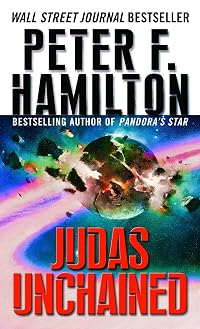
Peter F. Hamilton's superbly imagined, cunningly plotted interstellar adventures are conceived on a staggeringly epic scale and filled with fully realized human and alien characters as complex as they are engaging. No mere world builder, Hamilton creates entire universes-and he does so with irresistible flair and intelligence. His previous novel, the acclaimed Pandora's Star, introduced the Intersolar Commonwealth, a star-spanning civilization of the twenty-fourth century. Robust, peaceful, show more and confident, the Commonwealth dispatched a ship to investigate the mystery of a disappearing star, only to inadvertently unleash a predatory alien species that turned on its liberators, striking hard, fast, and utterly without mercy.The Prime are the Commonwealth's worst nightmare. Coexistence is impossible with the technologically advanced aliens, who are genetically hardwired to exterminate all other forms of life. Twenty-three planets have already fallen to the invaders, with casualties in the hundreds of millions. And no one knows when or where the genocidal Prime will strike next.Nor are the Prime the only threat. For more than 100 years, a shadowy cult, the Guardians of Selfhood, has warned that an alien with mind-control abilities impossible to detect or resist-the Starflyer-has secretly infiltrated the Commonwealth. Branded as terrorists, the Guardians and their leader, Bradley Johansson, have been hunted by relentless investigator Paula Myo. But now evidence suggests that the Guardians were right all along and that the Starflyer has placed agents in vital posts throughout the Commonwealth-agents who are now sabotaging the war effort. Is the Starflyer an ally of the Prime, or has it orchestrated a fight to the death between the two species for its own advantage?Caught between two deadly enemies, one a brutal invader striking from without, the other a remorseless cancer killing from within, the fractious Commonwealth must unite as never before.This will be humanity's finest hour-or its last gasp. show lessTags
Recommendations



Member Reviews
Impressive conclusion to the epic Sci-fi saga that began with Pandora's Star. Not quite as unqualified a success as that previous volume, since I found the writing a bit uneven this time around and everything did fall into place rather neatly at the end. It was almost as if Hamilton was experiencing writer's fatigue at times. Understandable given that the two books are in fact one continuous 2,000 page novel.
Those minor quibbles aside, Hamilton succeed admirably here. The scale and complexity is unlike anything I've read. But since Hamilton has complete command of the story and offers good character development and mostly smooth writing, I did not find it hard to keep track of the myriad plot threads and characters. The denouement, show more juggling 3 or 4 different climaxes at once, was exciting. These 2 books would make one helluva Sci-Fi TV series a la Battlestar Galactica.
There is plenty of political intrigue, mysteries, danger, explosive action, and exotic technology. There is gritty realism. Aliens are attacking. Yet, Hamilton also has a great sense of humor. I found myself laughing out loud several times. Like when one character visits the NYC of 300 years in the future: "As always, the antics of the city's yellow cabs drew a frown on her forehead; whoever programmed their drive arrays did an appalling job. Her own car had to break sharply several times as they cut in front".
Or this, when one of the characters encounters an alien: “Who are you?” Ozzie asked.
The Silfen’s circular mouth opened wide, allowing the long slender tongue to vibrate between his rows of teeth. “I am the one who dances in the endless wind streams which flow along the tumbling white clouds as they circle in eternal orbit within the star of life.” He gave a sharp whistle. “But you may call me Clouddancer. I know how you humans have to be so quick and shallow.”
I found those two examples, and others, hilarious. You don't often find laugh out loud humor in Sci-Fi, at least not the books I've read. I've become quite a fan of Hamilton and his prodigious talent. Looking forward to Great North Road, Fallen Dragon, and the Void trilogy. show less
Those minor quibbles aside, Hamilton succeed admirably here. The scale and complexity is unlike anything I've read. But since Hamilton has complete command of the story and offers good character development and mostly smooth writing, I did not find it hard to keep track of the myriad plot threads and characters. The denouement, show more juggling 3 or 4 different climaxes at once, was exciting. These 2 books would make one helluva Sci-Fi TV series a la Battlestar Galactica.
There is plenty of political intrigue, mysteries, danger, explosive action, and exotic technology. There is gritty realism. Aliens are attacking. Yet, Hamilton also has a great sense of humor. I found myself laughing out loud several times. Like when one character visits the NYC of 300 years in the future: "As always, the antics of the city's yellow cabs drew a frown on her forehead; whoever programmed their drive arrays did an appalling job. Her own car had to break sharply several times as they cut in front".
Or this, when one of the characters encounters an alien: “Who are you?” Ozzie asked.
The Silfen’s circular mouth opened wide, allowing the long slender tongue to vibrate between his rows of teeth. “I am the one who dances in the endless wind streams which flow along the tumbling white clouds as they circle in eternal orbit within the star of life.” He gave a sharp whistle. “But you may call me Clouddancer. I know how you humans have to be so quick and shallow.”
I found those two examples, and others, hilarious. You don't often find laugh out loud humor in Sci-Fi, at least not the books I've read. I've become quite a fan of Hamilton and his prodigious talent. Looking forward to Great North Road, Fallen Dragon, and the Void trilogy. show less
Egads, I'm spent after this and it was but the second half of a twofer novel.
There is a brilliant, original, space-opera tale in this duology; that story shares space with two journeyman SF novels (the Ozzie/Orion/Tochee thread would do better as a separate novel), a garbage-scow load of autotype passages (one more "enzyme-bonded concrete" and I'd have been forced to find where this guy lives), far too much unnecessary prose, and 17 gilded kitchen sinks. A more self-indulgent and under-edited SF work I have never, ever encountered; what in the dreaming heavens was Del Rey Books _thinking_?
Beyond those brobdingnagian issues, there's something about Hamilton's SF universe that rings violently wrong. The reader is presented with a show more late-24th century, interstellar, human civilization with wormhole technology, body regeneration, and "re-lifing" that practically endows immortality, but society has not evolved to keep pace with the technological changes driving it. Would a society in which an individual could experience multiple lifetimes, bear children via birthing vats, and have serial ex-spouses remain more heteronormative than Western culture is NOW? Would gender remain solidly binary in all cultures on all human worlds? Twentieth century rock music would remain standard? Hamilton seems intentionally blind to cultural evolution, and very very Eurocentric in his ideologies and social forms.
If you want to read really good space-opera, read Reynolds, Tchaikovsky, or Arkady Martine. This dilutes its own merit. show less
There is a brilliant, original, space-opera tale in this duology; that story shares space with two journeyman SF novels (the Ozzie/Orion/Tochee thread would do better as a separate novel), a garbage-scow load of autotype passages (one more "enzyme-bonded concrete" and I'd have been forced to find where this guy lives), far too much unnecessary prose, and 17 gilded kitchen sinks. A more self-indulgent and under-edited SF work I have never, ever encountered; what in the dreaming heavens was Del Rey Books _thinking_?
Beyond those brobdingnagian issues, there's something about Hamilton's SF universe that rings violently wrong. The reader is presented with a show more late-24th century, interstellar, human civilization with wormhole technology, body regeneration, and "re-lifing" that practically endows immortality, but society has not evolved to keep pace with the technological changes driving it. Would a society in which an individual could experience multiple lifetimes, bear children via birthing vats, and have serial ex-spouses remain more heteronormative than Western culture is NOW? Would gender remain solidly binary in all cultures on all human worlds? Twentieth century rock music would remain standard? Hamilton seems intentionally blind to cultural evolution, and very very Eurocentric in his ideologies and social forms.
If you want to read really good space-opera, read Reynolds, Tchaikovsky, or Arkady Martine. This dilutes its own merit. show less
What a galaxy Peter F. Hamilton has created with the Commonwealth! This series was my first exposure to his writing and the immensity and vivid detail of his not-so-distant human civilization has few rivals on my bookshelf. It’s easy to picture it serving as the setting for additional novels (which I am greatly looking forward to reading) while still sparing plenty of room for yet more riffs exploring the nooks and crannies of its patchwork of worlds. Let’s put it this way: William Gibson, Neal Stephenson, and Kim Stanley Robinson could each write characteristic novels that slot perfectly into the Commonwealth without breaking its canon. It’s a shame that they’re never going to as I would die to see a seedy cyberpunk thriller show more cut out of the underbelly of the cloth used for Pandora’s Star and Judas Unchained.
In many ways I feel that Judas Unchained did not do the Commonwealth justice. Where Pandora’s Star was subtle and intriguing, Judas Unchained was blunt and overbearing. Characters were more repetitive and stereotypical. Sex scenes were more explicit and prolific. Battle scenes were less compelling and felt closer to what you might find in this year’s Marvel movie. For me the climax of the series came at the end of Pandora’s Star and Judas Unchained was a long coast back down from that peak like a hyperglider returning to Far Away from its apex above Mount Herculaneum. The ending was clear from hundreds of pages out and all that was left to be done was to flip through chapter after chapter of what boiled down to a flashy car chase.
Now, I should clarify that I did not find Pandora’s Star to be at all boring, which should indicate my preferences as a reader. If a thunderous plot unfolding is more interesting to you than character development, careful world building, and mystery, then Judas Unchained might be the book in the Saga that resonates more with you.
Viewing Judas Unchained as merely a single path through the rich tapestry of the Commonwealth, even though I was ultimately disappointed with its storytelling I still view the series in an overwhelmingly positive light. The Commonwealth for me stands as a benchmark demonstrating just how audacious and full-featured a fictional universe can be while still being packed full of relatable and fallible humans like the rest of us down here on Earth. show less
In many ways I feel that Judas Unchained did not do the Commonwealth justice. Where Pandora’s Star was subtle and intriguing, Judas Unchained was blunt and overbearing. Characters were more repetitive and stereotypical. Sex scenes were more explicit and prolific. Battle scenes were less compelling and felt closer to what you might find in this year’s Marvel movie. For me the climax of the series came at the end of Pandora’s Star and Judas Unchained was a long coast back down from that peak like a hyperglider returning to Far Away from its apex above Mount Herculaneum. The ending was clear from hundreds of pages out and all that was left to be done was to flip through chapter after chapter of what boiled down to a flashy car chase.
Now, I should clarify that I did not find Pandora’s Star to be at all boring, which should indicate my preferences as a reader. If a thunderous plot unfolding is more interesting to you than character development, careful world building, and mystery, then Judas Unchained might be the book in the Saga that resonates more with you.
Viewing Judas Unchained as merely a single path through the rich tapestry of the Commonwealth, even though I was ultimately disappointed with its storytelling I still view the series in an overwhelmingly positive light. The Commonwealth for me stands as a benchmark demonstrating just how audacious and full-featured a fictional universe can be while still being packed full of relatable and fallible humans like the rest of us down here on Earth. show less
After reading the first book, Pandora's Star, I was slightly miffed at just how scattered and sometimes ... dull... it seemed. I only felt that way because the alien bits and the big spaceship stuff and the weird alien stuff simply SHONE for me. I didn't really cotton to all the human-only investigation stuff or the politics until it kinda snuck up on me and grabbed me by the neck because IT WAS IMPORTANT.
Well. It became important eventually. But I should mention that each of these books is roughly the equivalent of four normal novels EACH. That's 8 standard-length novels. A slight digression is more of a novel-length wander. :)
What I am most impressed with is the wide range of genre-writing going on here. There's full-flung mil-SF, show more political intrigue SF, murder-mystery and spy SF, revolutionary thriller SF, media-scoop SF, as well as hardcore alien Hard-SF with Big Dumb Objects galore, miniature wormhole attacks, rejuvenation, memory cores so you can get a new body, as well as a LOT of nova'd stars. Big-ass scale.
But for me, it's just a matter of having to TRUST the author to get me there. All the other books I'd read by him had the same kind of style. Like a Dickens-like wander getting us the feel of so many levels of the society, or Hugo in the way he did Les Miserables. It's BIG. It requires a LOT of trust from the reader.
Fortunately, my trust was not misplaced. I'm going to rate-up the previous novel and wholeheartedly recommend BOTH books with this caveat. Stick with it. It's VERY rewarding and everything comes together eventually and necessarily.
The first book has a great blow-out at the end, but it is FAR from being wrapped up. This book did a GREAT job with that. :) show less
Well. It became important eventually. But I should mention that each of these books is roughly the equivalent of four normal novels EACH. That's 8 standard-length novels. A slight digression is more of a novel-length wander. :)
What I am most impressed with is the wide range of genre-writing going on here. There's full-flung mil-SF, show more political intrigue SF, murder-mystery and spy SF, revolutionary thriller SF, media-scoop SF, as well as hardcore alien Hard-SF with Big Dumb Objects galore, miniature wormhole attacks, rejuvenation, memory cores so you can get a new body, as well as a LOT of nova'd stars. Big-ass scale.
But for me, it's just a matter of having to TRUST the author to get me there. All the other books I'd read by him had the same kind of style. Like a Dickens-like wander getting us the feel of so many levels of the society, or Hugo in the way he did Les Miserables. It's BIG. It requires a LOT of trust from the reader.
Fortunately, my trust was not misplaced. I'm going to rate-up the previous novel and wholeheartedly recommend BOTH books with this caveat. Stick with it. It's VERY rewarding and everything comes together eventually and necessarily.
The first book has a great blow-out at the end, but it is FAR from being wrapped up. This book did a GREAT job with that. :) show less
‘Judas desencadenado’ no está a la altura de su predecesora, ‘La estrella de Pandora’. El cliffhanger con el que terminaba ésta, me hacía esperar un inicio más contundente. Pero no ha sido así. La cadencia de la narración, ya desde el principio, es excesivamente pausada y se extiende durante páginas y páginas sin que prácticamente suceda nada. Las piezas tardan excesivo tiempo en ponerse en juego y la trama se pierde en los detalles. Lo que resultaba absorbente y refrescante en el primer libro, ya que te sumergía de lleno en la narración por la riqueza del universo creado por el escritor, en este segundo resulta desesperante. El autor, Peter F. Hamilton, se centra casi exclusivamente en el misterio sobre la identidad show more del aviador estelar, ese alienígena del que muchos creen que es una leyenda, pasando a ser una especie de novela de espías en un entorno de ciencia ficción. Lo que podría haber resultado interesante en menos páginas, acaba aburriendo, agotando y poniendo nervioso porque te das cuenta que es completamente innecesario y que lo único que sucede es que el bueno de Hamilton está engordando a su criatura. En esta tesitura, me recuerda al segundo volumen de Endymion de Dan Simmon, ‘El ascenso de Endymion’, donde sucedía lo mismo: demasiada paja y mucho miedo por parte de los autores por no querer recortar cuando sea necesario.
La historia de la Federación compuesta por estos dos volúmenes, ‘La estrella de Pandora’ y ‘Judas desencadenado’, se queda en 1600 páginas de letra minúscula. Si a ‘La estrella de Pandora’, que es una gran novela de ciencia ficción, le hubiera añadido lo más elemental del segundo libro, todo hubiese quedado más fluido, y no hubiese importado nada que la historia se hubiese quedado en un novelón de 1000 páginas. Pero 1600, es una absoluta aberración. show less
La historia de la Federación compuesta por estos dos volúmenes, ‘La estrella de Pandora’ y ‘Judas desencadenado’, se queda en 1600 páginas de letra minúscula. Si a ‘La estrella de Pandora’, que es una gran novela de ciencia ficción, le hubiera añadido lo más elemental del segundo libro, todo hubiese quedado más fluido, y no hubiese importado nada que la historia se hubiese quedado en un novelón de 1000 páginas. Pero 1600, es una absoluta aberración. show less
If you have read [b:Pandora's Star|45252|Pandora's Star (Commonwealth Saga, #1)|Peter F. Hamilton|https://d.gr-assets.com/books/1347952635s/45252.jpg|987015] previously starting on Judas Unchained should feel like coming home, as there would be no need to familiarize yourself with the settings or characters. On the other hand, if you attempt to read this book without having read Pandora's Star first it would be like wandering into somebody else's home by mistake, wondering who changed your furniture, realizing your mistake and make a quick exit before the cops arrive.
Judas Unchained continues the epic story started in Pandora's Star without pausing for breath (because breathing is overrated), I suppose there are people who read show more "Pandora's" and decided not to bother with the next volume, I further suppose that such people are in the minority. Peter F. must be a very confident author to have the gall to write series that consist of such massive books and expect people to read them. Fat books series are prevalent in modern fantasy epics but rarely found in science fiction. Fortunately for sf readers Hamilton is more than capable to carry it off.
This book is basically about alien invasion and how humanity fend them off whereas the previous volume is more concerned with "WTF is going on?" Like most epic fiction the story features a large cast of characters and several protagonists, the plot is moved forward by switching the narrative between them. Hamilton does this very well for the most part, however the disadvantage of this format is that some characters are more compelling than others and when the reader's perspective is switched to one of the less interesting character it can drag down the pace a little. Still, this is not a major problem because such characters are in the minority and their chapters do not linger on for long. Hamilton's masterful action scenes also compensate for the few instances of drag. My favorite chapter is a deliciously gung-ho scene where a cybernetically enhanced human character faces off an alien modified character. A Marvel/DC style superheroic kickassery ensues with "disrupter pulses" and personal force fields being employed to maximum effect. I do love edifying books but the "F*ck Yeah!" moments are hugely entertaining and make me grin like an idiot ("like" being the operative word). There are also thoughtful passages about existence, humanity, responsibility, redemption etc., with a book this size it is a prerequisite that there is a wide range of elements and moods, nobody likes one single long note that goes on forever, the author does not disappoint here. The whole thing eventually wraps up beautifully and I went to bed in an excellent mood.
A whale of a book, a whale of a time!
_____________________________________
Edit March 30, 2015: After reading this I went on to read Hamilton's famed Night's Dawn Trilogy which is indeed very good (and each book very long), but I find the two Commonwealth Saga books to be more polished. At the moment I am reading [b:The Dreaming Void|866136|The Dreaming Void (Void, #1)|Peter F. Hamilton|https://d.gr-assets.com/books/1427515065s/866136.jpg|851537], first of the Void Trilogy which is a direct sequel to the Commonwealth Saga, so far it is wildly entertaining. show less
Judas Unchained continues the epic story started in Pandora's Star without pausing for breath (because breathing is overrated), I suppose there are people who read show more "Pandora's" and decided not to bother with the next volume, I further suppose that such people are in the minority. Peter F. must be a very confident author to have the gall to write series that consist of such massive books and expect people to read them. Fat books series are prevalent in modern fantasy epics but rarely found in science fiction. Fortunately for sf readers Hamilton is more than capable to carry it off.
This book is basically about alien invasion and how humanity fend them off whereas the previous volume is more concerned with "WTF is going on?" Like most epic fiction the story features a large cast of characters and several protagonists, the plot is moved forward by switching the narrative between them. Hamilton does this very well for the most part, however the disadvantage of this format is that some characters are more compelling than others and when the reader's perspective is switched to one of the less interesting character it can drag down the pace a little. Still, this is not a major problem because such characters are in the minority and their chapters do not linger on for long. Hamilton's masterful action scenes also compensate for the few instances of drag. My favorite chapter is a deliciously gung-ho scene where a cybernetically enhanced human character faces off an alien modified character. A Marvel/DC style superheroic kickassery ensues with "disrupter pulses" and personal force fields being employed to maximum effect. I do love edifying books but the "F*ck Yeah!" moments are hugely entertaining and make me grin like an idiot ("like" being the operative word). There are also thoughtful passages about existence, humanity, responsibility, redemption etc., with a book this size it is a prerequisite that there is a wide range of elements and moods, nobody likes one single long note that goes on forever, the author does not disappoint here. The whole thing eventually wraps up beautifully and I went to bed in an excellent mood.
A whale of a book, a whale of a time!
_____________________________________
Edit March 30, 2015: After reading this I went on to read Hamilton's famed Night's Dawn Trilogy which is indeed very good (and each book very long), but I find the two Commonwealth Saga books to be more polished. At the moment I am reading [b:The Dreaming Void|866136|The Dreaming Void (Void, #1)|Peter F. Hamilton|https://d.gr-assets.com/books/1427515065s/866136.jpg|851537], first of the Void Trilogy which is a direct sequel to the Commonwealth Saga, so far it is wildly entertaining. show less
I considered giving this a 5. It has everything and it manages to be both a Space Opera and a Thriller! Fantastic tech, complex enthralling plot, vivid page-turning prose, great characters. Stunning.
Members
- Recently Added By
Lists

Isaac Arthur’s Book Recommendations
98 works; 3 members

Books Read in 2014
2,343 works; 89 members

Books Read in 2015
3,299 works; 129 members

Books Read in 2017
4,249 works; 129 members

Books Read in 2025
4,128 works; 98 members
Author Information

126+ Works 42,778 Members
Peter F. Hamilton was born in Rutland, England on March 2, 1960. He started writing in 1987 and sold his first short story to Fear magazine in 1988. His first novel, Mindstar Rising, was published in 1993. His other works include the Night's Dawn series; Fallen Dragon; and the Void series. (Bowker Author Biography)
Some Editions
Series


Work Relationships
Common Knowledge
- Canonical title
- Judas Unchained
- Original publication date
- 2005-10
- People/Characters
- Nigel Sheldon; Ozzie Fernandez Issac; Wilson Kime; Paula Myo; Mellanie Rescorai
- Important places
- London, England, UK; Paris, France; New York, New York, USA
- Dedication
- To Sophie Hazel Hamilton
I never knew how much I missed you until you arrived - First words
- Right from the start, there was something about the investigation which made Lieutenant Renne Kempasa uneasy. (Prologue)
The harsh sound of ion pistol shots sizzled out of the speakers to reverberate around the LA Galactic security office. - Last words
- (Click to show. Warning: May contain spoilers.)"It will be interesting to see what you have become by then."
(Click to show. Warning: May contain spoilers.)"But we're not the Directorate," Tarlo said quietly. "Not anymore." (Prologue)
Classifications
Statistics
- Members
- 3,250
- Popularity
- 5,287
- Reviews
- 67
- Rating
- (4.05)
- Languages
- English, French, Romanian, Spanish
- Media
- Paper, Audiobook, Ebook
- ISBNs
- 22
- ASINs
- 21