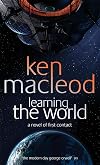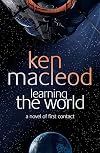
Learning the World
by Ken MacLeod
On This Page
Description
Humanity has spread to every star within 500 light-years of its half-forgotten origin, coloring the sky with a haze of habitats. Societies rise and fall. Incautious experiments burn fast and fade. On the fringes, less modified humans get on with the job of settling a universe that has, so far, been empty of intelligent life.The ancient starship But the Sky, My Lady! The Sky! is entering orbit around a promising new system after a four hundred year journey. For its long-lived inhabitants, the show more centuries have been busy. Now a younger generation is eager to settle the system. The ship is a seed-pod ready to burst.Then they detect curious electromagnetic emissions from the system's Earth-like world. As the nature of the signals becomes clear, the choices facing the humans become stark.On Ground, second world from the sun, a young astronomer searches for his system's outermost planet. A moving point of light thrills, then disappoints him. It's only a comet. His physicist colleague Orro takes time off from trying to invent a flying-machine to calculate the comet's trajectory. Something is very odd about that comet's path.They are not the only ones for whom the world has changed."We are not living in the universe we thought we lived in yesterday. We have to start learning the world all over again."At the Publisher's request, this title is being sold without Digital Rights Management Software (DRM) applied. show lessTags
Recommendations
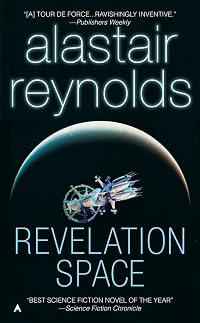
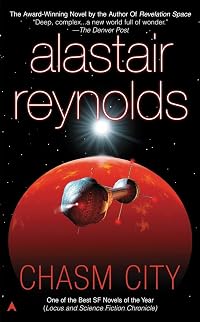
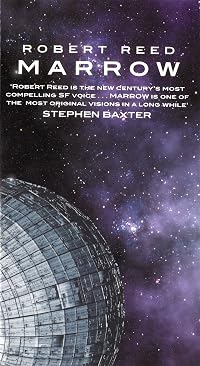
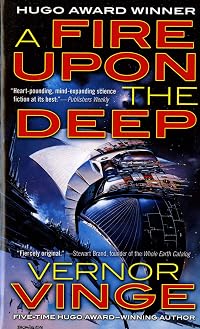






Member Recommendations
Member Reviews
Enjoyable and thought-provoking, a really original look at the First Contact theme. One diverting aspect of the novel is that is, at least in part, an epistolary novel, but one in which the writing is effectively a blog, written by a teenager. Macleod has really captured a style of writing here which is full of the half-baked ideas and full-on enthusiasms of teenagers and blog posting, along with the way in which these can be self-critical as the later self re-reads the postings of the earlier self. It's unfortunate, though, that this technique will date the book very quickly, because this is a book that deserves long-lived popularity.
I believe many of the other reviewers are missing the point. This is not an adventure, nor does it have a clear story arc. It's not a page-turner. It's mostly world-building, and big ideas, both sociological and scientific. Reasonably interesting characters of both genders. And the author expects the reader to share in the task of building (and Learning!) the world. By the end most ideas and themes are clarified, but none are actually answered, none are actually fully developed.
I'd love to see MacLeod's notes. Glossary, maps, timelines, sketches, outline... it's all there, but even though it took me three days (long time for me!) of careful reading I still feel a need to reread to appreciate everything... and I know I'd never understand show more everything.
All that complexity, all those ideas, make this a fairly dense read. I really had trouble at the beginning and almost did a DNF. I'm glad I didn't and now hope that I can find something else by the author.
I love the little bits of attention to detail, like the importance of a developed economy, the fashions, the fact that the non-humans have SF but call it 'engineering tales.' I love the proffered philosophical bits.
The title has at least two meanings. One refers to the biolog (biographical blog, not biology log) of one of the main characters. The other refers to the idea that finding out that there are aliens does not mean simply finding out that there are aliens in the universe; it means finding out that the universe is a kind of place that we didn't know it is, the kind of place where aliens exist... it's a bigger deal than most SF makes it out to be.
"Falling in love meant that your genes were complementary to those of your loved one. It told you nothing about whether your personalities and sexualities were compatible."
It'd make a terrific BotM. show less
I'd love to see MacLeod's notes. Glossary, maps, timelines, sketches, outline... it's all there, but even though it took me three days (long time for me!) of careful reading I still feel a need to reread to appreciate everything... and I know I'd never understand show more everything.
All that complexity, all those ideas, make this a fairly dense read. I really had trouble at the beginning and almost did a DNF. I'm glad I didn't and now hope that I can find something else by the author.
I love the little bits of attention to detail, like the importance of a developed economy, the fashions, the fact that the non-humans have SF but call it 'engineering tales.' I love the proffered philosophical bits.
The title has at least two meanings. One refers to the biolog (biographical blog, not biology log) of one of the main characters. The other refers to the idea that finding out that there are aliens does not mean simply finding out that there are aliens in the universe; it means finding out that the universe is a kind of place that we didn't know it is, the kind of place where aliens exist... it's a bigger deal than most SF makes it out to be.
"Falling in love meant that your genes were complementary to those of your loved one. It told you nothing about whether your personalities and sexualities were compatible."
It'd make a terrific BotM. show less
This was my first MacLeod novel. The book offers a reasonable number of original and intriguing ideas which initially seem to promise quite a bit of potential. In the end, though, I found Learning the World to be light on resolution and heavy on serving up mild platitudes. Indeed, it’s hard not to read this as a watered down Young Adultish version of Vernor Vinge’s A Deepness in the Sky. Not that there’s anything wrong with YA scifi, but it’s not particularly my cup of tea.
I found the world / society / race building consistently the best thing about the book (both for the surprisingly human aliens and for the surprisingly different-from-human homo sapiens colonists who come visiting). Not the deepest perhaps and at times show more leaving me feeling that I had missed some logical leap, but interesting enough to keep me reading and keep me thinking.
On the other hand, the characters never did much for me. Our human protagonists Atomic Discourse Gale and Horrocks Mathmatical had clever names, but not much else to recommend them. I found the alien protagonist Darvin somewhat more sympathetic, but generally too good to be true, and smack dab in the middle of far too many amazing events to be particularly plausible.
As we approach the climax of the book, the human people all act like thirteen year olds (whether sixteen, of sixty, or three thousand), the alien people all act with a wisdom beyond any explanation, and the readers are thrown a big curveball which somehow makes everything work out ok.
I could see this being quite satisfying for a young reader seeking validation of their opinions that (1) they are wise beyond their years, and (2) old people are dumb. show less
I found the world / society / race building consistently the best thing about the book (both for the surprisingly human aliens and for the surprisingly different-from-human homo sapiens colonists who come visiting). Not the deepest perhaps and at times show more leaving me feeling that I had missed some logical leap, but interesting enough to keep me reading and keep me thinking.
On the other hand, the characters never did much for me. Our human protagonists Atomic Discourse Gale and Horrocks Mathmatical had clever names, but not much else to recommend them. I found the alien protagonist Darvin somewhat more sympathetic, but generally too good to be true, and smack dab in the middle of far too many amazing events to be particularly plausible.
As we approach the climax of the book, the human people all act like thirteen year olds (whether sixteen, of sixty, or three thousand), the alien people all act with a wisdom beyond any explanation, and the readers are thrown a big curveball which somehow makes everything work out ok.
I could see this being quite satisfying for a young reader seeking validation of their opinions that (1) they are wise beyond their years, and (2) old people are dumb. show less
Intriguing first contact story told from the contactees' point of view, as the aliens, who call themselves 'humans', arrive in their generation starship. Concepts are thrown in all over the place; I particularly noted Macleod playing with political and economic systems and straying outside his usual socialist comfort zone, without being at all po-faced about his free-market system.
http://nhw.livejournal.com/592810.html
I really liked it. I thought that it does indeed add something new to the old sf theme of first contact between humans and aliens. It takes the premise of Vernor Vinge's A Deepness in the Sky, a book I really didn't like at all, and does it a whole lot better - basically, the aliens on their planet have a society which feels much more like ours than do the humans in the approaching spaceship. I thought the various cultures and subcultures, both human and alien, were convincingly fleshed out. (Planets in sf novels are too often portrayed as having just one culture and one language - in extreme cases, appearing to possess a single time zone.) MacLeod is on top form in both depth and humour in his show more portrayal of the intellectual shock of the encounter for both humans and aliens.
I did feel the novel had one glaring weakness, shared with most of the classics of the hard sf genre to which it clearly belongs. We find out very little about the characters' inner lives. Much of the human side of the story is conveyed through the blog of a teenage girl, which is frankly much more reminiscent of the author's own blog than of the real thing at the younger end of livejournal; I guess I must be reading more teenage blogs than Ken does (and I don't read them much at all). The human characters jump in and out of bed with each other and suffer little emotional embarrassment; as for the aliens, this is the one respect in which we really don't get inside their heads. show less
I really liked it. I thought that it does indeed add something new to the old sf theme of first contact between humans and aliens. It takes the premise of Vernor Vinge's A Deepness in the Sky, a book I really didn't like at all, and does it a whole lot better - basically, the aliens on their planet have a society which feels much more like ours than do the humans in the approaching spaceship. I thought the various cultures and subcultures, both human and alien, were convincingly fleshed out. (Planets in sf novels are too often portrayed as having just one culture and one language - in extreme cases, appearing to possess a single time zone.) MacLeod is on top form in both depth and humour in his show more portrayal of the intellectual shock of the encounter for both humans and aliens.
I did feel the novel had one glaring weakness, shared with most of the classics of the hard sf genre to which it clearly belongs. We find out very little about the characters' inner lives. Much of the human side of the story is conveyed through the blog of a teenage girl, which is frankly much more reminiscent of the author's own blog than of the real thing at the younger end of livejournal; I guess I must be reading more teenage blogs than Ken does (and I don't read them much at all). The human characters jump in and out of bed with each other and suffer little emotional embarrassment; as for the aliens, this is the one respect in which we really don't get inside their heads. show less
I gave up reading [a:Ken MacLeod|108281|Ken MacLeod|http://d202m5krfqbpi5.cloudfront.net/authors/1283522468p2/108281.jpg] after three books in a row banging on in strident fashion about revolutionary left wing politics.
I was given this one after a 5 or so year gap and was a little trepiditious about it. It turns out, however that this book has no such theme. It's a first contact novel, where-in a generation ship arrives in a solar-system that has the first multi-cellular life humans have found outside Earth - but not only that - it has a civilisation just developing radio and powered flight.
Cue the usual political contentions between and within both species. We get points of view from both species. I found the aliens more interesting show more than the humans, despite an intriguing social order prevailing in order to make a generation ship work. This was mainly because the alien characters were much more likeable than the humans. So far, so good. There are enough interesting ideas to make an SF cliche work for the umpteenth time - just like time-travel stories, it's always possible to find something new in first contact if you apply enough imagination - and imagination is something MacLeod has never been short of.
So why only two stars? Because lots of the ideas are under-explored. Quite how the human generation ships work, both physically and socially is under explored and the lack of sympathetic characters makes things worse. The story quietly builds to a tense and complex situation only for the denouement to be terribly anti-climactic and the aftermath gets rushed through, with explanations for it that seem either unconvincing or hasty.
I've never payed for a MacLeod book and I'm not planning to start, even though this proved a considerable improvement on my previous experiences. show less
I was given this one after a 5 or so year gap and was a little trepiditious about it. It turns out, however that this book has no such theme. It's a first contact novel, where-in a generation ship arrives in a solar-system that has the first multi-cellular life humans have found outside Earth - but not only that - it has a civilisation just developing radio and powered flight.
Cue the usual political contentions between and within both species. We get points of view from both species. I found the aliens more interesting show more than the humans, despite an intriguing social order prevailing in order to make a generation ship work. This was mainly because the alien characters were much more likeable than the humans. So far, so good. There are enough interesting ideas to make an SF cliche work for the umpteenth time - just like time-travel stories, it's always possible to find something new in first contact if you apply enough imagination - and imagination is something MacLeod has never been short of.
So why only two stars? Because lots of the ideas are under-explored. Quite how the human generation ships work, both physically and socially is under explored and the lack of sympathetic characters makes things worse. The story quietly builds to a tense and complex situation only for the denouement to be terribly anti-climactic and the aftermath gets rushed through, with explanations for it that seem either unconvincing or hasty.
I've never payed for a MacLeod book and I'm not planning to start, even though this proved a considerable improvement on my previous experiences. show less
A wonderful book that balances the advancing human civilization with an alien species that is just starting its industrial revolution. We see the questions asked by the humans on how to approach the aliens, while the aliens see the human ship approaching, calculating trajectories.
There are a few rough spots in this book - namely in the last third of the book, dealing with the beasts of burden used by the aliens. I went back and forth on how I felt, and decided it wasn't just a gimmick, but clumsily written plot device. It makes sense with the story.
I especially liked how human and alien the aliens were. Ken Macleod makes a huge effort to make the aliens seem humans, but when the story ends, the aliens are truly alien...
This is a great show more story. I highly recommend it. show less
There are a few rough spots in this book - namely in the last third of the book, dealing with the beasts of burden used by the aliens. I went back and forth on how I felt, and decided it wasn't just a gimmick, but clumsily written plot device. It makes sense with the story.
I especially liked how human and alien the aliens were. Ken Macleod makes a huge effort to make the aliens seem humans, but when the story ends, the aliens are truly alien...
This is a great show more story. I highly recommend it. show less
Members
- Recently Added By
Lists

Stories About Other Worlds
145 works; 13 members

Generation Ship
28 works; 7 members

Space Colonization
100 works; 26 members

Nonhuman Protagonists
235 works; 34 members

Arthur C. Clarke Award Winners and Shortlisted Books
219 works; 14 members

Books Read in 2015
3,299 works; 129 members
Author Information

61+ Works 12,411 Members
Some Editions
Awards and Honors
Awards
Distinctions
Work Relationships
Is abridged in
Common Knowledge
- Canonical title
- Learning the World
- Original title
- Learning the World : a novel of first contact
- Original publication date
- 2005-08
- People/Characters
- Atomic Discourse Gale; Horrocks Mathmatical; Darvin
- Epigraph
- Population will mightily increase, and the earth will be a garden. Governments will be conducted wih the quiettude and regularity of club committees. The interest which is now felt in politics will be transferred to science; ... (show all)the latest news from the laboratory of the chemist, or the observatory of the astronomer, or the experimenting room of the biologist will be eagerly discussed ... Disease will be extirpated; the causes of decay will be removed; immortality will be invented. And then, the earth being small, mankind will migrate into space, and will corss the airless Saharas which separate planet from planet, and sun from sun. The earth will become a Holy Land which will be visited by pilgrims from all the quarters of the universe. Finally, men will master the forces of Nature; they will become thmeselves architects of systems, manufacturers of worlds.
Winwood Reade, The Martyrdom of Man, 1872 - Dedication
- To James, Jess and Eilidh
- First words
- The world is four thousand years old.
- Last words
- (Click to show. Warning: May contain spoilers.)Long before the starships and the Moon Caves, these words were written:
We teach that the soul is immortal we
teach that there is a future life; we teach
that there is a Heaven in the ages far away;
but not for us... - Publisher's editor
- Nielsen Hayden, Patrick
- Original language
- English
- Canonical DDC/MDS
- 823.087625
Classifications
- Genres
- Science Fiction, Fiction and Literature
- DDC/MDS
- 823.087625 — Literature & rhetoric English & Old English literatures English fiction By type Genre fiction Adventure fiction Speculative fiction Science fiction Space opera
- LCC
- PR6063 .A2515 .L43 — Language and Literature English English Literature 1961-2000
- BISAC
Statistics
- Members
- 958
- Popularity
- 27,622
- Reviews
- 19
- Rating
- (3.63)
- Languages
- English
- Media
- Paper, Ebook
- ISBNs
- 6
- ASINs
- 4