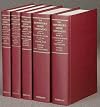
The Expositor's Greek Testament [5-volume set]
by W. Robertson Nicoll
The Expositor's Greek Testament (Set)
On This Page
Description
I. The Synoptic gospels, by A. B. Bruce. The Gospel of St. John, by Marcus Dods.--II. The Acts of the apostles, by R. J. Knowling. St. Paul's Epistle to the Romans, by James Denney. St. Paul's First epistle to the Corinthians, by G. G. Findlay.--III. The Second epistle to the Corinthians, by J. H. Bernard. The Epistle to the Galatians, by Frederic Rendall. The Epistle to the Ephesians, by S. D. F. Salmond. The Epistle to the Philippians, by H. A. A. Kennedy. The Epistle to the Colossians, by show more A. S. Peake.--IV. The First and Second epistles to the Thessalonians, by James Moffatt. The First and Second epistles to Timothy and the Epistle to Titus, by N. J. D. White. The Epistle to Philemon, by W. E. Oesterley. The Epistle to the Hebrews, by Marcus Dods. The General epistle of James, by W. E. Oesterley.--V. The First epistle general of Peter, by J. H. A. Hart. The Second epistle general of Peter, by R. H. Strachan. The Epistles of John, by David Smith. The General epistle of Jude, by J. B. Mayor. The Revelation of St. John the Divine, by James Moffatt. show lessTags
Recommendations














Member Reviews
Even immortal literature can get old.
That is the only defect that can be charged to this Bible commentary set. It includes a Greek text, texual footnotes, and an extensive discussion of the meaning of the Greek. The result, at the time it was written, was simply brilliant. But time has overtaken it.
This is true in several regards. The Greek text adopted is the venerable Textus Receptus, which goes all the way back (with slight modifications) to Erasmus in 1516, and it frankly isn't any good. With the sole exception of the New King James Version, no modern editions follow this text any more.
The textual footnotes try to address this, often mentioning the texts of Tischendorf and Westcott and Hort, as well as the manuscript support for show more each. But even these are now more than a century old, and have been largely displaced in general use by the United Bible Societies text. At minimum, one would wish that the text used had been Westcott and Hort.
And the marginal notes describing the textual variations are also out of date, because they use Tischendorf sigla, and these have now been universally replaced by Gregory symbols. So to actually use the apparatus requires a conversion key.
Plus the commentary on the Greek text is based on what was known of Greek before the papyri revealed the existence of koine Greek. Thus the commentary sometimes goes astray in its interpretation.
Do not misunderstand me. This is an excellent reference work which still deserves its place on any Bible scholar's shelf. Almost all of what it says is correct; it is merely not complete. A modern student needs to supplement it with many resources -- the texts of Nestle-Aland 27, United Bible Societies 4, and perhaps Merk if one truly wishes to examine textual problems; the vocabularies of Moulton-Milligan and Bauer-et-al; a modern commentary or two; a newer concordance; and probably some computer software. With those as supplements and sources of corrections, this series of books will probably be able to serve you well for another century or two. show less
That is the only defect that can be charged to this Bible commentary set. It includes a Greek text, texual footnotes, and an extensive discussion of the meaning of the Greek. The result, at the time it was written, was simply brilliant. But time has overtaken it.
This is true in several regards. The Greek text adopted is the venerable Textus Receptus, which goes all the way back (with slight modifications) to Erasmus in 1516, and it frankly isn't any good. With the sole exception of the New King James Version, no modern editions follow this text any more.
The textual footnotes try to address this, often mentioning the texts of Tischendorf and Westcott and Hort, as well as the manuscript support for show more each. But even these are now more than a century old, and have been largely displaced in general use by the United Bible Societies text. At minimum, one would wish that the text used had been Westcott and Hort.
And the marginal notes describing the textual variations are also out of date, because they use Tischendorf sigla, and these have now been universally replaced by Gregory symbols. So to actually use the apparatus requires a conversion key.
Plus the commentary on the Greek text is based on what was known of Greek before the papyri revealed the existence of koine Greek. Thus the commentary sometimes goes astray in its interpretation.
Do not misunderstand me. This is an excellent reference work which still deserves its place on any Bible scholar's shelf. Almost all of what it says is correct; it is merely not complete. A modern student needs to supplement it with many resources -- the texts of Nestle-Aland 27, United Bible Societies 4, and perhaps Merk if one truly wishes to examine textual problems; the vocabularies of Moulton-Milligan and Bauer-et-al; a modern commentary or two; a newer concordance; and probably some computer software. With those as supplements and sources of corrections, this series of books will probably be able to serve you well for another century or two. show less
Like Loeb for the Bible (but commentary instead of the translated text). Technical and brilliant.
Members
- Recently Added By
Author Information

168+ Works 2,368 Members
Series

Work Relationships
Common Knowledge
- Canonical title
- The Expositor's Greek Testament [5-volume set]
- Original publication date
- 1897-1910
Classifications
Statistics
- Members
- 650
- Popularity
- 44,558
- Reviews
- 8
- Rating
- (4.14)
- Languages
- English, Greek (Ancient), Greek
- Media
- Paper
- ISBNs
- 4
- ASINs
- 12