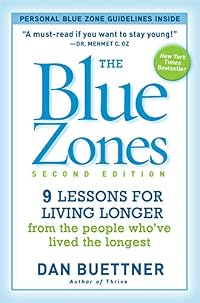
The Blue Zones: Lessons for Living Longer From the People Who've Lived the Longest
by Dan Buettner
On This Page
Description
Bestselling author, longevity expert, and National Geographic Explorer Dan Buettner reports on health, fitness, diet, and aging, drawing on his research from extraordinarily long-lived communities--Blue Zones--around the globe. Buettner has launched a major public health initiative to transform cities based on principles from this book, an updated and expanded edition of his bestselling classic on longevity. His prescriptions for lifestyle, nutrition, outlook, and stress-coping practices show more will add years to your life and life to your years. The latest Blue Zone is Ikaria, Greece, where strong, sweet wine, family, and a Mediterranean diet all play a role in longer life. Also new in this book is a reading group guide, designed for groups to read about, discuss, and implement many of the simple changes advocated for better health. A long, healthy life is no accident. It begins with good genes, but it also depends on good habits. If you adopt the right lifestyle, experts say, chances are you may live up to a decade longer. Buettner has led teams of researchers across the globe--from Costa Rica to Sardinia, Italy, to Okinawa, Japan and beyond--to uncover the secrets of Blue Zones. He found that the recipe for longevity is deeply intertwined with community, lifestyle, and spirituality. People live longer and healthier by embracing a few simple but powerful habits, and by creating the right community around themselves. In The Blue Zones, Second Edition, Buettner has blended his lifestyle formula with the latest longevity research to inspire lasting, behavioral change and add years to your life. Region by region, Buettner reveals the "secrets" of longevity through stories of his travels and interviews with some of the most remarkable--and happily long-living people on the planet. It's not coincidence that the way they eat, interact with each other, shed stress, heal themselves, avoid disease, and view their world yield them more good years of life. Buettner's easy to follow. show lessTags
Recommendations
Member Reviews
The Blue Zones recounts Dan Buettner's travels around the world to several special communities where people live longer and have more active years than anyone else. Buettner visits the Mediterranean, Japan, and Southern California to better understand the lifestyles of the long-lived.
The book has a number of highlights. In particular, Buettner's stories of finding and meeting centenarians around the world are a joy to read. Likewise, Buettner provides a fascinating look into the effects of globalization by contrasting the lifestyles of the centenarians and their children, grand-children, and great-grand-children.
But as interesting as The Blue Zones is when Buettner is telling a story, the book cannot escape being awfully dull at all show more times. Buettner occasionally talks about his meetings with scientists and doctors, but these portions of the book lack the story telling component of his meetings with centenarians and other long-lived characters. Instead, Buettner gives the impression that the only thing scientists are good for are data.
Which brings me to why the book fell flat: though the book bills itself as an explanation of how or why the people in The Blue Zones live so long, I felt as though very little was explained. Oftentimes, Buettner recounts a meeting with a scientist who makes conjectures at length, but has little else to show for himself. Or, in perhaps the most cringe-inducing moment in the book, Buettner and another journalist have a conjectural conversation of their own in the back of a moving van.
That is not to say that The Blue Zones is not an enjoyable read. It's just that there's a lot of speculative material to wade through in between the fascinating conversations with some of the world's healthiest people. show less
The book has a number of highlights. In particular, Buettner's stories of finding and meeting centenarians around the world are a joy to read. Likewise, Buettner provides a fascinating look into the effects of globalization by contrasting the lifestyles of the centenarians and their children, grand-children, and great-grand-children.
But as interesting as The Blue Zones is when Buettner is telling a story, the book cannot escape being awfully dull at all show more times. Buettner occasionally talks about his meetings with scientists and doctors, but these portions of the book lack the story telling component of his meetings with centenarians and other long-lived characters. Instead, Buettner gives the impression that the only thing scientists are good for are data.
Which brings me to why the book fell flat: though the book bills itself as an explanation of how or why the people in The Blue Zones live so long, I felt as though very little was explained. Oftentimes, Buettner recounts a meeting with a scientist who makes conjectures at length, but has little else to show for himself. Or, in perhaps the most cringe-inducing moment in the book, Buettner and another journalist have a conjectural conversation of their own in the back of a moving van.
That is not to say that The Blue Zones is not an enjoyable read. It's just that there's a lot of speculative material to wade through in between the fascinating conversations with some of the world's healthiest people. show less
 This review was written for LibraryThing Early Reviewers.
There's a lot of interesting stuff contained within this book. Good luck if you can find yourself in a situation where you have all the support and society around you that allows you to achieve these things.
Sadly, most of us simply don't have the land available to farm our own organic vegetables and fruit for every meal, most people don't live in places where they can drink pure water that isn't some other town's poorly-treated sewage dumped upstream into the river that fills the local reservoir, and most people don't get to live in places free of all the traffic, and industrial, produced noise and air pollution.
Most people won't ever be surrounded by family and friends their whole lives that would support, share and help them in show more achieving the same organic wholefood, stress free, pollution free, clean living lifestyle that is espoused in these stories.
I'd heard a lot of good things about this book and i really was looking forward to reading it. Having read it, i just find most of it disingenuous, in that it is utterly ridiculous to suggest that most people could have a lifestyle like this even if they wanted to. But hey, don't throw the baby out with the bathwater, maybe you can find some things within to help you.
It's even suggested at the end of the book that you build your own blue zone. Good luck with that, i sincerely hope you can find yourself some space in this ever more overpopulated world that leaves less and less space free from air pollution, light pollution, noise, junk food, bad people, traffic, noise, industry, habitat destruction and all the rest of modern society's garbage: because that's what you need to do. Maybe when Antarctica finally melts you'll find some nice, free, unpolluted land, but i reckon the corporations will have beaten you to it with massive military, mining and construction projects.
My biggest gripe with this book is that there are far better ways for people to be thinking about improving their health and longevity in today's modern societies. This book suggests 10 extra years of healthy life, but consider, when it's becoming more and more common that people are sick and diseased and reliant upon medication to survive in their 30's and 40's, is 10 extra years all you really want? I want 40 or 50 years of extra healthy life and this book isn't offering that at all. show less
Sadly, most of us simply don't have the land available to farm our own organic vegetables and fruit for every meal, most people don't live in places where they can drink pure water that isn't some other town's poorly-treated sewage dumped upstream into the river that fills the local reservoir, and most people don't get to live in places free of all the traffic, and industrial, produced noise and air pollution.
Most people won't ever be surrounded by family and friends their whole lives that would support, share and help them in show more achieving the same organic wholefood, stress free, pollution free, clean living lifestyle that is espoused in these stories.
I'd heard a lot of good things about this book and i really was looking forward to reading it. Having read it, i just find most of it disingenuous, in that it is utterly ridiculous to suggest that most people could have a lifestyle like this even if they wanted to. But hey, don't throw the baby out with the bathwater, maybe you can find some things within to help you.
It's even suggested at the end of the book that you build your own blue zone. Good luck with that, i sincerely hope you can find yourself some space in this ever more overpopulated world that leaves less and less space free from air pollution, light pollution, noise, junk food, bad people, traffic, noise, industry, habitat destruction and all the rest of modern society's garbage: because that's what you need to do. Maybe when Antarctica finally melts you'll find some nice, free, unpolluted land, but i reckon the corporations will have beaten you to it with massive military, mining and construction projects.
My biggest gripe with this book is that there are far better ways for people to be thinking about improving their health and longevity in today's modern societies. This book suggests 10 extra years of healthy life, but consider, when it's becoming more and more common that people are sick and diseased and reliant upon medication to survive in their 30's and 40's, is 10 extra years all you really want? I want 40 or 50 years of extra healthy life and this book isn't offering that at all. show less
I may not always follow what I learn but I love reading and studying nutrition and health topics. And I have a mother who is very nearly a centenarian. So this book is of particular interest.
The author and his researcher cohorts set out to study the secrets of people who live the longest. "Blue Zones" were identified, which are areas of the world that have the greatest concentration of centenarians, people who have reached 100. This book focuses on these Blue Zone locations: Sardinia, Italy, Okinawa, Japan, Loma Linda, California, Ikaria, Greece, and Nicoya, Costa Rica.
Written in a breezy, conversational tone, and filled with stories and anecdotes from the centenarians themselves, some common threads appeared:
1. Eat simple local foods show more and in the words of Michael Pollan, "Eat mostly plants, not too much". Not strictly vegetarian. Drink alcohol, but, again, not too much.
2. Move a lot, but do it naturally without having to think about it (I.e. no gym rats or marathon runners in the group!). Activity is built into their daily routines.
3. Have a strong sense of purpose, a reason to get up in the morning and contribute to their families and/or communities.
4. Slow down: less stress means less inflammation that can lead to disease. There is a natural rhythm of work, rest, and play (socializing) to their days. And don't worry, be content. The author points out that none of the centenarians are grumps.
5. Participate in a supportive community with strong social connections. Along the same lines, family is a priority. Multiple generations lived together or were close by. The elderly were revered.
There's more to the book than this, there's much more depth and the words of the centarians themselves. For the most part, it's a way of life that is foreign to us in the U.S. and I loved reading about it. There are no guarantees that if you do x, y and z you will live to a healthy ripe old age. But , if nothing else, these principles can certainly add life to your years. The author ends the book with tips and ideas to put the principles in place. show less
The author and his researcher cohorts set out to study the secrets of people who live the longest. "Blue Zones" were identified, which are areas of the world that have the greatest concentration of centenarians, people who have reached 100. This book focuses on these Blue Zone locations: Sardinia, Italy, Okinawa, Japan, Loma Linda, California, Ikaria, Greece, and Nicoya, Costa Rica.
Written in a breezy, conversational tone, and filled with stories and anecdotes from the centenarians themselves, some common threads appeared:
1. Eat simple local foods show more and in the words of Michael Pollan, "Eat mostly plants, not too much". Not strictly vegetarian. Drink alcohol, but, again, not too much.
2. Move a lot, but do it naturally without having to think about it (I.e. no gym rats or marathon runners in the group!). Activity is built into their daily routines.
3. Have a strong sense of purpose, a reason to get up in the morning and contribute to their families and/or communities.
4. Slow down: less stress means less inflammation that can lead to disease. There is a natural rhythm of work, rest, and play (socializing) to their days. And don't worry, be content. The author points out that none of the centenarians are grumps.
5. Participate in a supportive community with strong social connections. Along the same lines, family is a priority. Multiple generations lived together or were close by. The elderly were revered.
There's more to the book than this, there's much more depth and the words of the centarians themselves. For the most part, it's a way of life that is foreign to us in the U.S. and I loved reading about it. There are no guarantees that if you do x, y and z you will live to a healthy ripe old age. But , if nothing else, these principles can certainly add life to your years. The author ends the book with tips and ideas to put the principles in place. show less
Despite the book having a quote from Dr. Oz on the front, I found this book to be very interesting and informative. It was a great mix of science and personal stories, mixing qualitative and quantitative evidence. Th author had a few missteps, such as the fact that, despite longevity research having been predominantly focused around women, in none of his expeditions did he include a single female longevity expert. And him drawing conclusions about things that are true for "most of the population (except pre-menopausal women)"--yes, technically the number of males and women who are peri- or post-menopausal in the United States is greater than the rest of the female population, but it is not like females under the age of 45ish make up an show more insignificant portion of the population. But despite there being a few moments which led to me argue with the author in the margins, in general this book provided excellent food for thought (and discussion with my family, whether they liked it or not), and I would highly recommend. show less
"The Blue Zone," by Dan Buettner, is founded on an intriguing concept. Certain people live longer than others. That's not quite as interesting as the next part: certain parts of the world have greater concentrations of these longer-living people. Why is that? Dan Buettner set out to discover the answer.
Using what he learned in each of the five areas he studied, Buettner distills the lessons into options we all can adopt to add years (and/or quality) to our lives. My favorite part is that he states specifically that, if we should choose to try something from the book, we don't need to adopt all of these suggestions. We can try one or two, five, seven, ten, or none, depending on what we want to do. There is no self-righteous, "Do all of show more this or die tomorrow" doomsday prophecy speech. What a comfort in a self-help book!
I really wanted to like this book. I really did. It's written in a conversational, non-academic, unpatronizing tone. Even the technical stuff, while I got lost a little bit in the details, was at least somewhat interesting. The people are fascinating. His skill at describing their lives was tantamount to being there myself.
I believe that we should all be good stewards of the bodies we've been given, treating them well, with kindness, and not being self-destructive. That's what the book is about! But my foundational worldview is the polar opposite of Buettner's foundational worldview - Christian vs. evolutionary. I have to say this because anything else that I say will be colored by that. If you come from an evolutionary worldview, I think you'd really enjoy this book. But at every turn, our foundational differences (WHY should we want to live longer? WHO is living longer about? WHAT is really important in life?) colored his writing, and my digestion of it. I found myself thinking, "Yes, but..." over and over. If your worldview is in agreement with his, then you will definitely enjoy reading and learning from this book. For me, it was just too hard to separate it. show less
Using what he learned in each of the five areas he studied, Buettner distills the lessons into options we all can adopt to add years (and/or quality) to our lives. My favorite part is that he states specifically that, if we should choose to try something from the book, we don't need to adopt all of these suggestions. We can try one or two, five, seven, ten, or none, depending on what we want to do. There is no self-righteous, "Do all of show more this or die tomorrow" doomsday prophecy speech. What a comfort in a self-help book!
I really wanted to like this book. I really did. It's written in a conversational, non-academic, unpatronizing tone. Even the technical stuff, while I got lost a little bit in the details, was at least somewhat interesting. The people are fascinating. His skill at describing their lives was tantamount to being there myself.
I believe that we should all be good stewards of the bodies we've been given, treating them well, with kindness, and not being self-destructive. That's what the book is about! But my foundational worldview is the polar opposite of Buettner's foundational worldview - Christian vs. evolutionary. I have to say this because anything else that I say will be colored by that. If you come from an evolutionary worldview, I think you'd really enjoy this book. But at every turn, our foundational differences (WHY should we want to live longer? WHO is living longer about? WHAT is really important in life?) colored his writing, and my digestion of it. I found myself thinking, "Yes, but..." over and over. If your worldview is in agreement with his, then you will definitely enjoy reading and learning from this book. For me, it was just too hard to separate it. show less
This review was written for LibraryThing Early Reviewers.I don't care much about longevity, but this is a book about living well as much as long. The secret? You already knew it. Eat more plants than animals, have a purpose in life each day when you rise, stay socially connected, move your body every day, keep your sense of humor. (There are nine major recommendations in all, with numerous sub-components.)
The authors describe four visits to Okinawa, Sardinia, Loma Linda California (a Seventh Day Adventist community), and Costa Rica, and in each place they visit communities with an unusual number of centenarians. They interview them about their lives, now and in the past, and look at younger people (as in, age 60 and 70) in the community who are living in similar ways.
There are interesting show more details that emerge in conversations with scientists and anthropologists who provide a guide to each local community. Some communities drink red wine and some do not. One group keeps the Sabbath. Each has some special foods, mugwort, fish oil, whatever. Good genes will get you 25% of the way there too. But from these details the author synthesizes some good general principles that are really as much about living well as living long.
How long we live is really a trivial detail. The goal is not to live long but to live well, and to die quickly when the living is done.
This book is a bit too chatty for my taste. I prefer more science and examples and less detail about the cafe in which the author held a conversation with a local researcher. Nonetheless, you can skim through it and hear some interesting voices and stories of good living -- well worth reading. show less
The authors describe four visits to Okinawa, Sardinia, Loma Linda California (a Seventh Day Adventist community), and Costa Rica, and in each place they visit communities with an unusual number of centenarians. They interview them about their lives, now and in the past, and look at younger people (as in, age 60 and 70) in the community who are living in similar ways.
There are interesting show more details that emerge in conversations with scientists and anthropologists who provide a guide to each local community. Some communities drink red wine and some do not. One group keeps the Sabbath. Each has some special foods, mugwort, fish oil, whatever. Good genes will get you 25% of the way there too. But from these details the author synthesizes some good general principles that are really as much about living well as living long.
How long we live is really a trivial detail. The goal is not to live long but to live well, and to die quickly when the living is done.
This book is a bit too chatty for my taste. I prefer more science and examples and less detail about the cafe in which the author held a conversation with a local researcher. Nonetheless, you can skim through it and hear some interesting voices and stories of good living -- well worth reading. show less
Worth reading if you are wondering what the research says about different ways of increasing life satisfaction and how other nations handle public policy and how national habits affect the level of satisfaction that citizens feel. The data is relevant but those sections are pretty dry reading. I liked learning how different countries' lifestyles and habits differ. I lived in Europe for six years, so I have never been one of those Americans who thought we had the best standard of living and life satisfaction level. I think the US could do much better for children, poor, homeless, and disabled to live better lives. We do consume too much of the world's resources and we aren't happier for it. In any case, this book did give lots of show more information and recommendations from a panel of experts to consider. I'd rate this three and a half stars, but I'll round up. show less
Members
- Recently Added By
Lists

The Joe Rogan Experience Library
254 works; 3 members

The Great Courses: The Learning Brain
61 works; 1 member
Author Information
17+ Works 1,990 Members
Dan Buettner is the founder of Blue Zones, an organization that helps Americans live longer, healthier, happier lives. His groundbreaking work on longevity led to his 2005 National Geographic cover story "The Secrets of Long Life" and four national bestsellers: The Blue Zones, Thrive, The Blue Zones Solution, and The Blue Zones Kitchen. He is also show more the author of The Blue Zones of Happiness. He lives in Miami, Florida. Find him on Instagram (@danbuettner) and at danbuettner.com. show less
Common Knowledge
- Important places
- Sardinia, Italy; Okinawa, Japan; Loma Linda, California, USA; Nicoya, Costa Rica
- Dedication
- For Roger and Dolly
- First words
- The first time I met Sayoko Ogata, she was wearing the sort of fashionable gear one might expect a young Tokyo executive to take on a safari: hiking boots and cuffed socks, khaki shorts and shirt, and a pith helmet.
- Last words
- (Click to show. Warning: May contain spoilers.)As my centenarian friends showed me, the choice is largely up to us.
Classifications
Statistics
- Members
- 721
- Popularity
- 39,057
- Reviews
- 31
- Rating
- (3.71)
- Languages
- Dutch, English, Indonesian
- Media
- Paper, Audiobook, Ebook
- ISBNs
- 15
- ASINs
- 9