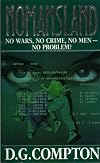
Nomansland
by D. G. Compton
On This Page
Tags
Recommendations
























Member Reviews
Compton is a science fiction writer I admire a great deal. I think his prose is far far better than 99% of genre writers, living or dead, and his relatively low profile is not only due to the quality of his prose (many sf readers consider such prose either irrelevant or a hindrance), nor the fact his last novel was published in 1996 and only the SF Gateway has any of his books currently in print (as ebooks and omnibuses), although he does have one novel in the SF Masterworks series… but chiefly because the bulk of his fiction has a very British flavour and a lot of it is really quite miserable. Nomansland displays both these last two qualities, despite being set in an invented, and unnamed, European country, and because the world of show more the novel is forty years into the “Attrition”, an epidemic which causes pregant women to reject male embryos. In other words, only female babies have been born for nearly half a century. Nomansland also uses another common Compton technique – the double unsynchronised narrative, which is probably not the best way to describe it, but refers to paired narratives which differ in ways other than just POV. In Nomansland, one narrative is loosely-coupled third-person, set forty years after the Attrition, and focusing on scientist Dr Harriet Ryder-Kahn, who has just discovered a cure for MERS, Male Embryo Rejection Syndrome, but is being blocked from publication by her bosses at the Ministry of Science. The second narrative begins some ten years after the start of the Attrition, when Harriet is a young girl, and is first-person. It traces her history up to the 40-years-after narrative. There’s an elephant in the room in this story, and it takes two-thirds of the novel before anyone even mentions it: the world is a much nicer place now there are so few men (they’re still in charge, but they’re hugely outnumbered by women, and dying out). So the question becomes, is it worth actually curing MERS? Isn’t it better to leave the population as it is? Of course, the men – and few of them in this novel are painted in a flattering light – would like their own kind to be back in charge, but… I’m entirely sympathetic to the view a massively-majority, or entirely, female population would turn the planet into a much more pleasant place; and I can think of no good reason why men should be re-introduced, given a solution to reproductive needs. For all the crap we’re fed in the right-wing press about vile behaviour by other cultures, most of it is more a product of toxic masculinity than it is actual culture. In Nomansland, Compton is also clearly sympathetic, but he tries to present a balanced view and often undermines his point. MRA types will object to the characterisation of the male characters, but fuck ’em, they have no opinions worth treating seriously. If there is a problem, it’s that Compton is, if his fiction is any indication, somewhat misanthropic, and so even his female characters are far from sympathetic. Ryder-Kahn, for example, is fixated on publication, and does not seem to understand the impact of her cure. Nomansland is by no means one of Compton’s best, although my admiration for his writing remains undimmed. show less
Ratings
Members
- Recently Added By
Author Information

39+ Works 1,421 Members
Classifications
Statistics
- Members
- 33
- Popularity
- 860,427
- Reviews
- 2
- Rating
- (3.80)
- Languages
- English, German, Italian
- Media
- Paper
- ISBNs
- 3
- ASINs
- 2