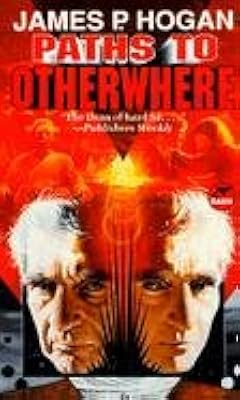
Paths to Otherwhere
by James P. Hogan
On This Page
Description
In the face of planet-wide economic disaster, two totalitarian empires rise in China and Japan, threatening the world with a devastating war, and the police states of the U.S. and Europe place their hopes in a team of DNA scientists.Tags
Recommendations
























Member Reviews
This book could have one of the highest drops from beginning to end in my sci-fi reading experience. It is a regular occurrence for a book, especially sci-fi, to have an interesting setup and then the playout and payoff level off or even stumble at the end.
This book has some of the coolest 'hard sci-fi' setup you can find in the first part. And he keeps expanding on it as things develop. But then, you kind of expect more to happen and instead it keeps ambling along. And then by the end, there is some action, but it's pretty tame, and the end comes to a pretty pat conclusion (which isn't that surprising if you know anything about Hogan's libertarian beliefs), but still a pretty sizable drop from all the interesting places the story and show more science could have gone after the setup. show less
This book has some of the coolest 'hard sci-fi' setup you can find in the first part. And he keeps expanding on it as things develop. But then, you kind of expect more to happen and instead it keeps ambling along. And then by the end, there is some action, but it's pretty tame, and the end comes to a pretty pat conclusion (which isn't that surprising if you know anything about Hogan's libertarian beliefs), but still a pretty sizable drop from all the interesting places the story and show more science could have gone after the setup. show less
James P. Hogan's novel starts out in a world heading towards crisis. In a not-too-distant future, the United States is slowly rotting from within, with revolutionaries and gangs forcing an authoritarian reaction from the government. As an increasingly likely conflict with Japan and China looms, scientists develop a device that heralds the prospect of improving decision-making by allowing users to tap into the infinite number of decisions made by their multitude of counterparts in alternate worlds, thus discovering the wisest course of action. But then the scientists discover a means of transporting a person's consciousness into their counterpart in another universe. As the scientists begin to explore the possibilities, though, the show more military prepares to move in and use the device for their own ends.
Like his earlier novel [b:The Proteus Operation|849493|The Proteus Operation|James P. Hogan|https://images.gr-assets.com/books/1178892317s/849493.jpg|906055], Hogan provides a plot of considerable interest, one well grounded in scientific theory as befitting an author of hard SF. Yet character development is lost amid the considerable political commentating the author continually engages in, as he uses his premise to both offer his theory on the failings of our world (too much government) and construct an idyllic alternative that in which everything is perfect (thanks to limited government). Some of it is laughable (as in how Britain manages to have socialized medicine without government), much of it demonstrates a poor understanding of human history, and all of it gets in the way of the suspense Hogan attempts to build throughout the novel. It makes for an annoying read, one that would have been better is there had been less of Hogan's political views and more focus on the characters and some of the interesting implications of his premise. show less
Like his earlier novel [b:The Proteus Operation|849493|The Proteus Operation|James P. Hogan|https://images.gr-assets.com/books/1178892317s/849493.jpg|906055], Hogan provides a plot of considerable interest, one well grounded in scientific theory as befitting an author of hard SF. Yet character development is lost amid the considerable political commentating the author continually engages in, as he uses his premise to both offer his theory on the failings of our world (too much government) and construct an idyllic alternative that in which everything is perfect (thanks to limited government). Some of it is laughable (as in how Britain manages to have socialized medicine without government), much of it demonstrates a poor understanding of human history, and all of it gets in the way of the suspense Hogan attempts to build throughout the novel. It makes for an annoying read, one that would have been better is there had been less of Hogan's political views and more focus on the characters and some of the interesting implications of his premise. show less
The quote on the cover proclaims Hogan the "Dean of hard SF." I'd think Arthur C. Clarke or Larry Niven better fits the title, but reading the book, even if he doesn't head the department, he definitely works there. This novel really does deal with a lot of fascinating and big ideas, and it isn't hand-waving Bat-science either in this book about the concept of the Multiverse. I can't recall ever reading a more lucid explanation of the paradoxes that inspired quantum physics. And from that hard physics foundation, Hogan spins a lot of implications biological, political and spiritual. It's well-written too, even if hardly literary fiction--all the science, for instance, is conveyed without of feeling of infodump.
Yet I'm rating this only show more three stars and putting it in the box of books to sell, give away or throw out. That's not because I would not recommend it to fans of hard science fiction, but I don't feel it's a keeper either. I'd read this before some years ago but couldn't remember one thing about it before rereading. In contrast, decades after reading them, I could remember the characters and events in Herbert's Dune, Robert Heinlein's Starship Troopers, even short stories by Isaac Asimov only by their titles. The main reason this book is getting purged from my collection is that I can't imagine I'll want to read it again. Its writing doesn't evoke writer's envy, it doesn't have characters or a world I love such as with Lois Bujold's Vorkosigan Saga or Anne McCaffrey's Pern such as it would make a good comfort read. It's an entertaining book--just not one I could read over and over again or that I see as exceptional--and it wasn't as fun to read as the Hogan book I read just before this one, Realtime Interrupt (or Code of the Lifemaker, which I later reread). show less
Yet I'm rating this only show more three stars and putting it in the box of books to sell, give away or throw out. That's not because I would not recommend it to fans of hard science fiction, but I don't feel it's a keeper either. I'd read this before some years ago but couldn't remember one thing about it before rereading. In contrast, decades after reading them, I could remember the characters and events in Herbert's Dune, Robert Heinlein's Starship Troopers, even short stories by Isaac Asimov only by their titles. The main reason this book is getting purged from my collection is that I can't imagine I'll want to read it again. Its writing doesn't evoke writer's envy, it doesn't have characters or a world I love such as with Lois Bujold's Vorkosigan Saga or Anne McCaffrey's Pern such as it would make a good comfort read. It's an entertaining book--just not one I could read over and over again or that I see as exceptional--and it wasn't as fun to read as the Hogan book I read just before this one, Realtime Interrupt (or Code of the Lifemaker, which I later reread). show less
This is a hard science novel full of interesting ideas both scientific and social. Easy to read and thought provoking. However I grew tired of it- somehow not enough characterization and somewhat repetitious.
Interesting theory about parallel universes. Rather than splitting there is a continuum based on quantum probabilities. However they still end up in a discrete and different world.
http://nhw.livejournal.com/59345.html
Though the style is a little bald, the ideas are great - scientists research into parallel universes, discover that one of them is a utopia; how does this change them and the intelligence agencies who are monitoring their activities?
Though the style is a little bald, the ideas are great - scientists research into parallel universes, discover that one of them is a utopia; how does this change them and the intelligence agencies who are monitoring their activities?
SF novel.
Members
- Recently Added By
Author Information

78+ Works 11,739 Members
James P. Hogan was born in London on June 27, 1941. He left school at the age of sixteen and eventually began an intensive, broad-based five-year program at the Royal Aircraft Establishment covering the practical and theoretical sides of electrical, electronic, and mechanical engineering. He worked as a design engineer for several companies before show more moving to sales. He started writing science fiction books in the 1970s and became a full-time writer in 1979. He wrote 30 fiction and non-fiction books during his lifetime including Inherit the Stars, Voyage from Yesteryear, and Kicking the Sacred Cow. He won three Seiun-sho awards, which were voted for by Japanese science fiction fans. He died suddenly on July 12, 2010 at the age of 69. (Bowker Author Biography) show less
Some Editions
Awards and Honors
Awards
Common Knowledge
- Original publication date
- 1996
- People/Characters
- Hugh Brenner; Theo Jantowitz
- Dedication
- To David Deutsch --an evening with whom was enough to inspire the book, and Sarah Lawrence --for introducing me to him.
- First words
- The woman in the tan business suit sat in a padded recliner that looked like a dentist's chair. - - Prologue
Sometimes Hugh Brenner thought he'd been born on the wrong palnet. - Last words
- (Click to show. Warning: May contain spoilers.)Above and behind, the lights of Los Alamos grew smaller against the outline of distant mountains, loomng in the last glow of the dying sun.
- Blurbers
- Deutsch, David
- Original language
- English
Classifications
Statistics
- Members
- 211
- Popularity
- 154,770
- Reviews
- 7
- Rating
- (3.50)
- Languages
- English
- Media
- Paper, Audiobook
- ISBNs
- 4
- ASINs
- 1