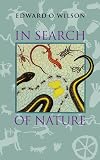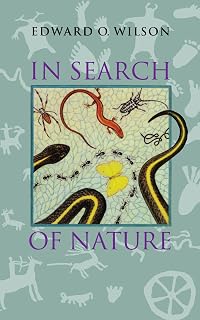
In Search of Nature
by Edward O. Wilson
On This Page
Description
"Perhaps more than any other scientist of our century, Edward O. Wilson has scrutinized animals in their natural settings, tweezing out the dynamics of their social organization, their relationship with their environments, and their behavior, not only for what it tell us about the animals themselves, but for what it can tell us about human nature and our own behavior. He has brought the fascinating and sometimes surprising results of these studies to general readers through a remarkable show more collection of books, including The Diversity of Life, The Ants, On Human Nature, and Sociobiology. The grace and precision with which he writes of seemingly complex topics has earned him two Pulitzer prizes, and the admiration of scientists and general readers around the world." "This book is a lively and accessible introduction to the writings of one of the most brilliant scientists of the 20th century. Imaginatively illustrated by noted artist Laura Southworth, it is a book all readers will treasure."--Jacket. show lessTags
Recommendations











Member Reviews
Perhaps more than any other scientist of our century, Edward O. Wilson has scrutinized animals in their natural settings, tweezing out the dynamics of their social organization, their relationship with their environments, and their behavior, not only for what it tell us about the animals themselves, but for what it can tell us about human nature and our own behavior. He has brought the fascinating and sometimes surprising results of these studies to general readers through a remarkable collection of books, including The Diversity of Life, The Ants, On Human Nature, and Sociobiology. The grace and precision with which he writes of seemingly complex topics has earned him two Pulitzer prizes, and the admiration of scientists and general show more readers around the world. This book is a lively and accessible introduction to the writings of one of the most brilliant scientists of the 20th century. Imaginatively illustrated by noted artist Laura Southworth, it is a book all readers will treasure. Source: GoodReads show less
Essays from the 1980s and '90s:
"To be anthropocentric is to remain unaware of the limits of human nature, the significance of biological processes underlying human behavior, and the deeper meaning of long-term genetic evolution." pg. 100
"... culture is ultimately a biological product. .... Culture conforms to an important principle of evolutionary biology: most change occurs to maintain the organism in its steady state." pg. 107
"... culture is created and shaped by biological processes while biological processes are simultaneously altered in response to cultural change." pg. 111
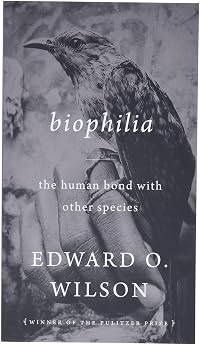
"Biophilia, if it exists, and I believe it exists, is the innately emotional affiliation of human beings to other living organisms. .... The brain evolved in a show more biocentric world, not a machine-regulated one." pp. 165-166
"Biodiversity is the frontier of the future. Humanity needs a vision of an expanding and unending future. That spiritual craving cannot be satisfied by the colonization of space. .... The true frontier for humanity is life on Earth -- its science, art, and practical affairs. .... The manifold ways by which human beings are tied to the remainder of life are very poorly understood, crying for new scientific inquiry and bold aesthetic interpretation. .... The search is rendered more urgent by the rapid disappearance of the living part of that environment, creating a need not only for a better understanding of human nature but for a more powerful and intellectually convincing environmental ethic based upon it." pp. 178-179 show less
"To be anthropocentric is to remain unaware of the limits of human nature, the significance of biological processes underlying human behavior, and the deeper meaning of long-term genetic evolution." pg. 100
"... culture is ultimately a biological product. .... Culture conforms to an important principle of evolutionary biology: most change occurs to maintain the organism in its steady state." pg. 107
"... culture is created and shaped by biological processes while biological processes are simultaneously altered in response to cultural change." pg. 111
"Biophilia, if it exists, and I believe it exists, is the innately emotional affiliation of human beings to other living organisms. .... The brain evolved in a show more biocentric world, not a machine-regulated one." pp. 165-166
"Biodiversity is the frontier of the future. Humanity needs a vision of an expanding and unending future. That spiritual craving cannot be satisfied by the colonization of space. .... The true frontier for humanity is life on Earth -- its science, art, and practical affairs. .... The manifold ways by which human beings are tied to the remainder of life are very poorly understood, crying for new scientific inquiry and bold aesthetic interpretation. .... The search is rendered more urgent by the rapid disappearance of the living part of that environment, creating a need not only for a better understanding of human nature but for a more powerful and intellectually convincing environmental ethic based upon it." pp. 178-179 show less
Stimulative reading: This book is not as provocative as 'On human nature'. The writing is not as combative, although it has many of the same themes :
- human aggression (he does not agree with Konrad Lorenz - even aggression evolves rapidly - and Erich Fromm - humanity is not suicidal -)
- the fallacy of ethics (human nature is to a large extent the heritage of a Pleistocene hunter-gatherer existance)
- the place of mankind in Gaia (the totality of Life on Earth). He argues clearly that if human beings were to disappear, the world would go on little changed and would heal itself from the damage inflicted by mankind. The only necessary animals,for Gaia and also for the human species, are the invertebrates.
Perhaps the most controversial show more point of the book are his arguments in defence of racial differences in the human populations, based on genetic components. But as always with E. O. Wilson, his argumentation is based on solid research and clear thinking. show less
- human aggression (he does not agree with Konrad Lorenz - even aggression evolves rapidly - and Erich Fromm - humanity is not suicidal -)
- the fallacy of ethics (human nature is to a large extent the heritage of a Pleistocene hunter-gatherer existance)
- the place of mankind in Gaia (the totality of Life on Earth). He argues clearly that if human beings were to disappear, the world would go on little changed and would heal itself from the damage inflicted by mankind. The only necessary animals,for Gaia and also for the human species, are the invertebrates.
Perhaps the most controversial show more point of the book are his arguments in defence of racial differences in the human populations, based on genetic components. But as always with E. O. Wilson, his argumentation is based on solid research and clear thinking. show less
This book presents for the first time a collection of the seminal short writings of Edward O. Wilson, one of the most brilliant scientists of the 20th century. It is a lively and accessible introduction to Wilson's writing addressing a brief and eminent readable form the themes that have actively engaged this remarkable intellect throughout his career. Imaginatively illustrated by noted artist Laura Southworth, it is a book all readers will treasure.
Sep 19, 2021Spanish
nmiddels zijn Wilsons sociobiologische opvattingen veel minder omstreden geworden en na een glanzende academische carrière en twee Pulitzerprijzen, maakt hij een breed publiek met deze bundel lichtvoetige, prachtige geschreven verhalen deelgenoot van zijn liefde voor de natuur.
Recensie(s)
NBD|Biblion recensie
Wilson is één van de belangrijkste grondleggers van het moderne ecologisch en gedragsbiologisch onderzoek. Daarnaast is hij bijzonder succesvol in het populariseren van biologische theorieën. Twee keer heeft hij de Pulitzer Prize ontvangen voor populair wetenschappelijke boeken. 'Kijk op de natuur' is net als 'Biophilia' (Harvard, 1984) een bundel verhalen over grote onderwerpen in de biologie, zoals altruïsme, agressie en show more cultuur. De rode draad is een evolutionaire kijk op gedrag van mens en dier. Bijna alle verhalen in 'Kijk op de natuur' zijn eerder verschenen in onder meer populaire en wetenschappelijke tijdschriften. Hoewel Wilson heeft getracht ze op elkaar af te stemmen, blijft een duidelijke diversiteit aan stijlen aanwezig. Echter, de heldere manier van schrijven, de rake uitleg van biologische fenomenen en het brede scala aan fascinerende voorbeelden, maken dat deze verhalenbundel door een zeer breed biologisch geïnteresseerd publiek gelezen zal worden.
(Biblion recensie, Pieternella Luttikhuizen.) show less
Recensie(s)
NBD|Biblion recensie
Wilson is één van de belangrijkste grondleggers van het moderne ecologisch en gedragsbiologisch onderzoek. Daarnaast is hij bijzonder succesvol in het populariseren van biologische theorieën. Twee keer heeft hij de Pulitzer Prize ontvangen voor populair wetenschappelijke boeken. 'Kijk op de natuur' is net als 'Biophilia' (Harvard, 1984) een bundel verhalen over grote onderwerpen in de biologie, zoals altruïsme, agressie en show more cultuur. De rode draad is een evolutionaire kijk op gedrag van mens en dier. Bijna alle verhalen in 'Kijk op de natuur' zijn eerder verschenen in onder meer populaire en wetenschappelijke tijdschriften. Hoewel Wilson heeft getracht ze op elkaar af te stemmen, blijft een duidelijke diversiteit aan stijlen aanwezig. Echter, de heldere manier van schrijven, de rake uitleg van biologische fenomenen en het brede scala aan fascinerende voorbeelden, maken dat deze verhalenbundel door een zeer breed biologisch geïnteresseerd publiek gelezen zal worden.
(Biblion recensie, Pieternella Luttikhuizen.) show less
Dec 26, 2013Dutch
Ratings
Members
- Recently Added By
Author Information

72+ Works 18,028 Members
He was born in Birmingham, Alabama, in 1929. He is currently Pellegrino University Research Professor & Honorary Curator in Entomology of the Museum of Comparative Zoology at Harvard. He is on the Board of Directors of the Nature Conservancy, Conservation International & the American Museum of Natural History. He lives in Lexington, Massachusetts. show more (Bowker Author Biography) show less
Series
Belongs to Publisher Series
Common Knowledge
- Canonical title
- In Search of Nature
- Original title
- In Search of Nature
- Original publication date
- 1996-07-01
- First words
- The collected essays offered here, first published from 1975 through 1993, address two archetypal and hence elusive conceptions.
- Original language
- English
Classifications
- Genres
- Science & Nature, Nonfiction, General Nonfiction, Philosophy
- DDC/MDS
- 113 — Philosophy & psychology Metaphysics (existence, purpose, and the nature of reality) Cosmology (Philosophy of nature)
- LCC
- BD581 .W476 — Philosophy, Psychology and Religion Speculative philosophy Speculative philosophy Cosmology
- BISAC
Statistics
- Members
- 282
- Popularity
- 114,348
- Reviews
- 5
- Rating
- (3.89)
- Languages
- 5 — Dutch, English, German, Italian, Turkish
- Media
- Paper, Ebook
- ISBNs
- 10
- ASINs
- 1