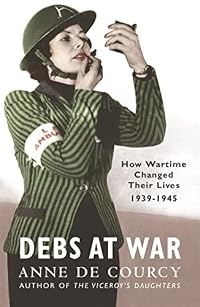
Debs at War
by Anne De Courcy
On This Page
Description
An extraordinary account - from firsthand sources - of upper class women and the active part they took in the War Pre-war debutantes were members of the most protected, not to say isolated, stratum of 20th-century society: the young (17-20) unmarried daughters of the British upper classes. For most of them, the war changed all that for ever. It meant independence and the shock of the new, and daily exposure to customs and attitudes that must have seemed completely alien to them. For many, show more the almost military regime of an upper class childhood meant they were well suited for the no-nonsense approach needed in wartime. This book records the extraordinary diversity of challenges, shocks and responsibilities they faced - as chauffeurs, couriers, ambulance-drivers, nurses, pilots, spies, decoders, factory workers, farmers, land girls, as well as in the Women's Services. How much did class barriers really come down? Did they stick with their own sort? And what about fun and love in wartime - did love cross the class barriers? show lessTags
Recommendations






















Member Reviews
This is about the upbringing and wartime experiences of upper-class women who came of age just before WWII. I loved this book and couldn't put it down.
The author doesn't assume the reader knows anything beyond the broadest details of WWII and her explanations - about upper-class society, or wartime conditions, or the war work available to women - are straightforward and helpful. These explanations are followed with the debs' stories about their experiences, often told in their own words - de Courcy quotes from interviews, and occasionally letters or diaries. The details shared fascinating and surprising, and the result is a very conversational book. Debs at War's opening chapters focus on the women's childhood and education (or, er, show more lack thereof), their experiences as debutantes and how they came to join up for war work. It then devotes a chapter to each of the different types of war work these women did, as well as chapters about how the war affected their social lives and loves lives.
What surprised me the most was just how sheltered these women were. While some women in the '30s attended university, further education for upper-class young women was generally limited to being sent to France or Germany (or both) for a couple of year to learn the language. It often wasn't seen as important to teach them about maths. (Or sex. Which was a problem if they were given high-ranking positions within a service and barely knew what sex was, let alone how to respond to reports of sexual abuse!)
The difficulty with reviewing a non-fiction book of this nature is that it is hard to summarise so many disparate pieces, the little details of the lives of so many women. I thought many of those little details were remarkable.
I liked the photos included in this book. With so many women being referred to - de Courcy interviewed over 40 of them - sometimes it was useful to have a face to put to the name! It was also interesting to see their uniforms (as uniforms was something several of them talked about) and working conditions.
I can't remember the last time I was so captivated by a non-fiction book. show less
The author doesn't assume the reader knows anything beyond the broadest details of WWII and her explanations - about upper-class society, or wartime conditions, or the war work available to women - are straightforward and helpful. These explanations are followed with the debs' stories about their experiences, often told in their own words - de Courcy quotes from interviews, and occasionally letters or diaries. The details shared fascinating and surprising, and the result is a very conversational book. Debs at War's opening chapters focus on the women's childhood and education (or, er, show more lack thereof), their experiences as debutantes and how they came to join up for war work. It then devotes a chapter to each of the different types of war work these women did, as well as chapters about how the war affected their social lives and loves lives.
What surprised me the most was just how sheltered these women were. While some women in the '30s attended university, further education for upper-class young women was generally limited to being sent to France or Germany (or both) for a couple of year to learn the language. It often wasn't seen as important to teach them about maths. (Or sex. Which was a problem if they were given high-ranking positions within a service and barely knew what sex was, let alone how to respond to reports of sexual abuse!)
The difficulty with reviewing a non-fiction book of this nature is that it is hard to summarise so many disparate pieces, the little details of the lives of so many women. I thought many of those little details were remarkable.
I liked the photos included in this book. With so many women being referred to - de Courcy interviewed over 40 of them - sometimes it was useful to have a face to put to the name! It was also interesting to see their uniforms (as uniforms was something several of them talked about) and working conditions.
I can't remember the last time I was so captivated by a non-fiction book. show less
Following on her book on the last debutante season before World War II, author Anne de Courcy follows her subjects through the six years that Britain was at war. Although largely clueless about international events, once war was upon them, the debs by and large, rose to the occasion, taking up jobs in the various service organizations and even working in factories.
The war essentially ended the pampered lives of the British upper classes by opening up multiple job opportunities for their servants who never returned after the war was over. The Labour government that took over in 1945 also hastened the end of the easy life through the nationalization of coal mines, railroads and other heavy industry concerns as well as the dramatic rise in show more taxes needed to pay for the new welfare state.
hat is interesting is that most of the women interviewed for this book (almost 50 in all, all now very elderly) complain about the life they lost. One has to admire their pluck. show less
The war essentially ended the pampered lives of the British upper classes by opening up multiple job opportunities for their servants who never returned after the war was over. The Labour government that took over in 1945 also hastened the end of the easy life through the nationalization of coal mines, railroads and other heavy industry concerns as well as the dramatic rise in show more taxes needed to pay for the new welfare state.
hat is interesting is that most of the women interviewed for this book (almost 50 in all, all now very elderly) complain about the life they lost. One has to admire their pluck. show less
Acquired via BookCrossing 23 Jul 2011
An excellent work of social history that will appeal to anyone who liked the Bluestockings book several of us read earlier. We meet a group of wealthy and titled ladies and find out about their lives before WWII, and then are taken through themed chapters on the different arms of the Services (and nursing) as well as love and marriage, class, and the important question of what happened next. Both meticulously researched and warmly written - a great read.
An excellent work of social history that will appeal to anyone who liked the Bluestockings book several of us read earlier. We meet a group of wealthy and titled ladies and find out about their lives before WWII, and then are taken through themed chapters on the different arms of the Services (and nursing) as well as love and marriage, class, and the important question of what happened next. Both meticulously researched and warmly written - a great read.
Interesting social history telling what sheltered lives debs and women lead pre-war and how their involvement in most aspects of the war changed their lives permanently.
I really like this period, and as I am making my way deeper into the Mitford sisters, this is a good book to getting some perspective. I like books about WWII, Britain, and also biographies. I also like romances, so the fact that there are real Lords and Ladies certainly worked for me too. In other words, this book suited me just fine, and I recommend it to anybody with similar interests.
What struck me was the incredible abysses between the girls interviewed and "normal people". It is hard to imagine that a girl lived at the Ritz while nursing, or how people were served by a butler in white gloves, while there was a dog fight over the terrace. And that when it ended, the party merrily went to play tennis, until being called away to show more take care of the casualties.
Even though they describe that the war changed their world upside down, majority went on to continue living very privileged lives, and could not imagine going out with somebody outside of their class, even if he was a doctor.
It is a book of contrasts, and worth while reading for sure. show less
What struck me was the incredible abysses between the girls interviewed and "normal people". It is hard to imagine that a girl lived at the Ritz while nursing, or how people were served by a butler in white gloves, while there was a dog fight over the terrace. And that when it ended, the party merrily went to play tennis, until being called away to show more take care of the casualties.
Even though they describe that the war changed their world upside down, majority went on to continue living very privileged lives, and could not imagine going out with somebody outside of their class, even if he was a doctor.
It is a book of contrasts, and worth while reading for sure. show less
More like 3.5 stars. I felt like some of the sections were poorly organized, which led to some repetition. But it was a nice tribute to the human spirit during trying times.
An excellent overview of the lives of pre-war debutantes during the Second World War. Very readable.
Members
- Recently Added By
Author Information

15 Works 1,881 Members
Anne de Courcy is an English biographer and journalist. Her title's include: Kithcens, Making Room at the Top, Snowdon: The Biography, The Fishing Fleet: Husband Hunting in the Raj, and The Husband Hunters: Social Climbing in London and New York. (Bowker Author Biography)
Common Knowledge
- Canonical title
- Debs at War
- Original publication date
- 2005
- Important places
- England, UK
- Important events
- World War II, British Home Front
- First words
- All over England, the daughters of the upper classes were growing up in similar fashion.
Classifications
- Genres
- Nonfiction, History, General Nonfiction, Biography & Memoir
- DDC/MDS
- 305.2422094109044 — Society, Government, and Culture Social sciences, sociology & anthropology Social group - Age, Gender, Ethnicity Age groups Early adulthood
- LCC
- D810 .W7 .D42 — History of Europe, Asia, Africa and Oceania History (General) World War II (1939-1945)
- BISAC
Statistics
- Members
- 160
- Popularity
- 204,001
- Reviews
- 8
- Rating
- (3.66)
- Languages
- English
- Media
- Paper, Ebook
- ISBNs
- 6
- ASINs
- 2