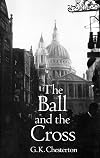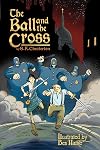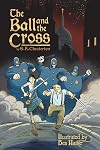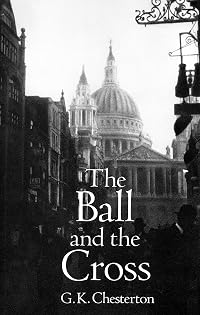
The Ball and the Cross
by G. K. Chesterton
On This Page
Description
Only G.K. Chesterton could tackle some of the most persistent and complex questions about the Christian faith in such an engaging format. The Ball and the Cross presents a surprisingly good-humored take on timeless debates about faith, pairing plenty of witty repartee with deep and penetrating philosophical insights..
Tags
Recommendations










Member Reviews
The Ball and the Cross follows Evan MacIan, a devout Catholic, and James Turnbull, an ardent atheist, on an engaging romp throughout England as they attempt to find a quiet spot to fight to the death over the supremacy of their respective ideologies. Satire, humor and solid writing follow as various adventures and assorted characters interrupt their immolatory efforts. Despite, or even because of, their differences, they come to like and respect the other, even as they vow to run him through with a sword.
Published in 1909, this book remains timely 100+ years later. (Only now, Christopher Hitchens and Alistair MacGrath debate on YouTube about religious belief in a modern world.) My edition includes an excellent introduction by Martin show more Gardner, who describes the genesis of the book from many conversations between Catholic Chesterton and Robert Peel Glanville Blatchford, a "then widely read journalist who was an archenemy of Christianity." (Amazingly, upon the death of his wife, in 1923, Blatchford developed a belief in the afterlife and became a spiritualist!) I appreciate that Chesterton, in writing The Ball and The Cross, didn't take sides. MacIan and Turnball are well matched in their vigorous and various positions. Chesterton allows the reader to make up his or her own mind.
Quite enjoyed this book. There is humor, particularly as the two main characters' battle royale is constantly being denied by circumstance. show less
Published in 1909, this book remains timely 100+ years later. (Only now, Christopher Hitchens and Alistair MacGrath debate on YouTube about religious belief in a modern world.) My edition includes an excellent introduction by Martin show more Gardner, who describes the genesis of the book from many conversations between Catholic Chesterton and Robert Peel Glanville Blatchford, a "then widely read journalist who was an archenemy of Christianity." (Amazingly, upon the death of his wife, in 1923, Blatchford developed a belief in the afterlife and became a spiritualist!) I appreciate that Chesterton, in writing The Ball and The Cross, didn't take sides. MacIan and Turnball are well matched in their vigorous and various positions. Chesterton allows the reader to make up his or her own mind.
Quite enjoyed this book. There is humor, particularly as the two main characters' battle royale is constantly being denied by circumstance. show less
In the beginning, the Catholic premise begins after a seemingly irrelevant chapter about an airship designed and flown by a mad scientist. Turnbull, a smug atheist newspaper publisher in London, has apparently published an article insulting the Virgin Mary. MacIan, a militant traditionalist Catholic man from Scotland, reads it and smashes the publisher's window in a rage. He challenges Turnbull to a duel; Turnbull accepts; and after buying swords in an antique shop, they have at it, fully attempting to kill each other. I was unable to sympathize with wanting to murder someone for insulting one's
What happens for about the next two-thirds of the book is almost a screwball comedy: MacIan and Turnbull, who become almost friends, keep going from place to place for their duel because people keep interrupting them and the police keep finding and chasing them.
The story eventually becomes more serious, and takes a bizarre and much more interesting turn. It becomes, in fact, possibly the strangest Chesterton book I've yet read. (The others being The Napoleon of Notting Hill; Manalive; The Man Who Was Thursday; The Everlasting Man; and What I Saw In America.) Even The Man Who Was Thursday doesn't seem so absurd, once you accept that it's surreal.
MacIan and Turnbull jump over a wall to evade the latest police pursuit, and eventually find that they have been tricked into entering an inescapable insane asylum that was apparently designed by mysterious and evil people who may or may not be trying to take over England. This section, very much like The Man Who Was Thursday, is so strange and surreal (if definitely less puzzling and difficult) that I have felt compelled to reread it.
The Ball and the Cross begins with a challenge of faith and honor - the pious Catholic Evan MacIan is so incensed by James Turnbull's skepticism about the origins of Christianity that he smashes one of his windows and they agree to settle the matter with a duel. The conflict gets thwarted at every turn though; the entire country becomes embroiled, if a little bit baffledly, in the duel - nobody has witnessed such sincere fervor about personal beliefs as MacIan and Turnbull both possess.
So, in a peculiar way, the two become comrades, united by passion in an anti-septic and passionless world. Chesterton never spoonfeeds the reader a conclusion, much less a Moral, but he does open up avenues of religious dialogue.
Plus, the book is show more terribly funny, with satire enough for everyone to appreciate. It has such a surprisingly modern feel to it, impressive since it was written a century ago. The issues touched upon are still discussed and relevant, and the religious versus the non-religious are (perhaps sadly) still treading the same ground today. show less
So, in a peculiar way, the two become comrades, united by passion in an anti-septic and passionless world. Chesterton never spoonfeeds the reader a conclusion, much less a Moral, but he does open up avenues of religious dialogue.
Plus, the book is show more terribly funny, with satire enough for everyone to appreciate. It has such a surprisingly modern feel to it, impressive since it was written a century ago. The issues touched upon are still discussed and relevant, and the religious versus the non-religious are (perhaps sadly) still treading the same ground today. show less
Chesteron's virtues, as always, swamp his vices. With Chesterton you always get fair play to the enemy when you don't expect it, and vivid, unforgettable moments: the sunlight shining into the back lot behind the shop, the doomed duel in the canyon filled by the tide, the repulsive Magdalen fellow with the south sea idol in his garden. Not ultimately, as successful as his other great, strange dreams (Thursday, Napoleon of Notting Hill), but that's a high standard.
I really want to like GK Chesterton. He's witty and has a lot of good things to say. But I just can't get into his novels. In this case it's probably the philosophical discussions that I'm not enjoying. I might try a non fiction work by him instead.
MacIan, a fiery Catholic, breaks the windows of the Ludgate Hill offices of The Atheist, incensed by one of its editorials, and determined to challenge its editor, Turnbull, to a duel. Thwarted at every turn in their attempts to fight, they continue their mad journey in search of solitude to the accompanimnet of continual debate, from which they come to recognise the validity of each other's position. Only an apocalyptic ending resolves the tensions of their relationship, in one of Chesterton's most individual novels, where passionate religious debate is combined with adventures in the high picaresque tradition.
Introduction by Paul Jennings
Introduction by Paul Jennings
I was disappointed in this work on many levels. On a positive note, the general story line is an interesting concept. However, Chesterton's writing style is dated and sometimes tedious, and many of his attempts at witty dialogue and/or compelling debate over religion versus atheism fall short. His preposterous ending did not help either.
Members
- Recently Added By
Lists

1001 Books You Must Read Before You Die
1,448 works; 1,135 members
Author Information

797+ Works 59,836 Members
Gilbert Keith Chesterton was born in London, England, in 1874. He began his education at St Paul's School, and later went on to study art at the Slade School, and literature at University College in London. Chesterton wrote a great deal of poetry, as well as works of social and literary criticism. Among his most notable books are The Man Who Was show more Thursday, a metaphysical thriller, and The Everlasting Man, a history of humankind's spiritual progress. After Chesterton converted to Catholicism in 1922, he wrote mainly on religious topics. Chesterton is most known for creating the famous priest-detective character Father Brown, who first appeared in "The Innocence of Father Brown." Chesterton died in 1936 at the age of 62. (Bowker Author Biography) show less
Series
Belongs to Publisher Series
Work Relationships
Common Knowledge
- Canonical title
- The Ball and the Cross
- Original title
- The Ball and the Cross
- Original publication date
- 1909; Copyright 1906
- People/Characters
- Evan MacIan; James Turnbull
- Important places
- London, England, UK
- First words
- The flying ship of Professor Lucifer sang through the skies like a silver arrow; the bleak white steel of it, gleaming in the bleak blue emptiness of the evening.
- Last words
- (Click to show. Warning: May contain spoilers.)He looked vaguely about at the fire that was already fading, and there among the ashes lay two shining things that had survived the fire, his sword and Turnbull's, fallen haphazard in the pattern of a cross.
Classifications
Statistics
- Members
- 911
- Popularity
- 29,555
- Reviews
- 10
- Rating
- (3.72)
- Languages
- 7 — English, French, German, Italian, Polish, Portuguese (Portugal), Spanish
- Media
- Paper, Audiobook, Ebook
- ISBNs
- 117
- UPCs
- 1
- ASINs
- 22