On This Page
Description
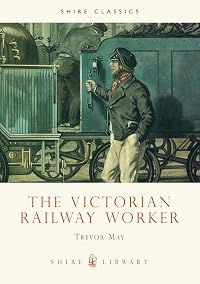
Thousands of Victorians were employed by railway companies, from the locomotive driver on the footplate to the booking clerk in the station. The companies provided work for navvies, signalmen, telegraph operators, station masters, hotel workers, and many other people, including those who worked the fleets of railway-owned ships and horse-drawn vehicles. Trevor May gives a fascinating overview of everyday life for the characters that worked in such varied railway occupations, and the often show more stringent discipline and hierarchies that meant, for instance, that firemen had to drink in separate bars from engine drivers. Interesting cameos are provided of the men who worked in the great railway factories in places like Crewe, Swindon and Derby, the wheel-tappers who checked the integrity of locomotive and carriage wheels to ensure their safety, the women who worked in the company laundries, and those who worked in scores of other occupations. show lessTags
Recommendations

















Member Reviews
A brief introduction to a vast subject. The author quickly covers a range of subjects, often drawing parallels between railway service and military service, something one suspects the Victorians found rather attractive. Even with such a short text, there is something new to learn from this book; for instance, at the height of the 'Railway Mania' in 1846, 200,000 men were engaged in building the railways, more than the entire armed forces of Britain at that time. When the railways were at their height in 1905, they employed 600,000 people, around 3% of the entire national workforce. And I also learnt that following the introduction of Regulations in 1840 and 1842, employees who broke company rules could be treated as having committed a show more criminal offence and be liable to have their case heard before a magistrate with a penalty of two months' imprisonment.
The book also makes it clear that railway workers covered a multitude of trades and crafts, including workshops, catering, hotel staff, clerical staff, carters and those responsible for the care of horses, mariners and dock workers, as the railways were engaged in all these activities.
The one area where the book has little to say is on the subject of the early days of the trade unions. The railway companies tended to stratify their workforce with strict demarcation of status, setting drivers as superior to firemen, who were in turn superior to railway staff employed in stations - and so on, with all the divisions that can be imagined. This meant that organised labour was set up on strict gradist lines, with few demonstrations of workers' solidarity during this period. It was only through a long process of amalgamation and campaigning that the railway unions emerged that we know today - and even then, divisions remain, such as that between ASLEF (the footplatemans' union) and the NUR (National Union of Railwaymen, the predecessor to today's RMT).
It would have been interesting to contrast the lot of railway workers with conditions today, but that would require a much bigger book addressing the whole subject since 1825. There is an interesting selection of illustrations with informative captions. show less
The book also makes it clear that railway workers covered a multitude of trades and crafts, including workshops, catering, hotel staff, clerical staff, carters and those responsible for the care of horses, mariners and dock workers, as the railways were engaged in all these activities.
The one area where the book has little to say is on the subject of the early days of the trade unions. The railway companies tended to stratify their workforce with strict demarcation of status, setting drivers as superior to firemen, who were in turn superior to railway staff employed in stations - and so on, with all the divisions that can be imagined. This meant that organised labour was set up on strict gradist lines, with few demonstrations of workers' solidarity during this period. It was only through a long process of amalgamation and campaigning that the railway unions emerged that we know today - and even then, divisions remain, such as that between ASLEF (the footplatemans' union) and the NUR (National Union of Railwaymen, the predecessor to today's RMT).
It would have been interesting to contrast the lot of railway workers with conditions today, but that would require a much bigger book addressing the whole subject since 1825. There is an interesting selection of illustrations with informative captions. show less
Ratings
Members
- Recently Added By
Author Information
19 Works 448 Members
Trevor May was educated at the universities of London and Exeter and is a professional historian, writer and educator. He has written over a dozen books on social and economic history topics, including The Victorian Railway Worker, The Victorian Workhouse and The Victorian Domestic Servant.
Series

Common Knowledge
- Canonical title
- The Victorian Railway Worker
Classifications
Statistics
- Members
- 32
- Popularity
- 880,784
- Reviews
- 1
- Rating
- (4.00)
- Languages
- English
- Media
- Paper
- ISBNs
- 1
- ASINs
- 1