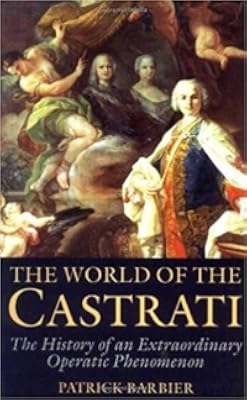
The World of the Castrati: The History of an Extraordinary Operatic Phenomenon
by Patrick Barbier
On This Page
Description
This entertaining and authoritative study of the castrati during the baroque period explores the lives and triumphs of more than 60 singers over three centuries--their social origins, training, and relationship to society and church. Blending history and anecdote, it traces the course of a phenomenon that held Europe in its thrall. People were fascinated by these hybrids--part man, part woman, and part child--who became virile heroes on the operatic stage. The reader will learn of the show more horrors of castration, the nature of the strange castrato voice, and the conflicts these singers experienced. show lessTags
Recommendations

















Member Reviews
I’d enjoyed both the movie Farinelli and the Anne Rice historical novel about castrati, Cry to Heaven, so when I saw this book there I decided to learn more about the topic.
Though it looked like it would be scandalous and juicy (as the movie Farinelli was) the execution was on the dry side. I think someone would need a grounding in the history of opera seria (Italian opera) first to really “get” it. Certainly they’d need to be familiar with the Italian musical terms used to describe operatic singing. Though I picked up these from the text, it was a struggle for me not knowing what the singing the author was describing sounded like, or was meant to sound like. Which is of course true, as there are no castrated men singing opera show more today and making recordings for listeners to hear them. But even a glossary of terms would have been nice. The author is a professor of the history of opera so why he didn’t, I can’t guess.
I don’t think the overly academic approach helped the subject matter either. He divided the book into chapters based on a castrato’s life: childhood castration, conscription into an Italian music school, early performances, performing at the opera, etc. and then he would give myriad examples of how all the major castrati went through these passages. The problem with that it was very easy to get all these singers mixed up so they became a castrati zupa. I'd rather he'd just concentrated on a few singers to go in-depth on and make anecdotes out of all the others. What worked with this method, though, was describing the background history, and some of that was very fascinating, like how it was customary for Italians to talk loudly, eat, and socialize as they watched that week’s opera with no regard for the performers.
Everything about that world of the 1600s and 1700s was so dramatic and colorful, it seems a shame more pictures weren’t included to make it more of a coffee-table book.
The entire era was a glorious yet disquieting one in European music, for the boys who were castrated to feed the mania had no choice in the matter, and of course some of them died from the operation or never developed decent voices even after many years of grueling schooling. And grueling lessons they were, concentrating on breathing and developing the lungs, larynx and ribcage to the hit the supernaturally high notes so beloved of the Italian public. These singers were truly athletes; in the days before electrical amplification voices had to reach into the highest seats of the theater, the upper recesses of the church. Though they were the cossetted pop stars of their day they were produced in a manner similar to the endless stream of boy bands coming out of the US or Korea, created to fill a need that, even at its height, was always questionable, and questioned, for reasons of taste and morality.
In the end, I enjoyed did enjoy learning about early opera but, being there are no castrati around today who can recreate those sounds, the whole book was like a what-if. show less
Though it looked like it would be scandalous and juicy (as the movie Farinelli was) the execution was on the dry side. I think someone would need a grounding in the history of opera seria (Italian opera) first to really “get” it. Certainly they’d need to be familiar with the Italian musical terms used to describe operatic singing. Though I picked up these from the text, it was a struggle for me not knowing what the singing the author was describing sounded like, or was meant to sound like. Which is of course true, as there are no castrated men singing opera show more today and making recordings for listeners to hear them. But even a glossary of terms would have been nice. The author is a professor of the history of opera so why he didn’t, I can’t guess.
I don’t think the overly academic approach helped the subject matter either. He divided the book into chapters based on a castrato’s life: childhood castration, conscription into an Italian music school, early performances, performing at the opera, etc. and then he would give myriad examples of how all the major castrati went through these passages. The problem with that it was very easy to get all these singers mixed up so they became a castrati zupa. I'd rather he'd just concentrated on a few singers to go in-depth on and make anecdotes out of all the others. What worked with this method, though, was describing the background history, and some of that was very fascinating, like how it was customary for Italians to talk loudly, eat, and socialize as they watched that week’s opera with no regard for the performers.
Everything about that world of the 1600s and 1700s was so dramatic and colorful, it seems a shame more pictures weren’t included to make it more of a coffee-table book.
The entire era was a glorious yet disquieting one in European music, for the boys who were castrated to feed the mania had no choice in the matter, and of course some of them died from the operation or never developed decent voices even after many years of grueling schooling. And grueling lessons they were, concentrating on breathing and developing the lungs, larynx and ribcage to the hit the supernaturally high notes so beloved of the Italian public. These singers were truly athletes; in the days before electrical amplification voices had to reach into the highest seats of the theater, the upper recesses of the church. Though they were the cossetted pop stars of their day they were produced in a manner similar to the endless stream of boy bands coming out of the US or Korea, created to fill a need that, even at its height, was always questionable, and questioned, for reasons of taste and morality.
In the end, I enjoyed did enjoy learning about early opera but, being there are no castrati around today who can recreate those sounds, the whole book was like a what-if. show less
For my full review, please see my blog:
http://theidlewoman.blogspot.co.uk/2014/09/the-world-of-castrati-patrick-barbier...
http://theidlewoman.blogspot.co.uk/2014/09/the-world-of-castrati-patrick-barbier...
Ratings
Members
- Recently Added By
Lists

In Our Time books
4,934 works; 2 members
Author Information

Patrick Barbier is a Professor at the West Catholic University in Angers and is an expert on operatic history. He has also published a biography of Farinelli, the most famous of the castrati.
Some Editions
Common Knowledge
- Canonical title*
- Histoire des castrats
- Original title
- Histoire des castrats
- Original publication date
- 1989 (1e édition originale française, Grasset) (1e édition originale française, Grasset)
- First words*
- A learned surgeon or a mere village barber - either might carry out the operation.
- Last words*
- (Click to show. Warning: May contain spoilers.)This advenutre lasted for three centuries, defying all the laws of morality and reason to achieve the impossible union of monster and angel.
- Original language*
- Français
*Some information comes from Common Knowledge in other languages. Click "Edit" for more information.
Classifications
Statistics
- Members
- 98
- Popularity
- 328,821
- Reviews
- 2
- Rating
- (3.65)
- Languages
- 8 — Dutch, English, Estonian, French, Italian, Portuguese, Russian, Spanish
- Media
- Paper
- ISBNs
- 11