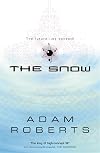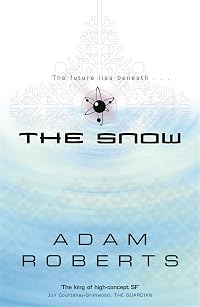
The Snow
by Adam Roberts
On This Page
Description
And this is how the world will end . . . ¿The snow started falling on the sixth of September, soft noiseless flakes filling the sky like a swarm of white moths, or like static interference on your TV screen - whichever metaphor, nature or technology, you find the more evocative. Snow everywhere, all through the air, with that distinctive sense of hurrying that a vigorous snowfall brings with it. Everything in a rush, busy-busy snowflakes. And, simultaneously, paradoxically, everything is show more hushed, calm, as quiet as cancer, as white as death. And at the beginning people were happy.¿ But the snow doesn¿t stop. It falls and falls and falls. Until it lies three miles thick across the whole of the earth. Six billion people have died. Perhaps 150,000 survive. But those 150,000 need help, they need support, they need organising, governing. And so the lies begin. Lies about how the snow started. Lies about who is to blame. Lies about who is left. Lies about what really lies beneath. show lessTags
Recommendations






Member Reviews
As a malapropistic sports commentator might say, this is a book of three halves.
We start with a catastrophe that creeps up very quietly on us. It starts snowing - and then doesn't stop. But a Cosy British Catastrophe this isn't. Our Heroes don't retreat to a country house in the Cotswolds and start to re-establish society. Instead, a handful of survivors eke out an existence in the ruins, sometimes against all the odds. Things look bleak, mainly because they are.
But then, there is a rescue; and we are propelled into 'Handmaiden's Tale' territory. There are efforts to establish a New World Order on top of the snow, which is now a number of miles thick across the globe. In the middle of this tale, the pov character changes, and we get a show more confession in the form of a flashback, and that seems to concentrate on a different kind of "snow" altogether. Are we perhaps in the Realm of Allegory?
But again there is a shift and there is an explanation, of sorts. This section is reminiscent of Thomas Disch's 'The Genocides', except the outcome is less terminal for the human race.
I started out enjoying the book, partly because the protagonist is located in a section of London that I know somewhat, and so I identified with the setting until the world was so completely transformed. By then, I was identifying well with the main character. The central section, with its 'Handmaiden's Tale' theme, I felt was a bit too long and a bit too heavy-handed in the demonisation of the military mindset and a certain sort of American establishment figure. But the writing carried me through this, and the description of the landscape was reminiscent of Roberts' first novel, 'Salt', which I admired precisely because of its vivid depiction of a majestic, terrible wasteland.
The denouement, and the outcome in the final segment of the novel, was ingenious, different and (just for a change) probably not all a delusion.
The presentation of the narrative, via the use of official documents and confessions, presented as though in their native format, set a particular set of expectations running; and some of these are red herrings. For me, they added to the sense of reality that the novel projects.
So, an uneven read, and not an easy one, but one that is thought-provoking. I got on better with this than other Adam Roberts novels. show less
We start with a catastrophe that creeps up very quietly on us. It starts snowing - and then doesn't stop. But a Cosy British Catastrophe this isn't. Our Heroes don't retreat to a country house in the Cotswolds and start to re-establish society. Instead, a handful of survivors eke out an existence in the ruins, sometimes against all the odds. Things look bleak, mainly because they are.
But then, there is a rescue; and we are propelled into 'Handmaiden's Tale' territory. There are efforts to establish a New World Order on top of the snow, which is now a number of miles thick across the globe. In the middle of this tale, the pov character changes, and we get a show more confession in the form of a flashback, and that seems to concentrate on a different kind of "snow" altogether. Are we perhaps in the Realm of Allegory?
But again there is a shift and there is an explanation, of sorts. This section is reminiscent of Thomas Disch's 'The Genocides', except the outcome is less terminal for the human race.
I started out enjoying the book, partly because the protagonist is located in a section of London that I know somewhat, and so I identified with the setting until the world was so completely transformed. By then, I was identifying well with the main character. The central section, with its 'Handmaiden's Tale' theme, I felt was a bit too long and a bit too heavy-handed in the demonisation of the military mindset and a certain sort of American establishment figure. But the writing carried me through this, and the description of the landscape was reminiscent of Roberts' first novel, 'Salt', which I admired precisely because of its vivid depiction of a majestic, terrible wasteland.
The denouement, and the outcome in the final segment of the novel, was ingenious, different and (just for a change) probably not all a delusion.
The presentation of the narrative, via the use of official documents and confessions, presented as though in their native format, set a particular set of expectations running; and some of these are red herrings. For me, they added to the sense of reality that the novel projects.
So, an uneven read, and not an easy one, but one that is thought-provoking. I got on better with this than other Adam Roberts novels. show less
"The Snow" was my first Adam Roberts novel and I enjoyed it! Roberts explores the end of the world theme in a fresh new way: imagine the world is covered in snow several miles deep. Only a tiny fraction of humanity survive. The story explores the lives of a handful of survivors - men and women - as they attempt to rebuild some kind of society. There are thoughtful explorations of power, terrorism and how people respond to the mass trauma of most people dying under the snow.
Published in 2004, the novel explores the implications of the "War on Terror" in ways that still feel interesting 20 years later. I also enjoyed the use of "found documents" subject to a variety of censorship procedures throughout the novel intriguing as a way of show more signalling how the new post-Snow society works.
I read this book as the snow started falling in my area and it was the perfect time to read it. show less
Published in 2004, the novel explores the implications of the "War on Terror" in ways that still feel interesting 20 years later. I also enjoyed the use of "found documents" subject to a variety of censorship procedures throughout the novel intriguing as a way of show more signalling how the new post-Snow society works.
I read this book as the snow started falling in my area and it was the perfect time to read it. show less
This is, for me, Roberts first great book. I've enjoyed everything I've read by him – all his previous novels have been clever, well written stories that at the same time have deep themes and morals woven into their fabric – but The Snow was a real WOW! book.
The basic premise (although absolutely nothing is basic in an Adam Roberts book) is that heavy snow begins to fall and does not stop. The world is soon covered in a blanket many metres – and eventually kilometres – deep, and civilisation quickly collapses. We follow one woman in London, Tira, who survives by scavenging resources inside buildings buried entombed inside newly formed glaciers, until she is rescued by a mining team from the surface, where the few survivors of show more this strange apocalypse continue to try to impose old structures on this utterly changed world. But this is just the beginning.
The story is told in a series of official documents – mostly statements recorded by Tira, sometimes others, and sometimes annotated letters. Part of this device produces the one problem with the book; in most of Tira's testimony, the names of people she refers to a blanked out for security – partly to demonstrate how governments like to control ad suppress information – but this can make it difficult to follow who she is talking about, although a lovely touch when she has lost a companion in the snow and is calling after them “NAME DELETED! Where are you NAME DELETED!”. For me, this detracts a little more than it adds, but this is a very minor gripe.
Sometimes reviewers (and writers) try to distance great work from genre fiction, but this is one of those books that shows a novel can be genre and literature. This is diamond hard Science Fiction, this is an apocalyptic novel, but it is not just these things. The Snow is multi-layered story filled with so many themes and ideas it would be dizzying if it weren't so well written. You might expect a novel about global calamity to concern itself with the human spirit and resilience, hardship and survival, but this is a book that goes so far beyond that. It is about imperialism and control, about how our perceptions and expectations of the world shape it, about tribalism, religion, race and gender relations, the fallibility of perception and memory. There are echoes of [a:Ray Bradbury|1630|Ray Bradbury|http://photo.goodreads.com/authors/1190744775p2/1630.jpg]'s [b:The Martian Chronicles|76778|The Martian Chronicles|Ray Bradbury|http://photo.goodreads.com/books/1170899683s/76778.jpg|4636013] and [a:Margaret Atwood|3472|Margaret Atwood|http://photo.goodreads.com/authors/1282859073p2/3472.jpg]]'s [b:The Handmaid's Tale|38447|The Handmaid's Tale|Margaret Atwood|http://photo.goodreads.com/books/1255648830s/38447.jpg|1119185], and this book can sit proudly on a shelf with both of these. show less
The basic premise (although absolutely nothing is basic in an Adam Roberts book) is that heavy snow begins to fall and does not stop. The world is soon covered in a blanket many metres – and eventually kilometres – deep, and civilisation quickly collapses. We follow one woman in London, Tira, who survives by scavenging resources inside buildings buried entombed inside newly formed glaciers, until she is rescued by a mining team from the surface, where the few survivors of show more this strange apocalypse continue to try to impose old structures on this utterly changed world. But this is just the beginning.
The story is told in a series of official documents – mostly statements recorded by Tira, sometimes others, and sometimes annotated letters. Part of this device produces the one problem with the book; in most of Tira's testimony, the names of people she refers to a blanked out for security – partly to demonstrate how governments like to control ad suppress information – but this can make it difficult to follow who she is talking about, although a lovely touch when she has lost a companion in the snow and is calling after them “NAME DELETED! Where are you NAME DELETED!”. For me, this detracts a little more than it adds, but this is a very minor gripe.
Sometimes reviewers (and writers) try to distance great work from genre fiction, but this is one of those books that shows a novel can be genre and literature. This is diamond hard Science Fiction, this is an apocalyptic novel, but it is not just these things. The Snow is multi-layered story filled with so many themes and ideas it would be dizzying if it weren't so well written. You might expect a novel about global calamity to concern itself with the human spirit and resilience, hardship and survival, but this is a book that goes so far beyond that. It is about imperialism and control, about how our perceptions and expectations of the world shape it, about tribalism, religion, race and gender relations, the fallibility of perception and memory. There are echoes of [a:Ray Bradbury|1630|Ray Bradbury|http://photo.goodreads.com/authors/1190744775p2/1630.jpg]'s [b:The Martian Chronicles|76778|The Martian Chronicles|Ray Bradbury|http://photo.goodreads.com/books/1170899683s/76778.jpg|4636013] and [a:Margaret Atwood|3472|Margaret Atwood|http://photo.goodreads.com/authors/1282859073p2/3472.jpg]]'s [b:The Handmaid's Tale|38447|The Handmaid's Tale|Margaret Atwood|http://photo.goodreads.com/books/1255648830s/38447.jpg|1119185], and this book can sit proudly on a shelf with both of these. show less
Hmmm. I get inconclusive, open, indeterminate, unresolved. It leaves room for the imagination. I think I get the unreliability of reportage from multiple points of view. The mind plays tricks, and reports what is useful to know to deal with a known situation, unless tainted or diseased.
Unfortunately, I don't get this story. I was drawn along by the narrative - presented as 'documents' recording first person testimonies or legal and other reports - until it flagged alarmingly in the middle section. It picked up at the end, but ended on an ambiguous note that, for me, left it flapping in the breeze. If there had been a definite resolution, then I'd have forgiven the wooliness of the substance of the centre section. But no, we are show more presented with a set of choices and left to make up our own mind. I didn't care enough to pick one of the options.
Nicely written, however it didn't do enough for me. I know that Roberts is one of the shining lights of recent years, but Salt doesn't stand out in my memory either, and on the basis of this work I'll be spending my money elsewhere in the future. show less
Unfortunately, I don't get this story. I was drawn along by the narrative - presented as 'documents' recording first person testimonies or legal and other reports - until it flagged alarmingly in the middle section. It picked up at the end, but ended on an ambiguous note that, for me, left it flapping in the breeze. If there had been a definite resolution, then I'd have forgiven the wooliness of the substance of the centre section. But no, we are show more presented with a set of choices and left to make up our own mind. I didn't care enough to pick one of the options.
Nicely written, however it didn't do enough for me. I know that Roberts is one of the shining lights of recent years, but Salt doesn't stand out in my memory either, and on the basis of this work I'll be spending my money elsewhere in the future. show less
Just when i would think that I had a handle on what was going on in this science fiction novel, all of a sudden it would change and become a different kind of apocalypse. It begins with Londoner Tira experiencing the vast snow fall that blots out all of her normal life and then making her way to an office building where she lives with a man who has similarly become a refugee from the snow. Then, when it seems as though this is a pretty standard end of the world narrative, Tira is rescued from below the snow and brought above ground to where a militaristic government has taken command of the remaining population. Then, just when I became confident that I was reading a book that feel into the science fiction tradition of 1984, about what show more happens when a government attempts to completely control the population, there was yet another twist that morphed the story into a third kind of science fiction. I thought that these twists and turns made for a really interesting and thought provoking story.
The book is written in the form of narratives which have been released by the government and various names of characters are redacted. I thought this made for an interesting reading experience. At times it was aggravating because it took away from the flow of the story, but then at other times it made the story feel more authentic.
I would recommend this book to anyone who likes a good adventure/science fiction story as well as to anyone who is interested in the links between spirituality and science fiction. show less
The book is written in the form of narratives which have been released by the government and various names of characters are redacted. I thought this made for an interesting reading experience. At times it was aggravating because it took away from the flow of the story, but then at other times it made the story feel more authentic.
I would recommend this book to anyone who likes a good adventure/science fiction story as well as to anyone who is interested in the links between spirituality and science fiction. show less
It started off as a very promising novel and idea: what would happen if it simply never stopped snowing and most of the world died out, leaving something like 100,000 remaining survivors worldwide to build society from scratch?
Still, as I read on, it became simply... confusing. I googled the book to see if I'd missed anything, and it seemed that I was not alone in my stupor - this was a common response amongst anyone who had read the book, complete and utter confusion. The author tries to draw a cunning metaphor between a totalitarian society built on conspiracy and, I think, a hallucinagetic drug-infused experience (with just a little bit of science fiction), but completely fails, meaning that by the time you're finished reading the show more book, you feel that it simply doesn't make sense anymore. Add to the fact that the topical references will be lost on anyone who is not British and reading in the early 21st century, and what you're left with is a piece of poorly written material directed at a very limited audience.
Avoid this one. You'll most likely find there's nothing in it for you. show less
Still, as I read on, it became simply... confusing. I googled the book to see if I'd missed anything, and it seemed that I was not alone in my stupor - this was a common response amongst anyone who had read the book, complete and utter confusion. The author tries to draw a cunning metaphor between a totalitarian society built on conspiracy and, I think, a hallucinagetic drug-infused experience (with just a little bit of science fiction), but completely fails, meaning that by the time you're finished reading the show more book, you feel that it simply doesn't make sense anymore. Add to the fact that the topical references will be lost on anyone who is not British and reading in the early 21st century, and what you're left with is a piece of poorly written material directed at a very limited audience.
Avoid this one. You'll most likely find there's nothing in it for you. show less
What happens when it starts snowing? How about when it doesn't stop? What would happen to our civilization if that happened for years?
Another approachable and yet captivating sci-fi yarn from Adam Roberts. An easy read reminiscent of Children of Men or a Handmaiden's tale with racial and class examinations mixed in. A great and yet different kind of apocalypse novel.
Another approachable and yet captivating sci-fi yarn from Adam Roberts. An easy read reminiscent of Children of Men or a Handmaiden's tale with racial and class examinations mixed in. A great and yet different kind of apocalypse novel.
Members
- Recently Added By
Author Information

123+ Works 6,451 Members
Common Knowledge
- Canonical title
- The Snow
- Original title
- The snow
- Original publication date
- 2004-08
- People/Characters
- Tira Bojani Sahai; George Corvino; Edi Bisson; Thomas Pound; Teri Genert; Frank Robert Gillprazer (show all 7); G S Seidensticker
- Important places
- Liberty
- Epigraph
- He had prepared himself for every possibility. Reality must therefore be something that bears no relationship to possibilities, any more than the stab of a knife in one's body bears to the gradual movement of the clouds over... (show all)head.
-- Proust, Du cote de chez Swann - First words
- The snow started falling on September 6th, soft noiseless flakes filling the sky like a swarm of white moths, or like static interference on your TV screen -- whichever metaphor, nature or technology, you find more evocative.
- Last words
- (Click to show. Warning: May contain spoilers.)Of course I can't pretend to be a prophet. The prophets belong to a different age. I think that's all I want to say right now. Thank you.
- Blurbers
- Grimwood, Jon Courtenay; Hamilton, Peter F.
- Original language*
- Englisch
*Some information comes from Common Knowledge in other languages. Click "Edit" for more information.
Classifications
Statistics
- Members
- 281
- Popularity
- 115,367
- Reviews
- 11
- Rating
- (3.17)
- Languages
- English
- Media
- Paper, Ebook
- ISBNs
- 4
- ASINs
- 3