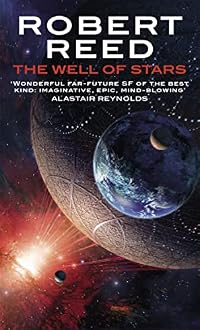
The Well of Stars
by Robert Reed
Marrow (2), Mere (aftermath of the events of the novel version of "Marrow"), Pamir (out of hiding, 2), Quee Lee and Perri (aftermath of the events of the novel version of "Marrow"), The Great Ship (novel - 9, change of mission, 2)
On This Page
Description
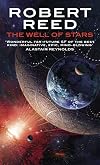
In The Well of Stars, Hugo award-nominated author Robert Reed has written a stunning sequel to his acclaimed novel Marrow. The Great Ship, so vast that it contains within its depths a planet that lay undiscovered for generations, has cruised through the universe for untold billions of years. After a disastrous exploration of the planet, Marrow, the Ship's captains face an increasingly restive population aboard their mammoth vessel.And now, compounding the captains' troubles, the Ship is show more heading on an irreversible course straight for the Ink Well, a dark, opaque nebula. Washen and Pamir, the captains who saved Marrow from utter destruction, send Mere, whose uncanny ability to adapt to and understand other cultures makes her the only one for the job, to investigate the nebula before they plunge blindly in. While Mere is away, Pamir discovers in the Ink Well the presence of a god-like entity with powers so potentially destructive that it might destroy the ship and its millions.Faced with an entity that might prevent the Ship from ever leaving the Ink Well, the Ship's only hope now rests in the ingenuity of the vast crew . . . and with Mere, who has not contacted them since she left the Ship...With the excitement of epic science fiction adventure set against a universe full of wonders, the odyssey of the Ship and its captains will capture the hearts of science fiction readers.At the Publisher's request, this title is being sold without Digital Rights Management Software (DRM) applied. show lessTags
Recommendations





















Member Reviews
I enjoyed the prequel to this book, 'Marrow', but found it lacking in some respects. This is a different experience altogether, but it does help to have read the first book just to start getting your head around the setting.
The Great Ship is the size of a Jovian planet. Humans were the first to discover it, empty and drifting, and they took it over. Centuries later, the Ship has become the ultimate cruise liner, voyaging the galaxy to allow different races to come together, explore and journey or just plain hang out together. As there is no faster-than-light travel in Reed's universe, the biological forms overcome this by having greatly extended lifespans as well as advanced medical techniques to overcome many of the more inconvenient show more kinds of death.
The first novel, 'Marrow', had a lot of scene-setting and a plot about the very centre of the Great Ship, an ordinary planet-sized core called Marrow. The trouble was that, having given his characters extended lifespans, Reed had to do something with them, and it made for quite a static story. Civilizations rose and fell in the course of a few pages. Not so in this book; suddenly the plot is far more mobile, there are new characters and many more of them; and there is wide-screen action on a scale that I found staggering.
This is certainly a book of contrasting scales; one minute you are contemplating parts of the Ship and boggling at its size; the next, the focus has pulled out and you are watching a major space battle as the movements of pinpricks of light. There are more incidental characters, and they are actually interesting people, if still a little fleeting in their passage through the pages; and the level of invention is up there with the rest and the best of Reed's earlier work.
This isn't the end of the story; another book is signposted at the close of this one. But with this size of canvas, there's enough scope for as many books as Reed can produce. And if they're all like this, then I'll have no problem with that. show less
The Great Ship is the size of a Jovian planet. Humans were the first to discover it, empty and drifting, and they took it over. Centuries later, the Ship has become the ultimate cruise liner, voyaging the galaxy to allow different races to come together, explore and journey or just plain hang out together. As there is no faster-than-light travel in Reed's universe, the biological forms overcome this by having greatly extended lifespans as well as advanced medical techniques to overcome many of the more inconvenient show more kinds of death.
The first novel, 'Marrow', had a lot of scene-setting and a plot about the very centre of the Great Ship, an ordinary planet-sized core called Marrow. The trouble was that, having given his characters extended lifespans, Reed had to do something with them, and it made for quite a static story. Civilizations rose and fell in the course of a few pages. Not so in this book; suddenly the plot is far more mobile, there are new characters and many more of them; and there is wide-screen action on a scale that I found staggering.
This is certainly a book of contrasting scales; one minute you are contemplating parts of the Ship and boggling at its size; the next, the focus has pulled out and you are watching a major space battle as the movements of pinpricks of light. There are more incidental characters, and they are actually interesting people, if still a little fleeting in their passage through the pages; and the level of invention is up there with the rest and the best of Reed's earlier work.
This isn't the end of the story; another book is signposted at the close of this one. But with this size of canvas, there's enough scope for as many books as Reed can produce. And if they're all like this, then I'll have no problem with that. show less
Ok, but kind of slow - or perhaps "carefully paced" would be a better way to describe it. From memory, I preferred Marrow.
From Publishers Weekly
As it sails the galaxy, the Great Ship (introduced in 2000's Marrow) meets an opponent worthy of its Jupiter-like size in Reed's taut sequel. Pitted against an entity that has sculpted its own dark cloud nebula called the Inkwell, the Ship's human captains and their nonhuman allies engage in a duel of wits and strength that drains gas giants and turns black holes into weapons. Washen, second in command but first in authority, must prepare the Great Ship for the encounter with the Inkwell. Washen's lover, Pamir, sets off in a streakship to confront the nebula's dominant species, the polyponds. Unraveling the dark nebula's secrets requires Washen to uncover some of the Great Ship's mysteries as well. The infinite show more depths of space are well matched by the all-too-human depths of Reed's characters, who range from near-deity to damaged fosterling, but must all face the problem of resolving conflicts between individual desires and communal needs. Having body-rebuilding immortality genes only gives them that much more time to debate the issue (as well as catching the unwary reader with quick-cut jumps of decades in a sentence). This literary SF novel works at all levels, from the big action sequences and mind-expanding concepts to the quiet, reflective moments. Agent, Merrilee Heifetz at Writers House. (Apr. 12) show less
As it sails the galaxy, the Great Ship (introduced in 2000's Marrow) meets an opponent worthy of its Jupiter-like size in Reed's taut sequel. Pitted against an entity that has sculpted its own dark cloud nebula called the Inkwell, the Ship's human captains and their nonhuman allies engage in a duel of wits and strength that drains gas giants and turns black holes into weapons. Washen, second in command but first in authority, must prepare the Great Ship for the encounter with the Inkwell. Washen's lover, Pamir, sets off in a streakship to confront the nebula's dominant species, the polyponds. Unraveling the dark nebula's secrets requires Washen to uncover some of the Great Ship's mysteries as well. The infinite show more depths of space are well matched by the all-too-human depths of Reed's characters, who range from near-deity to damaged fosterling, but must all face the problem of resolving conflicts between individual desires and communal needs. Having body-rebuilding immortality genes only gives them that much more time to debate the issue (as well as catching the unwary reader with quick-cut jumps of decades in a sentence). This literary SF novel works at all levels, from the big action sequences and mind-expanding concepts to the quiet, reflective moments. Agent, Merrilee Heifetz at Writers House. (Apr. 12) show less
Ratings
Members
- Recently Added By
Author Information

250+ Works 3,308 Members
Robert Reed is an American science fiction author. He was born in Omaha, Nebraska on October 9, 1956, and received a B.S. in Biology from Nebraska Wesleyan University in Lincoln, Nebraska, in 1987. He worked as a lab technician for several years, before being able to earn his living as a full-time author. Reed has won numerous literary awards show more throughout his prolific career, most notably, the Hugo Award in 2007 for his novella, A Billion Eyes. His other titles include: The Memory of Sky, The Greatship, The Cuckoo's Boys, Sister Alice, The Well of Stars, and Marrow. (Bowker Author Biography) show less
Some Editions
Awards and Honors
Series


Common Knowledge
- Original title
- The well of stars
- Original publication date
- 2004-12
- People/Characters
- Captain Washen; Pamir; Quee Lee; Perri; Mere; Aasleen
- Important places
- The Great Ship; The Polypond's nebula; The hull
- Dedication
- To my wife, Leslie Renee
- First words
- I have no voice that explains where I began, no mouth to tell why I was imagined or how I was assembled, and I no idea who deserves thanks for my simple existence, assuming that thanks are appropriate.
- Last words
- (Click to show. Warning: May contain spoilers.)It was the full-throated, wonderstruck shriek of a girl who until now, until this moment, had forgotten just how much fun it was to fall.
- Publisher's editor
- Frenkel, James
- Blurbers
- Brin, David
- Original language*
- Amerikanisch
*Some information comes from Common Knowledge in other languages. Click "Edit" for more information.
Classifications
Statistics
- Members
- 343
- Popularity
- 91,845
- Reviews
- 5
- Rating
- (3.66)
- Languages
- English, French
- Media
- Paper, Ebook
- ISBNs
- 6
- ASINs
- 3