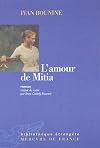
Mitya's Love
by Bunin Ivan Alekseevic
On This Page
Description
Excerpt from Mitya's Love He was actually twenty-one when his first book - a volume of verse - was pub lished at Orel, the capital of his native province and the birthplace Of Turgenev. Twelve years later, in 1903, Bunin was awarded the Pushkin Prize for literature, and had taken his place in the front rank of Chekhov's successors. After the death of Chekhov, in 1904, and the Revolution of 1905, Vladimir Korolenko survived as the representative of the older school of romantic fiction, but he show more had no followers of importance. The leadership of the new school of Realism fell to Maxim Gorky, about whom were grouped the. About the Publisher Forgotten Books publishes hundreds of thousands of rare and classic books. Find more at www.forgottenbooks.com This book is a reproduction of an important historical work. Forgotten Books uses state-of-the-art technology to digitally reconstruct the work, preserving the original format whilst repairing imperfections present in the aged copy. In rare cases, an imperfection in the original, such as a blemish or missing page, may be replicated in our edition. We do, however, repair the vast majority of imperfections successfully; any imperfections that remain are intentionally left to preserve the state of such historical works. show lessTags
Recommendations



















Member Reviews
Members
- Recently Added By
Author Information

249+ Works 1,980 Members
Ivan A. Bunin was little known in the United States until he received the Nobel Prize for literature, the first Russian writer to do so. By then he had decades of extensive literary activity behind him. In the intensely group-oriented literary milieu of turn-of-the-century Russia, Bunin largely remained a loner, working within the realist show more tradition in prose but enriching it with a powerful lyric element. He traveled abroad a great deal and used exotic locales as settings for many of his works. An outspoken opponent of the Bolsheviks, he emigrated to Paris and ironically, years after his death, he became celebrated in the Soviet Union as a major writer. Bunin's themes are diverse, ranging from a changing Russia to the universal human experience. Born into an impoverished rural-gentry family, he often wrote about the decline and passing of a way of life. Sometimes his depiction of provincial Russia is elegiac; at other times it is violent and tragic, as in the novella Dry Valley (1911]). A number of his works, such as the remarkable short story "The Gentleman from San Francisco" (1915), may be read as allegories of human encounter with the transcendent. In later years, Bunin grew increasingly preoccupied with problems of sexual attraction and death, evidenced in his last collection of stories, Dark Avenues (1930). In 1933 he was awarded the Nobel Prize for Literature. Bunin died in 1953. (Bowker Author Biography) show less
Awards and Honors
Series
Belongs to Publisher Series
Common Knowledge
- Canonical title
- Mitya's Love
- Original title
- Митина любовь; Митина любовь
- Original publication date
- 1925
- Original language
- Russian
- Disambiguation notice*
- Die Erzählungen Ignaz u. Natalie in d. Übers. von Ilona Koenig, die Erzählung Mitjas Liebe in d. Übers. von Käthe Rosenberg.
*Some information comes from Common Knowledge in other languages. Click "Edit" for more information.
Classifications
Statistics
- Members
- 63
- Popularity
- 490,977
- Rating
- (4.17)
- Languages
- 8 — English, French, German, Italian, Norwegian (Bokmål), Portuguese (Portugal), Russian, Swedish
- Media
- Paper, Ebook
- ISBNs
- 8
- ASINs
- 3