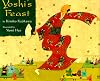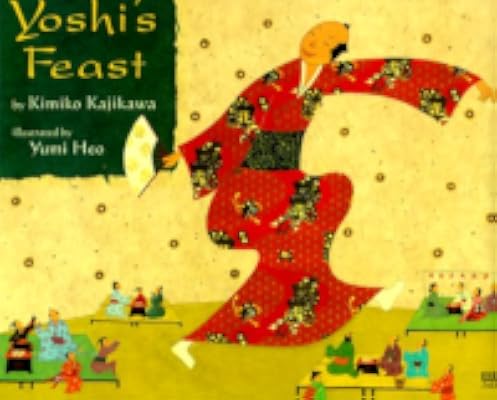
Yoshi's Feast
by Kimiko Kajikawa
On This Page
Description
When Yoshi's neighbor, Sabu, the eel broiler, attempts to charge him for the delicious smelling aromas he has been enjoying, Yoshi hatches a plan to enrich them both.Tags
Recommendations







Member Reviews
I like this book for two reasons. First, the illustrations are very ornate. The illustrator, Yumi Heo, uses handmade Japanese papers in her illustrations of pencil, oil, and college, which create a very unique illustration. The images also vary in sizes; some take up the entire page and others fit the line of the text. In a traditional Japanese folktale story, it is appreciated to see the characters wearing very detailed kimonos of red, gold, green and blue. Second, I like the text choices used for this story. The font reminds me of ancient writing because it is not the typical font used for books; it looks like traditional folklore print. Also, when Yoshi is dancing around with his jingling coins, the text looks like it is dancing with show more him because it is not aligned like other parts of the text, it has a flowing motion. The author uses different font sizes to emphasize Yoshi flaunting his coins chanting, “Chin chin jara jara chin jara jara…” getting louder and louder. The big idea of this book is compromise. This is shown through the character Yoshi and Sabu’s feud over money. Yoshi was too stubborn to purchase Sabu’s delicious eels. So Sabu starts to cook smelly fish, which causes Yoshi to lose his appetite. Yoshi decides to help Sabu’s business by attracting customers through dances. show less
Yoshi loves broiled eels. His neighbor Sabu makes and sells broiled eels. Yoshi believes his neighbor should share the leftovers. Sabu believes Yoshi should pay for them. But Yoshi is too stingy to pay. After a hilarious dispute involving Yoshi paying for the smell of the eels with the sound of his clinking money, they both work together to bring Sabu more customers.
A delightful tale about a selfish, eel-loving neighbor and a cunning eel chef who eventually become good friends-- but not before they each test each other through a variety of eel-related tricks. Children will enjoy the quirkiness of this tale, and its moral lesson about the virtues of generosity and friendship.
I liked this story for a few reasons. The first reason that I liked the story was because it is able to broaden the readers’ perspectives. This is because at first Sabu thought that Yoshi was stealing from him because he was always smelling the eels, but never buying any. But Yoshi thought that Yoshi should not have to pay for just smelling, so he danced around with money and said the sound of money was payment enough. They then came to an agreement. Yoshi danced to get the attention of people, and then they would buy Sabu’s eels. This book broaden readers’ perspectives because they were able to see who they agreed with. Readers can understand why Sabu would be upset with Yoshi always smelling but never buying. But readers could show more also understand why Yoshi would not feel the need to buy the expensive eel. The story allows readers to see that people have different outlooks on situations, and that everyone is entitled to their own opinion. Readers will be able to take the information from this conflict and remember it when they get in a disagreement with someone else. Another thing that I liked about the story was that the illustrations were able to enhance the story. When it is described that Yohsi is dancing around with the money the illustration is able to show this. The same illustration is also able to display what is happening in the town, too. Readers are able to witness the crowd that is being drawn in with his loud dancing. Through the illustrations the written words are enriched. The illustrations can show the anger and joy in the story better than the written words by themselves. Another reason that I liked the story was because it flowed so well. The whole story was leading to the resolution at the end of the story. The parts of the story leading to that event all flowed well, and were able to give the story a fluid feel, instead of the story being choppy. A last reason that I liked the story was because of the point of view. The point of view was in the third person and I thought that this was appropriate for the story. Having the point of view be in third person allowed the story to be equally about both main characters. If the story was in first person than the reader would probably agree with their perspective because the reader would only be witnessing that characters opinion. Having the story in third person allowed the reader to see both perspectives without biased opinions. I think the overall message of the story is conflicts can be solved if both parties are willing to make sacrifices. After Yoshi and Sabu discussed the problem they were able to come up with a solution that worked for both of them. One the last page the resolution is explained to readers when it is stated that, “Every day after that, Yoshi danced for happy crowds around Sabu’s hibachi. And every evening the two neighbors sat on Yoshi’s porch-laughing and enjoying Sabu’s sizzling-hot eels.” This shows readers that conflicts are able to be overcome if both parties are making efforts for the better. show less
This book was full of culture in its illustrations and I like the storyline because it leads into friendship, teamwork, and caring for one another.
Beautiful oil, pencil, and collage illustrations and creative use of typesetting come together in this classic folktale to form an engaging and provocative picture book. This adaptation of the Japanese folktale "Smells and Jingles" tells the story of Yoshi, a fan maker, and his neighbor Sabu, an eel broiler. The eels Sabu broils smell delicious, but Yoshi won't buy them; he just smells them cooking while he eats plain rice. When Yoshi tells Sabu that he'll never buy the eels because he can smell them for free, Sabu gets angry and gives Yoshi a bill. Yoshi "pays" the bill in a clever way. Although they reach an impasse, in the end the neighbors cooperate. Sabu makes money, and Yoshi gets to eat eels for free. The simple text and engaging show more illustrations will appeal to a range of ages, and the story will prompt discussion on topics such as fairness, teamwork, and creative problem solving. 2000, DK Publishing, $15.95. Ages 6 to 14.Eileen Hanning (Children's Literature) show less
Ratings
Members
- Recently Added By
Lists

A Child's Book Tour of Japan
58 works; 4 members
Author Information
12 Works 1,118 Members
Awards and Honors
Common Knowledge
- Canonical title
- Yoshi's Feast
Classifications
Statistics
- Members
- 116
- Popularity
- 280,564
- Reviews
- 6
- Rating
- (4.05)
- Languages
- English, French
- Media
- Paper
- ISBNs
- 2
- UPCs
- 1