The Meaning of Tingo: and Other Extraordinary Words from Around the World
by Adam Jacot de Boinod
Tingo (book 1)
On This Page
Description
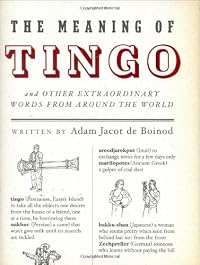
A garden of delights for the word obsessed: a world tour of the best of all those strange words that don't have a precise English equivalent, the ones that tell us so much about other cultures' priorities and preoccupations and expand our minds. Did you know that people in Bolivia have a word that means "I was rather too drunk last night and it's all their fault"? This collection of trivia from more than 254 languages also includes a frank discussion of exactly how many Eskimo words there show more are for snow. So, what in fact is "tingo"? In the Pascuense language of Easter Island, it's to take all the objects one desires from the house of a friend, one at a time, by asking to borrow them. Well, of course it is.--From publisher description. show lessTags
Recommendations


















Member Reviews
A delightful book for people interested in language and trivia. I found myself copying down words and phrases to incorporate into my vocabulary, including the Persian sanud, "the exercise of the mind upon an unprofitable subject"; the Japanese phrase suna o kamu yo na, "like chewing sand"; and the Indonesian desus, "a quiet and smooth sound as someone farting but not very loudly." I was kind of disappointed that there was no scatological section however; I know Pennsylvania Dutch (the language of the Amish) has a fine word meaning "globules of poop that get caught in your pubic hair."
Boinod’s culling from over 250 languages can get a bit tiring if one tries to read in a single sitting. The sheer insane spectrum of meanings and shades of meanings and nuances of meanings is mind-boggling. This isn’t one of those books whose fifty-cent words you try to incorporate into your daily life, but rather a window into the necessity of certain cultures to coin words to mean very, very specific things. It would make for an interesting bathroom reader.
http://nwhyte.livejournal.com/1334256.html
The author is a researcher for the Stephen Fry quiz show QI, and the book basically reads like an extended set of QI rounds about funny words in foreign languages, all mildly amusing. I spotted one spelling error - the excellent Serbian word inat is given as iant - and there may be others, but I will not be consumed by vengeful spite over it; also I imagine there is room for interpretation of some of the definitions, such as the 10 Albanian ways of describing a moustache, which to be do not seem very different from the ways we describe different moustaches in English.
Going back to spelling, I was a bit dubious of the example given of a word with five consecutive consonants - cmrlj which is show more Slovenian for bumble-bee - first off, 'lj' is a single letter in Slovenian and second I think the 'r' is basically functioning as a vowel there. (If you are trying to say it to yourself, remember that 'c' is pronounced 'ts'.) However there is no doubting the authenticity of the Dutch word with eight consecutive consonants, angstschreeuw - linguists may cry out in fear and horror that 'ch' is a single phoneme, but it is spelt with two letters. (Again, if you are trying to say that to yourself, remember that 's' and 'ch' are pronounced distinctly in Dutch, unlike in German.)
Like the TV programme it is based on, the book is a little too pleased with its own cleverness, but fun all the same. show less
The author is a researcher for the Stephen Fry quiz show QI, and the book basically reads like an extended set of QI rounds about funny words in foreign languages, all mildly amusing. I spotted one spelling error - the excellent Serbian word inat is given as iant - and there may be others, but I will not be consumed by vengeful spite over it; also I imagine there is room for interpretation of some of the definitions, such as the 10 Albanian ways of describing a moustache, which to be do not seem very different from the ways we describe different moustaches in English.
Going back to spelling, I was a bit dubious of the example given of a word with five consecutive consonants - cmrlj which is show more Slovenian for bumble-bee - first off, 'lj' is a single letter in Slovenian and second I think the 'r' is basically functioning as a vowel there. (If you are trying to say it to yourself, remember that 'c' is pronounced 'ts'.) However there is no doubting the authenticity of the Dutch word with eight consecutive consonants, angstschreeuw - linguists may cry out in fear and horror that 'ch' is a single phoneme, but it is spelt with two letters. (Again, if you are trying to say that to yourself, remember that 's' and 'ch' are pronounced distinctly in Dutch, unlike in German.)
Like the TV programme it is based on, the book is a little too pleased with its own cleverness, but fun all the same. show less
This had some entertaining words and insights into other cultures, but for the most part it was completely forgettable and the writing style got on my nerves. I need to read something better now. RIGHT NOW.
It's not so much the words (which as many reviewers have pointed out, are often used out of context) as much as the idea that a certain sentiment/idea/situation happens often enough in a certain culture for it to merit an actual word. It's like The Meaning of Liff, only real. Better check with a native speaker first, however, before throwing any of these around.
I love how certain Filipino words made it here: "magandang hinaharap" (meaning both "a bright future" and "big breasts"), "dangkal" (a handspan) and "layogenic". But where are "gigil" and "kulit"?
Small quibble: The Chinese could have been written in pinyin, to make it easier for me to have the words verified.
More like this online. The good stuff is in the comments section.
I love how certain Filipino words made it here: "magandang hinaharap" (meaning both "a bright future" and "big breasts"), "dangkal" (a handspan) and "layogenic". But where are "gigil" and "kulit"?
Small quibble: The Chinese could have been written in pinyin, to make it easier for me to have the words verified.
More like this online. The good stuff is in the comments section.
nach Kategorien unterteilt: Wörter aus anderen Kulturen, weil du schon immer wissen wolltest, wie man eine Frau nennt, die von hinten toll aussieht, aber nicht so von vorne: BAKKU-SHAN, die Japaner scheinen sich da auszukennen
a fun book of odd words
Members
- Recently Added By
Lists

Great Books About Language
73 works; 48 members
Author Information

6 Works 1,051 Members
Some Editions
Series

Work Relationships
Is contained in
Common Knowledge
- Original publication date
- 2006 (1st American ed.) (1st American ed.)
- First words
- My interest in the quirkiness of foreign words was triggered when one day, working as a researcher for the BBC quiz programme QI, I picked up a weighty Albanian dictionary to discover that they have no fewer than twenty-seven... (show all) words for eyebrows and the same number for moustache, ranging from mustaqe madh, or bushy, to a mustaqe posht, one which droops down at both ends.
- Quotations
- And which of us has not at some time experienced what the Germans define as Scheissenbedauren, 'the disappointment one feels when something turns out not nearly as badly as one had hoped' (it literally means 'shit regr... (show all)et')?
[Actually, according to Robertsonlanguages.com (http://robertsonlanguages.com/disappo...) and (http://forums.menshealth.com/topic/63...) Scheissbedauren was made up by Joe Queenan, and according Wiktionary (https://en.wiktionary.org/wiki/Talk:sc...), isn't even constructed properly. ] - Publisher's editor
- Wilcockson, Nigel; Laycock, Georgina; Lazar, Sophie
- Blurbers
- Fry, Stephen
Classifications
Statistics
- Members
- 824
- Popularity
- 33,284
- Reviews
- 11
- Rating
- (3.49)
- Languages
- 11 — Danish, Dutch, English, Finnish, French, German, Italian, Norwegian (Bokmål), Norwegian, Portuguese, Swedish
- Media
- Paper, Ebook
- ISBNs
- 17
- ASINs
- 7