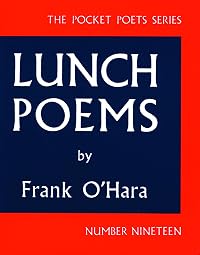
Lunch Poems
by Frank O'Hara
On This Page
Description
"Important poems by the late New York poet published in The New American Poetry, Evergreen Review, Floating Bear and stranger places. Often this poet, strolling through the noisy splintered glare of a Manhattan noon, has paused at a sample Olivetti to type up thirty or forty lines of ruminations, or pondering more deeply has withdrawn to a darkened ware- or firehouse to limn his computed misunderstandings of the eternal questions of life, coexistence, and depth, while never forgetting to eat show more lunch, his favorite meal."--Jacket. show lessTags
Recommendations







Member Recommendations
by anonymous user
Member Reviews
I've been meaning to read this book since falling in love with "Why I am Not a Painter" back when I took that Modern Poetry class. I slipped into my bag when I was heading out to take my twelve-year-old to the ACT -- and read most of it while sitting with the other parents of adolescents taking the test early -- and occasionally giggling, to the surprise of the other parents.
But the early poems are so well-crafted, so light and funny and accessible and easy. Making me wish I lived the kind of life that afforded me hour long lunch breaks on the streets of New York City. As the collection goes on, though, many of the poems are more and more opaque, and suddenly it was work to fight my way into them. Not that they wouldn't be worth the show more work, but it left me wishing that the entire collection was all "lunch poems."
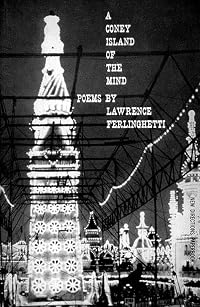
But as someone who has recently jumped into publishing, perhaps my favorite part of the book was the unexpected inclusion of the correspondence between O'Hara and his publisher, Lawrence Ferlinghetti, on the acceptance and formation of this work.
Now I need a copy of the collection with "Why I am Not a Painter." show less
But the early poems are so well-crafted, so light and funny and accessible and easy. Making me wish I lived the kind of life that afforded me hour long lunch breaks on the streets of New York City. As the collection goes on, though, many of the poems are more and more opaque, and suddenly it was work to fight my way into them. Not that they wouldn't be worth the show more work, but it left me wishing that the entire collection was all "lunch poems."
But as someone who has recently jumped into publishing, perhaps my favorite part of the book was the unexpected inclusion of the correspondence between O'Hara and his publisher, Lawrence Ferlinghetti, on the acceptance and formation of this work.
Now I need a copy of the collection with "Why I am Not a Painter." show less
My creative writing professor is a huge fan of this collection. I'm not quite as enthusiastic, but I still enjoyed it. There are some real gems where O'Hara's conversational, prosey style and unique imagery shine. A few of my favorites are "Cambridge," "The Day Lady Died," "St. Paul and All That," and "Galanta." The rest range from okay to good, but not great. It's not a long collection, by any means, but by the end I was a little tired of O'Hara's namedropping and constant allusions. A few references can really make a poem strong, but he uses so many that, 50 years later, the poems seem dated and a lot of the original meaning is lost. Plus it's annoying to have to Google every other word. An uneven collection.
I'm so damned literary
and at the same time the waters rushing past remind
me of nothing
I have to admit I was caught unprepared by the muscular images of these reveries. The questioning at the core appears against the grain of consumption and conformity. O'Hara isn't proclaiming a revolt but just asking questions. I admit to not knowing much of his biography, but the ideas being bandied about appear earnest, not that the liberation ethics of the more popular Beats were not.
I can’t even find a pond small enough
to drown in without being ostentatious
I told Joel that I didn't see Bukowski in these lines but rather a memory of Crane and Whitman. Perhaps I'm mistaken.
and at the same time the waters rushing past remind
me of nothing
I have to admit I was caught unprepared by the muscular images of these reveries. The questioning at the core appears against the grain of consumption and conformity. O'Hara isn't proclaiming a revolt but just asking questions. I admit to not knowing much of his biography, but the ideas being bandied about appear earnest, not that the liberation ethics of the more popular Beats were not.
I can’t even find a pond small enough
to drown in without being ostentatious
I told Joel that I didn't see Bukowski in these lines but rather a memory of Crane and Whitman. Perhaps I'm mistaken.
I was not familiar with the New York School of poets and so was pleased to win Frank O'Hara's Lunch Poems in a Goodreads Giveaway.
These poems were fun and conversational. They read like diary entries filled with lunch hour wanderings, travel experiences, and friends the author knows (one poem is dedicated to Allen Ginsberg). O’Hara’s style reminds me of Beat poetry in that it is free-verse and spontaneous, but with an added urban sensibility. There are several colorful descriptions of New York City as seen from the street, as in this poem Music :
Clasp me in your handkerchief like a tear, trumpet
of early afternoon! in the foggy autumn.
As they’re putting up the Christmas trees on Park Avenue
I shall see my daydreams walking by with show more dogs in blankets,
put to some use before all those coloured lights come on!
I sought to learn more about some references to the past that were beyond my understanding (Jean Dubuffet, Mary Desti, ‘St. Bridget’s steeple leaning a little to the left’). Sometimes this effort was futile, but other times it really helped to bring things into focus; for example in the sensual poem At Kamin’s Dance Bookshop about Fanny Elssler, who it turns out was a famous ballerina in 19th century Vienna (‘you were twining your left leg around your right as if your/ right were me’). Other poems are populated with familiar faces well-known to all, as in the following passage from Steps, that also showcases O'Hara's usual sense of humor and playfulness.
where’s Lana Turner
she’s out eating
and Garbo’s backstage at the Met
everyone’s taking their coat off
so they can show a rib-cage to the rib-watchers
and the park’s full of dancers and their tights and shoes
in little bags
who are often mistaken for worker-outers at the West Side Y
There was a sexual freedom in some poems that surprised me for 1953-1961, although I suppose this was accepted in avant garde circles of the time, as was O’Hara’s homosexuality of which he writes openly. Yet It was impossible not to catch a glimmer of the coming 1960s counterculture and its more liberal attitudes stirring within these poems.
The book closes with correspondence between O’Hara and Lawrence Ferlinghetti of City Lights Press discussing Lunch Poems, the typewritten postcards with spacing errors a welcome bit of nostalgia. They were a nice addition to the 50th anniversary printing of the book.
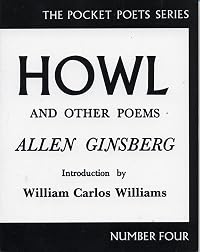
Lunch Poems is Number 19 of 60 in the City Lights Pocket Poet Series. Those interested in learning more about the rest of the series, as I am, can find them all in list form HERE. show less
These poems were fun and conversational. They read like diary entries filled with lunch hour wanderings, travel experiences, and friends the author knows (one poem is dedicated to Allen Ginsberg). O’Hara’s style reminds me of Beat poetry in that it is free-verse and spontaneous, but with an added urban sensibility. There are several colorful descriptions of New York City as seen from the street, as in this poem Music :
Clasp me in your handkerchief like a tear, trumpet
of early afternoon! in the foggy autumn.
As they’re putting up the Christmas trees on Park Avenue
I shall see my daydreams walking by with show more dogs in blankets,
put to some use before all those coloured lights come on!
I sought to learn more about some references to the past that were beyond my understanding (Jean Dubuffet, Mary Desti, ‘St. Bridget’s steeple leaning a little to the left’). Sometimes this effort was futile, but other times it really helped to bring things into focus; for example in the sensual poem At Kamin’s Dance Bookshop about Fanny Elssler, who it turns out was a famous ballerina in 19th century Vienna (‘you were twining your left leg around your right as if your/ right were me’). Other poems are populated with familiar faces well-known to all, as in the following passage from Steps, that also showcases O'Hara's usual sense of humor and playfulness.
where’s Lana Turner
she’s out eating
and Garbo’s backstage at the Met
everyone’s taking their coat off
so they can show a rib-cage to the rib-watchers
and the park’s full of dancers and their tights and shoes
in little bags
who are often mistaken for worker-outers at the West Side Y
There was a sexual freedom in some poems that surprised me for 1953-1961, although I suppose this was accepted in avant garde circles of the time, as was O’Hara’s homosexuality of which he writes openly. Yet It was impossible not to catch a glimmer of the coming 1960s counterculture and its more liberal attitudes stirring within these poems.
The book closes with correspondence between O’Hara and Lawrence Ferlinghetti of City Lights Press discussing Lunch Poems, the typewritten postcards with spacing errors a welcome bit of nostalgia. They were a nice addition to the 50th anniversary printing of the book.
Lunch Poems is Number 19 of 60 in the City Lights Pocket Poet Series. Those interested in learning more about the rest of the series, as I am, can find them all in list form HERE. show less
If only more of the poems had been like the best Lunch one, "Poem" on page 78 where "Lana Turner has Collapsed!"
This one has curiosity, insight inspiration, and is highly a lot of fun to read.
Most others are boring and self-indulgent, with the exception of these I enjoyed:
A STEP AWAY FROM THEM, CAMBRIDGE, PERSONAL POEM, Ave Maria,
and the upbeat tempo in SONG.
Nice quote = "Where does the evil go?"
This one has curiosity, insight inspiration, and is highly a lot of fun to read.
Most others are boring and self-indulgent, with the exception of these I enjoyed:
A STEP AWAY FROM THEM, CAMBRIDGE, PERSONAL POEM, Ave Maria,
and the upbeat tempo in SONG.
Nice quote = "Where does the evil go?"
PBS has a nice series featuring poets commenting on work from other poets, and Frank O'Hara is one of the best episodes. The episode focuses specifically on "Poem" but examines other work in this wonderful, if diminutive, book. O'Hara owes some to the beats, but is his own man - and he is quite similar to Billy Collins. He loves to infuse the work with the mundanities of every-day life, as well as, lots of cultural references. Pop this one in your pocket or a slot in your back-pack to pull out for a perspective shift when you have a few minutes in the day.
5 bones!!!!!
Highly recommended
5 bones!!!!!
Highly recommended
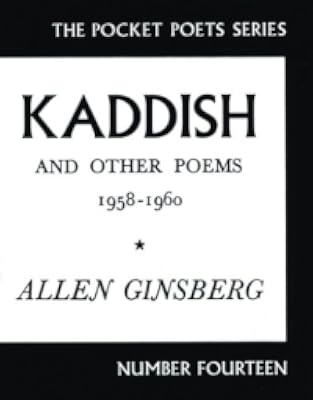
This is an interesting read particularly if you've read Ginsberg and enjoyed his work as you can see his influence in both language and form. It is more pedestrian though and reads, in a way, like a personal journal moreso than the desperatation that comes across in Ginsberg's work. You never get the feeling that O'Hara is driving his readers towards anything, and I admit I would have liked a bit more of that. There were some enjoyable images and moments though I probably won't return to the book as a whole.
Members
- Recently Added By
Lists

hopes
34 works; 1 member

Poetry volumes by single author
122 works; 8 members
Author Information

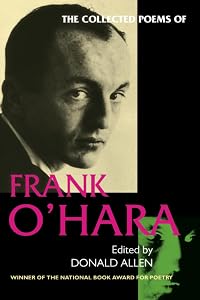
Frank O'Hara 1926-1966 Poet Frank O'Hara was born in Baltimore, MD and raised in Massachusetts. He served in the Navy and then studied at Harvard and the University of Michigan. From 1952 to 1966, O'Hara was on the staff at the Museum of Modern Art. He was a critic and a playwright and stayed active in the art scene. O'Hara published six books of show more poetry from 1952 until his death. Frank O'Hara died in 1966 when he was run down by a dune buggy on Fire Island. The Collected Poems of Frank O'Hara edited by Donald Allen (Knopf, 1971), the first of several posthumous collections, shared the 1972 National Book Award for Poetry. (Bowker Author Biography) show less
Awards and Honors
Notable Lists
Series
Belongs to Publisher Series
Common Knowledge
- Canonical title
- Lunch Poems
- Original publication date
- 1964
- First words
- If I rest for a moment near The Equestrian
pausing for a liver sausage in the Mayflower
Shoppe,
that angel seems to be leading the horse into
... (show all) Bergdorf's
and I am as naked as a table cloth, my nerves humming. - Last words
- (Click to show. Warning: May contain spoilers.)Just free, that's all, never argue with the movies.
Classifications
Statistics
- Members
- 1,166
- Popularity
- 21,592
- Reviews
- 12
- Rating
- (4.03)
- Languages
- English, German, Multiple languages, Spanish
- Media
- Paper, Audiobook
- ISBNs
- 7
- ASINs
- 10