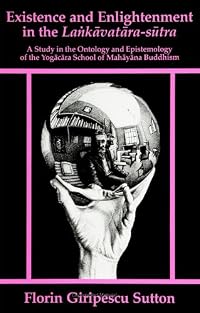
Existence and Enlightenment in the Lankavatara Sutra: A Study in the Ontology and Epistemology of the Yogacara School of Mahayana Buddhism
by Florin Giripescu Sutton
SUNY Series in Buddhist Studies
On This Page
Description
This book offers a systematic analysis of one of the most important concepts characterizing the Yogacara School of Buddhism (the last creative stage of Indian Buddhism) as outlined and explained in one of its most authoritative and influential texts, Lankavatara-sutra. Compiled in the second half of the fourth-century A.D., this sutra not only represents a comprehensive synthesis of both early and late religio-philosophical ideas crucial to the understanding of Buddhism in India, but it also show more provides an insight into the very early roots of the Japanese Zen Buddhism in the heart of the South Asian esotericism. The first part of the book outlines the three-fold nature of Being, as conceptualized in Buddhist metaphysics. The author uses an interpretive framework borrowed from the existentialist philosophy of Heidegger, in order to separate the transcendental Essence of Being from its Temporal manifestation as Self, and from its Spatial or Cosmic dimension. The second part clarifies the Buddhist approach to knowledge in its religious, transcendental sense and it shows that the Buddhists were actually first in making use of dialectical reasoning for the purpose of transcending the contradictory dualities imbedded in the common ways of perceiving, thinking, and arguing about reality. show lessTags
Recommendations














Member Reviews
This book offers a systematic analysis of one of the most important concepts characterizing the Yogacara School of Buddhism (the last creative stage of Indian Buddhism) as outlined and explained in one of its most authoritative and influential texts, Lankavatara-sutra. Compiled in the second half of the fourth-century A.D., this sutra not only represents a comprehensive synthesis of both early and late religio-philosophical ideas crucial to the understanding of Buddhism in India, but it also provides an insight into the very early roots of the Japanese Zen Buddhism in the heart of the South Asian esotericism.
The first part of the book outlines the three-fold nature of Being, as conceptualized in Buddhist metaphysics. The author uses an show more interpretive framework borrowed from the existentialist philosophy of Heidegger, in order to separate the transcendental Essence of Being from its Temporal manifestation as Self, and from its Spatial or Cosmic dimension. The second part clarifies the Buddhist approach to knowledge in its religious, transcendental sense and it shows that the Buddhists were actually first in making use of dialectical reasoning for the purpose of transcending the contradictory dualities imbedded in the common ways of perceiving, thinking, and arguing about reality. show less
The first part of the book outlines the three-fold nature of Being, as conceptualized in Buddhist metaphysics. The author uses an show more interpretive framework borrowed from the existentialist philosophy of Heidegger, in order to separate the transcendental Essence of Being from its Temporal manifestation as Self, and from its Spatial or Cosmic dimension. The second part clarifies the Buddhist approach to knowledge in its religious, transcendental sense and it shows that the Buddhists were actually first in making use of dialectical reasoning for the purpose of transcending the contradictory dualities imbedded in the common ways of perceiving, thinking, and arguing about reality. show less
Members
- Recently Added By
Author Information
1 Work 25 Members
Series

Common Knowledge
- Canonical title
- Existence and Enlightenment in the Lankavatara Sutra: A Study in the Ontology and Epistemology of the Yogacara School of Mahayana Buddhism
Classifications
- Genres
- Nonfiction, Religion & Spirituality, Philosophy
- DDC/MDS
- 181.043 — Philosophy and Psychology Ancient, medieval & eastern philosophy Eastern philosophy -- Religions of Indic Origin Buddhism
- LCC
- BQ1727 .S86 — Philosophy, Psychology and Religion Buddhism Buddhism Tripit.aka (Canonical literature)
- BISAC
Statistics
- Members
- 25
- Popularity
- 1,069,723
- Reviews
- 1
- Languages
- English
- Media
- Paper, Ebook
- ISBNs
- 4