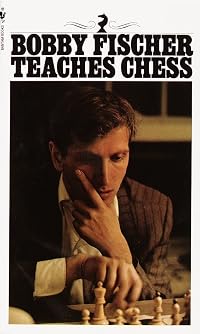
Bobby Fischer Teaches Chess
by Bobby Fischer, Stuart Margulies (Author), Donn Mosenfelder (Author)
On This Page
Description
Teaches common mating positions and combinations, conventional moves and principles to apply when playing chess.Tags
Recommendations






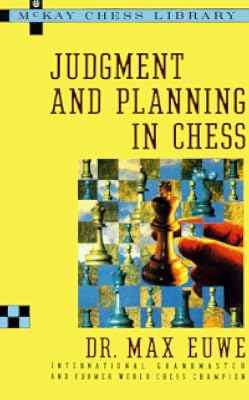

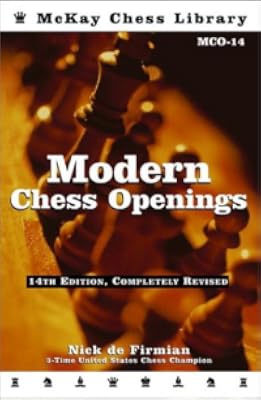
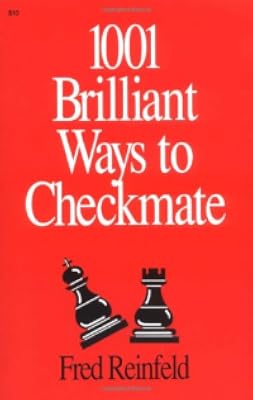
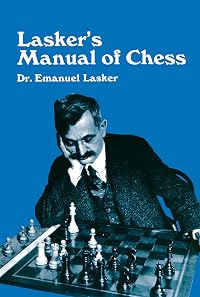


Member Reviews
I assume this publication was hastily published to rake in on the Fischer hype. It starts off by praising a back then novel [really?] technique called programmed instruction, with which they expect to make up for the lack of content. From the title one certainly expects some theory, alas, it comes down to a collection of easy chess puzzles. Although I enjoyed them, a mere collection does not make a book.
I'd only recommend this book to beginners, after they've read [b:Pandolfini's Ultimate Guide to Chess|360163|Pandolfini's Ultimate Guide to Chess|Bruce Pandolfini|https://images.gr-assets.com/books/1388623005s/360163.jpg|350279]. A guide that actually teaches, and can be called a book.
I'd only recommend this book to beginners, after they've read [b:Pandolfini's Ultimate Guide to Chess|360163|Pandolfini's Ultimate Guide to Chess|Bruce Pandolfini|https://images.gr-assets.com/books/1388623005s/360163.jpg|350279]. A guide that actually teaches, and can be called a book.
An interesting format that keeps you flipping back and forth to understand the explanations. Still in print after 55 years? Something must be working and useful for this book. I learned some new ways to look at checkmate and defense.
Let us be first aware that Bobby Fischer did not write this book. He allowed for the use of his name. The authors are Stuart Margulies and Donn Mosenfelder, both of Educational Design, Inc.
You will not need your pocket set for this book, only a pencil. Each page contains a diagram in which you are asked to find the best move, show the first move in a combination, et cetera. I hated to write in a book, but went ahead with it anyway, as the alternative would be overly complicated.
The entire book concentrates on Endgame alone. The first half of the book I breezed through in about a half hour--very simple problems. When you are finished you turn the book upside down and begin from the back of the last page, which is now the front of the show more 1st page, 2nd half... These take quite a bit more thought.
I liked the fact that you must visualize the moves, as you would in an actual game. This takes some practice. I learned some new chess lingo here: Interposition, Displacing, Driving away... I know that I will indeed be better at mating--something I very much needed a firmer grasp of.
It is true that there are much better books on Endgame out there, and that this book is even at first misrepresenting of itself. Bobby Fischer does manage to write a couple of sentences (and I mean 2). Also, in the introduction the two authors introduce themselves and explain their learning technique, which may not be groundbreaking, but is novel. I enjoyed picking up the book and a pencil and working problems at my leisure without the need of my pocket set. However, I am now ready to trade in my pencil for it back after this unique experience in chess reading.
By the way, I kept an honest record of problems that I got wrong--39 out of 300-something. A testament to the book's overall novice level. show less
You will not need your pocket set for this book, only a pencil. Each page contains a diagram in which you are asked to find the best move, show the first move in a combination, et cetera. I hated to write in a book, but went ahead with it anyway, as the alternative would be overly complicated.
The entire book concentrates on Endgame alone. The first half of the book I breezed through in about a half hour--very simple problems. When you are finished you turn the book upside down and begin from the back of the last page, which is now the front of the show more 1st page, 2nd half... These take quite a bit more thought.
I liked the fact that you must visualize the moves, as you would in an actual game. This takes some practice. I learned some new chess lingo here: Interposition, Displacing, Driving away... I know that I will indeed be better at mating--something I very much needed a firmer grasp of.
It is true that there are much better books on Endgame out there, and that this book is even at first misrepresenting of itself. Bobby Fischer does manage to write a couple of sentences (and I mean 2). Also, in the introduction the two authors introduce themselves and explain their learning technique, which may not be groundbreaking, but is novel. I enjoyed picking up the book and a pencil and working problems at my leisure without the need of my pocket set. However, I am now ready to trade in my pencil for it back after this unique experience in chess reading.
By the way, I kept an honest record of problems that I got wrong--39 out of 300-something. A testament to the book's overall novice level. show less
I had this as a kid and it was good for me. I didn't really have a teacher or coach. My dad taught me how to play and would play with me sometimes. So this book suited me at that time. On the other hand I don't really understand the obsession with this book because it is not really a great book in terms of chess instruction. The method of instruction is nice but the content as I remember it, and have read others describing it, is lacking.
If you're a novice, this is a good place to start. But you have to DO the puzzles, not just read about it. You have to do it.
Quite good practice on end-games of increasing complication. 275 exercises!
Great strategy primer on chess. If you are a seasoned player or beginner you have to read this book on chess.
Members
- Recently Added By
Author Information

76+ Works 2,477 Members
Some Editions
Series
Belongs to Publisher Series
rororo sachbuch (6870)
Common Knowledge
- Canonical title*
- Bobby Fischer lär dig schack
- Original title
- Bobby Fischer teaches chess
- Original publication date
- 1966-01
*Some information comes from Common Knowledge in other languages. Click "Edit" for more information.
Classifications
- Genres
- Nonfiction, General Nonfiction
- DDC/MDS
- 794.12077 — Arts & recreation Recreation, sports, and performing arts Indoor games of skill Chess Theory and instruction
- LCC
- GV1447 .F5 — Geography, Anthropology and Recreation Recreation. Leisure Recreation. Leisure Games and amusements Indoor games and amusements Board games. Move games
- BISAC
Statistics
- Members
- 1,631
- Popularity
- 13,908
- Reviews
- 14
- Rating
- (3.80)
- Languages
- 11 — Catalan, Dutch, English, Finnish, German, Hebrew, Italian, Norwegian (Bokmål), Spanish, Swedish, Turkish
- Media
- Paper
- ISBNs
- 28
- UPCs
- 1
- ASINs
- 24
