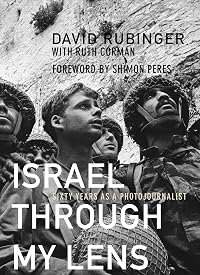
Israel Through My Lens: Sixty Years As a Photojournalist
by Daṿid Rubinger
On This Page
Description
Today, photojournalist David Rubinger stands at the peak of his profession: a winner of the Israel Prize for services to the media and a fixture on the masthead of Time, he is the only photographer whose work is on permanent display at the Knesset, Israel's legislature. In this fascinating volume, he reports his own story, which in many ways reflects the history of Israel that he has recorded so faithfully with his camera. Born in Vienna in 1924, he emigrated to British Palestine in 1939 and show more developed a passion for photography while serving in the British army's Jewish Brigade. After fighting in Israel's War of Independence, he became a professional news photographer, reporting on each of his young nation's subsequent wars from the front lines, at first for the Israeli media and later as a correspondent for Time-Life. He photographed all of Israel's leaders, many of whom have allowed him a remarkable degree of access to their lives; Ariel Sharon said, "I trust Rubinger even though I know he doesn't vote for me." But Rubinger has not confined his reporting to war and politics; by photographing the successive waves of Jewish immigrants from Europe, the Arab world, Russia, and Ethiopia, he has also created a valuable record of Israel's transformation from a country of six hundred thousand to one of seven million. show lessTags
Recommendations



























Member Recommendations

Member Reviews
The Promised Land was truly that for David Rubinger as he tells his life story through pictures, descriptions of his travels, and unfolds the modern history of Israel. He is a photographer exemplar who seems to have saved every image he has taken since getting his first camera.
Born in Vienna Austria in 1924 he grew up steeped in family tradition which developed strong Jewish ties to Palestine (Israel). He moved to a Kibbutz along with many others in his Austrian community where they sought refuge from the onslaught of the Nazis in 1939. His father was able to move to London, but was unable to extricate his mother from the clutches of the holocaust in which she perished in a concentration camp in 1942.
David returned to Europe, fighting show more in the war with the British Army, in the Jewish Brigade, and as with the rest of his life brought honor to his family through action and deed. In 1945, he was stationed in Belgium and received a gift from a girl friend upon his departure, an Argus 35 mm camera, his first! Subsequently, he was able to purchase a Leica camera in trade for cigarettes and thus began his career as a photographer.
His photographs were of the highest quality as demonstrated by the images in his book.
Even Rubinger’ s first attempts at portraying scenes of ordinary life at a German railway station with his Leica in 1946 showed extreme promise for this neophyte photographer. Through the years he chronicled the state of Israel after its creation by the United Nations.
Becoming a Life photographer opened vistas for him to become recognized by his peers in the reporting world. Also, it provided him with a living with which to raise his family. He gained a reputation of being at the right place at the right time and took some of the most extraordinary photos of statesmen, battle scenes, and humorous scenes showing war trophies on display.
Although the book is autobiographical in nature, it is much more, a descriptive scenario of the modern history of Israel through the eyes of Rubinger’s camera and his own. A wonderful book which captivates the reader from start to finish and makes you want to see more of the terrific images which he has taken. A remarkable story of a remarkable man in his 80’s who continues to capture life around him. show less
Born in Vienna Austria in 1924 he grew up steeped in family tradition which developed strong Jewish ties to Palestine (Israel). He moved to a Kibbutz along with many others in his Austrian community where they sought refuge from the onslaught of the Nazis in 1939. His father was able to move to London, but was unable to extricate his mother from the clutches of the holocaust in which she perished in a concentration camp in 1942.
David returned to Europe, fighting show more in the war with the British Army, in the Jewish Brigade, and as with the rest of his life brought honor to his family through action and deed. In 1945, he was stationed in Belgium and received a gift from a girl friend upon his departure, an Argus 35 mm camera, his first! Subsequently, he was able to purchase a Leica camera in trade for cigarettes and thus began his career as a photographer.
His photographs were of the highest quality as demonstrated by the images in his book.
Even Rubinger’ s first attempts at portraying scenes of ordinary life at a German railway station with his Leica in 1946 showed extreme promise for this neophyte photographer. Through the years he chronicled the state of Israel after its creation by the United Nations.
Becoming a Life photographer opened vistas for him to become recognized by his peers in the reporting world. Also, it provided him with a living with which to raise his family. He gained a reputation of being at the right place at the right time and took some of the most extraordinary photos of statesmen, battle scenes, and humorous scenes showing war trophies on display.
Although the book is autobiographical in nature, it is much more, a descriptive scenario of the modern history of Israel through the eyes of Rubinger’s camera and his own. A wonderful book which captivates the reader from start to finish and makes you want to see more of the terrific images which he has taken. A remarkable story of a remarkable man in his 80’s who continues to capture life around him. show less
Great insight and terrific photos of Rubinger's life's work. The man is an inspiration.
Ratings
Members
- Recently Added By
Lists

Best Israeli Reading
55 works; 12 members
Author Information

5+ Works 45 Members
David Rubinger was born in Vienna, Austria on June 29, 1924. In 1939, he was chosen under a youth quota system to immigrate to what was then British-controlled Palestine, where he joined a kibbutz. At the age of 18, he enlisted in the British Army. During World War II, he served in North Africa and Europe and helped smuggle Jews to Palestine. He show more became a photographer whose photos chronicled the birth of the modern state of Israel. After freelancing and working for local Israeli publications, he got his break as an international photographer in the 1950s, when he was asked to take photos for an article that was published in Life magazine. Later, he took photos primarily for Time, an association that lasted more than 50 years. In 1997, he was awarded the Israel Prize, his country's highest honor. His autobiography, Israel Through My Lens written with Ruth Corman, was published in 2007. He died on March 2, 2017 at the age of 92. (Bowker Author Biography) show less
All Editions
Common Knowledge
- Canonical title
- Israel Through My Lens: Sixty Years As a Photojournalist
- Original publication date
- 2007
- People/Characters
- David Rubinger
- Important places
- Israel
- Blurbers
- Kelly, Jim; Temko, Ned
- Original language
- English
Classifications
Statistics
- Members
- 33
- Popularity
- 838,084
- Reviews
- 2
- Rating
- (4.00)
- Languages
- English
- Media
- Paper
- ISBNs
- 1
- ASINs
- 1