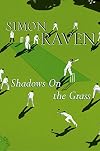
Shadows on the Grass
by Simon Raven
On This Page
Description
Simon Raven's wonderfully funny cricketing memoir covers a golden age from the early 1930s to the 1950s. With his unerring eye for observation, Raven hilariously recounts matches played at Charterhouse, Cambridge and cricket grounds as far afield as Bangalore, Kenya and Corfu. The autobiography is peopled with the author's famous and infamous friends and partners in crime and littered with memorable anecdotes.Tags
Recommendations





















Member Reviews
If you have ever been puzzled by the English expression "it's not cricket...", this book will do much to increase that confusion. All the anecdotes Raven includes in this memoir are based around cricket games of one sort or another, and they all, without exception, reveal the author and the English upper classes behaving in the worst possible way: Petty revenge, public urination, various odd sexual activities, excessive eating and drinking, the defrauding of shopkeepers and bookmakers, and all manner of bad sportsmanship.
Raven's masochistic streak ensures that he himself is shown in a worse light than anybody else, but there's also a certain pleasure in reading about the misdemeanours of associates of Raven's who had become pillars of show more English society by the time the book appeared (a Tory cabinet minister, the editor of the Times, various Oxbridge dons...). Those who are described as acting in ways that are actually criminal appear under pseudonyms, of course, and we don't have to believe all the stories (in some cases, it's clear from Barber's biography that Raven changed the facts quite significantly). Obviously Raven (or his publisher) knew exactly how far he could go without ending up in court.
Candid though Raven seems to be here, there is one silence which becomes very conspicuous when we compare his account with Barber's. There is not a single mention of his marriage. This is perhaps a laudable wish not to cause his ex-wife and son more distress, but it does require him to massage the facts quite considerably at a couple of points, notably when he explains his reasons for being forced to resign his army commission.
I tend to take the view that reading about ball games is almost as tedious as watching them, but I have to admit that Raven, writing about cricket, is still enjoyable. Even if you don't follow all the technicalities, there's a real pleasure in his use of the arcane terminology of the game, and most of the time it's perfectly clear how everything fits into the narrative.
As usual with Raven, you don't have to agree with his (real or assumed) attitudes to enjoy this book. You may think him the most awful bounder, or an unpleasantly unrepentant advocate of elitism and privilege, but it's his fluent writing and effortless storytelling ability that draws you in and allows you to find so much to laugh at in the nastiness of human nature.
In the end, though, I just had to drool at the thought of the dinner-party Raven describes in the penultimate chapter: the host was E.M. Forster, and the other guests beside Raven were Joe Ackerley and Christopher Isherwood. I think that might almost have been worth travelling to Cambridge for... show less
Raven's masochistic streak ensures that he himself is shown in a worse light than anybody else, but there's also a certain pleasure in reading about the misdemeanours of associates of Raven's who had become pillars of show more English society by the time the book appeared (a Tory cabinet minister, the editor of the Times, various Oxbridge dons...). Those who are described as acting in ways that are actually criminal appear under pseudonyms, of course, and we don't have to believe all the stories (in some cases, it's clear from Barber's biography that Raven changed the facts quite significantly). Obviously Raven (or his publisher) knew exactly how far he could go without ending up in court.
Candid though Raven seems to be here, there is one silence which becomes very conspicuous when we compare his account with Barber's. There is not a single mention of his marriage. This is perhaps a laudable wish not to cause his ex-wife and son more distress, but it does require him to massage the facts quite considerably at a couple of points, notably when he explains his reasons for being forced to resign his army commission.
I tend to take the view that reading about ball games is almost as tedious as watching them, but I have to admit that Raven, writing about cricket, is still enjoyable. Even if you don't follow all the technicalities, there's a real pleasure in his use of the arcane terminology of the game, and most of the time it's perfectly clear how everything fits into the narrative.
As usual with Raven, you don't have to agree with his (real or assumed) attitudes to enjoy this book. You may think him the most awful bounder, or an unpleasantly unrepentant advocate of elitism and privilege, but it's his fluent writing and effortless storytelling ability that draws you in and allows you to find so much to laugh at in the nastiness of human nature.
In the end, though, I just had to drool at the thought of the dinner-party Raven describes in the penultimate chapter: the host was E.M. Forster, and the other guests beside Raven were Joe Ackerley and Christopher Isherwood. I think that might almost have been worth travelling to Cambridge for... show less
Ratings
Members
- Recently Added By
Lists

Lesser known books of well known authors
39 works; 17 members
Author Information

51+ Works 1,788 Members
Simon Arthur Noel Raven, December 28, 1927 - May 19, 2001. Simon Raven was born in London on December 28, 1927. His father was independently wealthy from Raven's grandfathers death and his mother was a cross country runner who was once the second fastest woman in England. Raven attended Charterhouse, an exclusive private school which he was show more expelled from for homosexual activities. He spent some time in the army before heading off to Cambridge where his obvious intelligence was rewarded with a research scholarship to study the influence of the classics on Victorian schools. Eventually the scholarship money ran out, causing Raven to re-enlist in the army, where he served in Germany and Kenya. During his tour, Raven racked up serious gambling debts and the army eventually allowed him to resign rather than face court martial. In 1963, Raven told a publisher about his idea for his famous "Oblivion" series and signed a deal for 5,000 pounds for the entire collection. Raven also dramatized novels and plays for television and constantly chased after money. Raven wrote 36 novels in the satirical style, usually about homosexuality in upperclass English society. He died May 19, 2001 at a London hospital, the cause was unknown. He was 73. show less
Common Knowledge
- Original publication date
- 1982
- People/Characters
- Simon Raven; Jim Prior; William Rees-Mogg; Noël Annan
- Important places
- Charterhouse School, Godalming, Surrey, England, UK; King's College, University of Cambridge, Cambridge, Cambridgeshire, UK; Bangalore, Karnataka, India
Classifications
- Genres
- Nonfiction, Biography & Memoir, Sports and Leisure
- DDC/MDS
- 796.35 — Arts & recreation Recreation, sports, and performing arts Sports Ball sports Ball and stick sports
- LCC
- GV915 .R38 .A37 — Geography, Anthropology and Recreation Recreation. Leisure Recreation. Leisure Sports Ball games: Baseball, football, golf, etc.
- BISAC
Statistics
- Members
- 43
- Popularity
- 685,643
- Reviews
- 1
- Rating
- (3.69)
- Languages
- English
- Media
- Paper, Ebook
- ISBNs
- 4
- ASINs
- 2