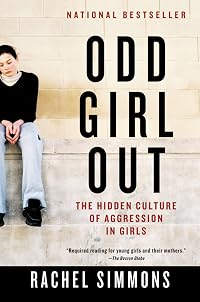
Odd Girl Out: The Hidden Culture of Aggression in Girls
by Rachel Simmons
On This Page
Description
There is little sugar but lots of spice in journalist Rachel Simmons's brave and brilliant book that skewers the stereotype of girls as the kinder, gentler gender. Odd Girl Out begins with the premise that girls are socialized to be sweet with a double bind: they must value friendships; but they must not express the anger that might destroy them. Lacking cultural permission to acknowledge conflict, girls develop what Simmons calls "a hidden culture of silent and indirect aggression." The show more author, who visited 30 schools and talked to 300 girls, catalogues chilling and heartbreaking acts of aggression, including the silent treatment, note-passing, glaring, gossiping, ganging up, fashion police, and being nice in private/mean in public. She decodes the vocabulary of these sneak attacks, explaining, for example, three ways to parse the meaning of "I'm fat." --- Amazon. When Odd girl out was first published, it ignit[ed] a long-overdue conversation about the hidden culture of female bullying. Today, the dirty looks, taunting notes, and social exclusion that plague girls' friendships have gained new momentum in cyberspace. Simmons gives girls, parents, and educators strategies for navigating social dynamics online, as well as classroom initiatives and step-by-step parental suggestions for dealing with conventional bullying.--p. [4] of cover. show lessTags
Recommendations
























Member Reviews
My 10-year-old daughter and I were in the library a few weeks ago picking up some holds for her when she saw this and asked to borrow it. Normally, adult non-fiction is not her thing, but she's had bullying problems at school these last two years, and I thought I would let her try it.
She finished it in 24 hours and loved it. "It makes me feel less alone," she said. "I'm not the only one going through this."
So, of course, I had to read it too.
And I ended up crying on the GO train going into Toronto (on a car full of Carabana revellers, no less). It's absolutely harrowing, for either those of us who remember this from our own girlhoods, or those of us watching it in the girlhoods of our daughters. Or, if you're like me, both. My god, show more girls can be vicious to each other. And the fact that they're being vicious to each other in this way because of the cultural expectations of Good Girls does not make it hurt any less.
Simmons does a good job of discussing all the ways and means of girl bullying and aggression, how it works and why it works the way it does. She has minimal advice for parents on how to deal with it, although the advice she does have is probably as complete as you can get; the fact is, there is not much parents can do from home about things that go on at school, and the most important thing is for the school and the kids' teachers to get it and act.
If you've ever dealt with a situation like this, you know that usually doesn't happen, even though this book came out over a decade ago and there's been tons of discussion on this issue ever since.
I feel at least better equipped to understand not only what she's experiencing, but also how best to listen and react to what she tells me so that she knows I understand and support her. I'd recommend it to other parents for that, if nothing else. show less
She finished it in 24 hours and loved it. "It makes me feel less alone," she said. "I'm not the only one going through this."
So, of course, I had to read it too.
And I ended up crying on the GO train going into Toronto (on a car full of Carabana revellers, no less). It's absolutely harrowing, for either those of us who remember this from our own girlhoods, or those of us watching it in the girlhoods of our daughters. Or, if you're like me, both. My god, show more girls can be vicious to each other. And the fact that they're being vicious to each other in this way because of the cultural expectations of Good Girls does not make it hurt any less.
Simmons does a good job of discussing all the ways and means of girl bullying and aggression, how it works and why it works the way it does. She has minimal advice for parents on how to deal with it, although the advice she does have is probably as complete as you can get; the fact is, there is not much parents can do from home about things that go on at school, and the most important thing is for the school and the kids' teachers to get it and act.
If you've ever dealt with a situation like this, you know that usually doesn't happen, even though this book came out over a decade ago and there's been tons of discussion on this issue ever since.
I feel at least better equipped to understand not only what she's experiencing, but also how best to listen and react to what she tells me so that she knows I understand and support her. I'd recommend it to other parents for that, if nothing else. show less
If you were Queen Bee on the playground, head cheerleader with all the right friends or simply the most popular girl in your class, this book is for you. If girls on power trips manipulated you through fear - or isolated you because you would not be manipulated - this book is for you. If your girlhood memories are tainted by secretly (or openly) abusive female "friends," this book is for you. If you're a parent raising a daughter, this book is for you.
Although I did not experience the depth of pain described by some in Rachel Simmon's book, old hurts resurfaced, including those that affect my friendships with women even today. And, I am grateful for the opportunity to take a hard look at them. The author goes beyond "girls can be mean" show more to give us language that describes bullying, girl-style. By helping us define what it is, she also empowers us to address these alternative aggressions and effect change among schools, parents and our own, often vulnerable children. show less
Although I did not experience the depth of pain described by some in Rachel Simmon's book, old hurts resurfaced, including those that affect my friendships with women even today. And, I am grateful for the opportunity to take a hard look at them. The author goes beyond "girls can be mean" show more to give us language that describes bullying, girl-style. By helping us define what it is, she also empowers us to address these alternative aggressions and effect change among schools, parents and our own, often vulnerable children. show less
The newly revised and updated edition of Odd Girl Out is a must have for every person who is parenting or educating a girl.
This was the first book I grabbed once my fall classes were over. Why? I think it's because I have a daughter. She's eight and in the 3rd grade and we've already had two incidents involving bullying. The first was in preschool and the second was last year. Both incidents were handled by teachers are administrators in a manner that Simmons suggests in Chapter 12: the road ahead for teachers and administrators. That chapter gives some wonderful suggestions on how to set up a school or even a classroom to be as bully-proof as possible. Obviously no place can be bully-proof, but one thing that Simmons points out is that show more one way to address bullying is to have a transparent and predictable system of consequences. If a student knows that Sally and Maria are the teacher's favorite and nothing they do gets them in real trouble, that student feels disempowered to act and report bullying she may be experiencing or witnessing. Having a consistent system of consequences also sends a clear message to students who bully that it will not be tolerated.
Simmons doesn't advocate for a zero-tolerance policy that gets 7-year-olds expelled, rather a zero-tolerance policy that is just that, zero-tolerance for bullying a classmate.
Three themes really struck me as key things to remember from this book.
One is that schools have relied on girls to maintain a certain peace for years.
And second is that this peace that we see in girls is really silence. Society teaches girls to silence their feelings in order to "be good."
Bullying is not just how girls are. Not if we decide that it ends today. HERE. NOW. When we teach our girls to get over it, that "that's how life is, wait until your boss is a bully," we are teaching our girls to ignore that voice in their head and heart that says, "This is wrong. Walk away."
The last theme is one that a friend and I were discussing a few weeks ago. Why are women afraid to promote themselves? I know that I can look back at my childhood and know that being "all that" was frowned upon. Pride in one's work could only be taken so far. Simmons really digs into how promoting oneself breaks one of the cardinal rules of being a girl -- fit in. You can't fit in if you let people know how awesome you are.
Simmons updated her book to include a great chapter on cyberbullying. If you don't have time to read the whole book, skip right to chapter four: bff 2.0: cyberbullying and cyberdrama and chapter nine: parents speak. But you really should read the whole thing.
Warning women reading this will experience flashbacks to high school. Men who read this may have a lot of WTF moments
Read the full review at my blog, Viva la Feminista. show less
This was the first book I grabbed once my fall classes were over. Why? I think it's because I have a daughter. She's eight and in the 3rd grade and we've already had two incidents involving bullying. The first was in preschool and the second was last year. Both incidents were handled by teachers are administrators in a manner that Simmons suggests in Chapter 12: the road ahead for teachers and administrators. That chapter gives some wonderful suggestions on how to set up a school or even a classroom to be as bully-proof as possible. Obviously no place can be bully-proof, but one thing that Simmons points out is that show more one way to address bullying is to have a transparent and predictable system of consequences. If a student knows that Sally and Maria are the teacher's favorite and nothing they do gets them in real trouble, that student feels disempowered to act and report bullying she may be experiencing or witnessing. Having a consistent system of consequences also sends a clear message to students who bully that it will not be tolerated.
Simmons doesn't advocate for a zero-tolerance policy that gets 7-year-olds expelled, rather a zero-tolerance policy that is just that, zero-tolerance for bullying a classmate.
Three themes really struck me as key things to remember from this book.
One is that schools have relied on girls to maintain a certain peace for years.
And second is that this peace that we see in girls is really silence. Society teaches girls to silence their feelings in order to "be good."
Bullying is not just how girls are. Not if we decide that it ends today. HERE. NOW. When we teach our girls to get over it, that "that's how life is, wait until your boss is a bully," we are teaching our girls to ignore that voice in their head and heart that says, "This is wrong. Walk away."
The last theme is one that a friend and I were discussing a few weeks ago. Why are women afraid to promote themselves? I know that I can look back at my childhood and know that being "all that" was frowned upon. Pride in one's work could only be taken so far. Simmons really digs into how promoting oneself breaks one of the cardinal rules of being a girl -- fit in. You can't fit in if you let people know how awesome you are.
Simmons updated her book to include a great chapter on cyberbullying. If you don't have time to read the whole book, skip right to chapter four: bff 2.0: cyberbullying and cyberdrama and chapter nine: parents speak. But you really should read the whole thing.
Warning women reading this will experience flashbacks to high school. Men who read this may have a lot of WTF moments
Read the full review at my blog, Viva la Feminista. show less
I read the first edition of Odd Girl Out about five years ago when my oldest daughter was in grade 4/5 and there were some real problems regarding bullying and power struggles amongst the girls in her year. While my daughter was not a direct target, nor a bully, it was a stressful time for her as two girls in particular aggressively manipulated the social hierarchy, girls switched alliances almost daily and the school seemed at a complete loss at how to deal with it. To help my daughter cope with the upheaval I read a number of books on the subject including Reviving Ophelia: Saving the Selves of Adolescent Girls and Queen Bees and Wannabes: Helping Your Daughter Survive Cliques, Gossip, Boyfriends, and Other Realities of Adolescence, show more both of which I also would recommend to parents and educators of girls.
I chose to read this revised edition because my oldest daughter is now fifteen and as an avid (ie constant) user of Facebook, MSN and various online social communities. Additionally my youngest daughter is now eight and an awareness of online social communities is beginning to creep into her consciousness. As such I was particularly interested in Simmons inclusion of the dynamics of cyber-bullying and how I might be able to help my daughters navigate this social arena.
The strength of Odd Girl Out is that it illustrates the experience of female bullying in a personal manner, with girls sharing their circumstances in their own words. I, like most women, recognised many of the methods girls use to control their social world. With hindsight, the daily drama of school seem mostly petty and irrelevant but I do still remember the intensity of the emotion that surrounded playground machinations – the agony of being dumped by a best friend, the desire to be popular, and like most I have been both a victim and perpetrator (though largely an unwitting one)of the type of bullying and aggression Simmons examines. Odd Girl Out is a reminder of the seriousness with which girls interact with their peers.
The new chapter that addresses cyber bullying/drama is interesting and I think is full of useful information, especially for parents who are not familiar with technology. I am a net-savvy parent who uses social media and have discussed the issues with my daughter but I know she doesn’t see the consequences of a casual status update or online flirting the same way as I do, which is highlighted by the stories shared in this chapter. Later on in the book, Simmons discusses strategies for managing media in the lives of girls in practical ways, this chapter is particularly useful and as I am trying to walk the line between keeping an eye on my teenager’s online activities without invading her social privacy too much, I found it informative and encouraging.
The focus of Odd Girl Out tends to be on girls aged 11-13 and in particular those whose experiences are at the extremes of the issue but nevertheless I think it has relevance for those involved in any setting where girls aged 8 to 16 interact. Simmons grounds the research, giving the experiences of young girls, and the lasting effects, credibility and for a parent (or educator) I think it can provide a vocabulary for discussion and investigation. show less
I chose to read this revised edition because my oldest daughter is now fifteen and as an avid (ie constant) user of Facebook, MSN and various online social communities. Additionally my youngest daughter is now eight and an awareness of online social communities is beginning to creep into her consciousness. As such I was particularly interested in Simmons inclusion of the dynamics of cyber-bullying and how I might be able to help my daughters navigate this social arena.
The strength of Odd Girl Out is that it illustrates the experience of female bullying in a personal manner, with girls sharing their circumstances in their own words. I, like most women, recognised many of the methods girls use to control their social world. With hindsight, the daily drama of school seem mostly petty and irrelevant but I do still remember the intensity of the emotion that surrounded playground machinations – the agony of being dumped by a best friend, the desire to be popular, and like most I have been both a victim and perpetrator (though largely an unwitting one)of the type of bullying and aggression Simmons examines. Odd Girl Out is a reminder of the seriousness with which girls interact with their peers.
The new chapter that addresses cyber bullying/drama is interesting and I think is full of useful information, especially for parents who are not familiar with technology. I am a net-savvy parent who uses social media and have discussed the issues with my daughter but I know she doesn’t see the consequences of a casual status update or online flirting the same way as I do, which is highlighted by the stories shared in this chapter. Later on in the book, Simmons discusses strategies for managing media in the lives of girls in practical ways, this chapter is particularly useful and as I am trying to walk the line between keeping an eye on my teenager’s online activities without invading her social privacy too much, I found it informative and encouraging.
The focus of Odd Girl Out tends to be on girls aged 11-13 and in particular those whose experiences are at the extremes of the issue but nevertheless I think it has relevance for those involved in any setting where girls aged 8 to 16 interact. Simmons grounds the research, giving the experiences of young girls, and the lasting effects, credibility and for a parent (or educator) I think it can provide a vocabulary for discussion and investigation. show less
Rachel Simmons says that, "There is a hidden culture of girls' aggression in which bullying is epidemic, distinctive, and destructive." Adolescent female culture consists of manipulation, treachery, and strained niceties, which she calls “alternative aggressions.” To research and interview girls about bullying in Odd Girl Out, Simmons spent over three years in a total of 10 different schools. The schools were in two urban areas and a small town. She interviewed more than 300 girls and 50 women. Many of the interviews consisted of discussion groups with girls in schools.
Simmons offers a detailed portrait of how "alternative aggression" is used by girls as a weapon to control and bully other girls and the damage it inflicts on the show more victims self esteem. Simmons feels that societal restraints on girls expressing negative feelings or anger helps perpetuate the vicious cycle of bullying. Simmons writes, "it forces their aggression into nonphysical, indirect, and covert forms. Girls use backbiting, exclusion, rumors, name-calling, and manipulation to inflict psychological pain on target victims."
With many examples of the pain and isolation bullying causes, Simmons makes an impassioned plea that no form of bullying be permitted. She has one chapter discussing better ways to respond to a girl being bullied and open up communication between parent and child. Odd Girl Out includes chapter notes, an extensive bibliography, and an index.
While I found Odd Girl Out extremely interesting, I also noted several weaknesses. The most obvious weakness is in the lack of professional data. Simmons uses the stories/interviews of girls to support her conclusions, but these stories are merely narratives, not hard data. The other major weakness is the lack of any course of action and specific responses that need to be taken. Since it was originally published in 2002, I would hope that a more detailed course of action has been researched and is being implemented.
Although the many stories and interviews of victims and bullies might be helpful for those who need to feel they are not alone, I did become a bit weary of all the stories of victims. Just take note that all the interviews might not be for everyone. And if you are a teacher, you might feel Simmons is simplifying the dynamics of the school setting and unfairly targeting you as ineffective.
Additionally, Simmons herself noted another weakness. She "neglected to talk with more girls who do feel comfortable with anger and conflict." There are girls who will stick up for themselves and don't participate in the power play of these bullies. I was one of those girls. I would have also fit the description of one girl who said, "the quieter you are, the better off you are." I was quiet, but if someone tried to bully me I wouldn't tolerate it. (Perhaps it explains why my best friends were always boys.)
Finally, I think Simmons should have noted that many of the behaviors these girl bullies exhibit are carried into adulthood. There are plenty of women who still try to manipulate other woman. I'd call it passive/aggressive behavior rather than Simmon's "alternative aggression" but it's the same thing. Perhaps the only difference is that fewer adult woman tolerate that behavior in others.
Highly Recommended - those of you who feel the pain of being bullied or have a daughter being bullied might appreciate it the most. http://shetreadssoftly.blogspot.com/
show less
Simmons offers a detailed portrait of how "alternative aggression" is used by girls as a weapon to control and bully other girls and the damage it inflicts on the show more victims self esteem. Simmons feels that societal restraints on girls expressing negative feelings or anger helps perpetuate the vicious cycle of bullying. Simmons writes, "it forces their aggression into nonphysical, indirect, and covert forms. Girls use backbiting, exclusion, rumors, name-calling, and manipulation to inflict psychological pain on target victims."
With many examples of the pain and isolation bullying causes, Simmons makes an impassioned plea that no form of bullying be permitted. She has one chapter discussing better ways to respond to a girl being bullied and open up communication between parent and child. Odd Girl Out includes chapter notes, an extensive bibliography, and an index.
While I found Odd Girl Out extremely interesting, I also noted several weaknesses. The most obvious weakness is in the lack of professional data. Simmons uses the stories/interviews of girls to support her conclusions, but these stories are merely narratives, not hard data. The other major weakness is the lack of any course of action and specific responses that need to be taken. Since it was originally published in 2002, I would hope that a more detailed course of action has been researched and is being implemented.
Although the many stories and interviews of victims and bullies might be helpful for those who need to feel they are not alone, I did become a bit weary of all the stories of victims. Just take note that all the interviews might not be for everyone. And if you are a teacher, you might feel Simmons is simplifying the dynamics of the school setting and unfairly targeting you as ineffective.
Additionally, Simmons herself noted another weakness. She "neglected to talk with more girls who do feel comfortable with anger and conflict." There are girls who will stick up for themselves and don't participate in the power play of these bullies. I was one of those girls. I would have also fit the description of one girl who said, "the quieter you are, the better off you are." I was quiet, but if someone tried to bully me I wouldn't tolerate it. (Perhaps it explains why my best friends were always boys.)
Finally, I think Simmons should have noted that many of the behaviors these girl bullies exhibit are carried into adulthood. There are plenty of women who still try to manipulate other woman. I'd call it passive/aggressive behavior rather than Simmon's "alternative aggression" but it's the same thing. Perhaps the only difference is that fewer adult woman tolerate that behavior in others.
Highly Recommended - those of you who feel the pain of being bullied or have a daughter being bullied might appreciate it the most. http://shetreadssoftly.blogspot.com/
show less
Definitely an interesting book. I haven't had to deal with this too much with my two girls but I do know that this book is right on. My one daughter does things to make herself different and is a protector of kids that are bullied. This does help me accept that she is fine not being in "the group". She sees they are fake already and does not want to be part of them. She is definitely more confident than I was at 14. My other daughter probably dealt with this more but karate helped lift her self esteem so much that she carried on and knows now that some friends just are not worth keeping.
What is real sad it so much of it does carry over into adulthood and it does explain why so many of us are more comfortable hanging with men/boys. I am show more not sure who will get this yet but will definitely be sharing. show less
What is real sad it so much of it does carry over into adulthood and it does explain why so many of us are more comfortable hanging with men/boys. I am show more not sure who will get this yet but will definitely be sharing. show less
Girls, and the women they become, are nuts. The things they value most are personal relationships, the things they fear most are losing personal relationships, and so the things they destroy are personal relationships. And apparently they do this because they lack the language to say how they feel, and the cultural permission to be angry.
Members
- Recently Added By
Author Information

7 Works 1,766 Members
Rachel Simmons is the author of the New York Times bestsellers Odd Girl Out: The Hidden Culture of Aggression in Girls and The Curse of the Good Girl: Raising Authentic Girls with Courage and Confidence. Cofounder of Girls Leadership, a national nonprofit, she is a leadership development specialist at Smith College. She lives in western show more Massachusetts with her daughter. show less
Awards and Honors
Distinctions
Common Knowledge
- Canonical title
- Odd Girl Out: The Hidden Culture of Aggression in Girls
- Original publication date
- 2002
- Related movies
- Odd Girl Out (2005 | IMDb)
- First words
- The Linden School campus is nestled behind a web of sports fields that seem to hold at bay the bustling city in which it resides.
- Last words
- (Click to show. Warning: May contain spoilers.)"Of what had I ever been afraid?"
- Disambiguation notice
- Odd Girl Speaks Out is the sequel to Odd Girl Out.
Classifications
- Genres
- Sociology, Nonfiction, General Nonfiction, Sexuality and Gender Studies
- DDC/MDS
- 302.5408342 — Society, government, & culture Social sciences, sociology & anthropology Mass Communication & Media Relation of individual to society Response of individuals
- LCC
- BF723 .A35 .S56 — Philosophy, Psychology and Religion Psychology Psychology Developmental psychology
- BISAC
Statistics
- Members
- 1,332
- Popularity
- 18,094
- Reviews
- 23
- Rating
- (3.90)
- Languages
- English, Portuguese
- Media
- Paper, Audiobook, Ebook
- ISBNs
- 20
- UPCs
- 1
- ASINs
- 14