Diamond Dust: Stories
by Anita Desai
On This Page
Description
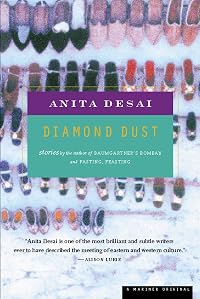
Upon the recent publication of Fasting, Feasting, critics raved about Anita Desai: "Desai is more than smart; she's an undeniable genius" (Washington Post Book World). The Wall Street Journal called Fasting, Feasting "poignant, penetrating . . . a splendid novel, " while the Boston Globe celebrated Desai's "beautiful literary universe." Now, in this richly diverse collection, Desai trains her luminous spotlight on private universes, stretching from India to New England, from Cornwall to show more Mexico. Skillfully navigating the fault lines between social obligation and personal loyalties, the men and women in these nine tales set out on journeys that suddenly go beyond the pale -- or surprisingly lead them back to where they started from. In the mischievous title story, a beloved dog brings nothing but disaster to his obsessed master; in other tales, old friendships and family ties stir up buried feelings, demanding either renewed commitment or escape. And in the final exquisite story, a young woman discovers a new kind of freedom in Delhi's rooftop community. With her trademark "perceptiveness, delicacy of language, and sharp wit" (Salman Rushdie) in full evidence here, Anita Desai once again gloriously confirms that she is "India's finest writer in English" (Independent). show lessTags
Recommendations
































Member Reviews
Excellent stories by Anita Desai, with a variety of settings and precise, crystalline prose. Most of them tend to be quiet, slice-of-life stories with sharp portrayals of discomfort and isolation. My favorites were the first and last. In “Royalty”, the life of a comfortable, successful couple – Sarla and Ravi – is upended temporarily by a visit from their charismatic, capricious famous friend Raja. Desai nicely shows all the little annoyances caused by the visit - they have to cancel their trip and stay in the sweltering heat; invitation etiquette causes some snubs; Raja is cheerfully selfish. There is a long backstory between Raja and several of the characters, but Desai leaves that to the reader’s imagination.
The final show more story, “The Rooftop Dwellers”, follows Moyna, a single woman carefully guarding her independence, as she moves to a rooftop apartment after being kicked out of a women’s hostel. All the major events in the story – which is comparatively long – are the stuff of everyday life – moving, job troubles, problems with the landlord, but the writing is wonderful and I was caught up in Moyna’s story.
“Winterscape”, the second story, creates a nice contrast between the life of a modern couple in Canada and the complicated situation with the husband’s mother and aunt – who are both mothers to him, in different ways – back in India.
The title story has some humor, as it is about the antics of a badly behaved dog, Diamond, and his owner who spoils him nonstop, creating problems with his wife and friends. However, this one comes to a bad end.
“Underground” is deftly written, although the two halves feel a little disjointed. A couple is desperately looking for a hotel, but everyone tells them that the White House, which appears to have vacancies, isn’t an option. The owner of the hotel refuses to let them in – he unhappily recalls his past and marriage.
“The Man Who Saw Himself Drown” is a little surreal, but feels a bit distant as well. The narrator, well, sees himself drown and is taken for dead.
Desai skillfully evokes Polly’s dreamy adolescent interest in art in “The Artist’s Life”. Polly is still on a high coming back from summer camp with a fascinating art instructor, but the odd tenant living behind the house also takes up some of her interest.
“Five Hours to Simla or Faisla” is a somewhat comical, absurdist story where an angry truck driver randomly decides to hold up traffic. Everyone is overheating, angry, and attempting to get him to move.
“Tepoztlan Tomorrow” was the weakest I thought – the writing was still vivid, but the story was mainly Louis returning to his hometown and seeing his relatives rigidly clinging to their old ways and his old friends passionately protesting the development of the town, while he is stuck and passive. show less
The final show more story, “The Rooftop Dwellers”, follows Moyna, a single woman carefully guarding her independence, as she moves to a rooftop apartment after being kicked out of a women’s hostel. All the major events in the story – which is comparatively long – are the stuff of everyday life – moving, job troubles, problems with the landlord, but the writing is wonderful and I was caught up in Moyna’s story.
“Winterscape”, the second story, creates a nice contrast between the life of a modern couple in Canada and the complicated situation with the husband’s mother and aunt – who are both mothers to him, in different ways – back in India.
The title story has some humor, as it is about the antics of a badly behaved dog, Diamond, and his owner who spoils him nonstop, creating problems with his wife and friends. However, this one comes to a bad end.
“Underground” is deftly written, although the two halves feel a little disjointed. A couple is desperately looking for a hotel, but everyone tells them that the White House, which appears to have vacancies, isn’t an option. The owner of the hotel refuses to let them in – he unhappily recalls his past and marriage.
“The Man Who Saw Himself Drown” is a little surreal, but feels a bit distant as well. The narrator, well, sees himself drown and is taken for dead.
Desai skillfully evokes Polly’s dreamy adolescent interest in art in “The Artist’s Life”. Polly is still on a high coming back from summer camp with a fascinating art instructor, but the odd tenant living behind the house also takes up some of her interest.
“Five Hours to Simla or Faisla” is a somewhat comical, absurdist story where an angry truck driver randomly decides to hold up traffic. Everyone is overheating, angry, and attempting to get him to move.
“Tepoztlan Tomorrow” was the weakest I thought – the writing was still vivid, but the story was mainly Louis returning to his hometown and seeing his relatives rigidly clinging to their old ways and his old friends passionately protesting the development of the town, while he is stuck and passive. show less
So far, this year's challenge (Iran to Bangladesh, by book) is a winner. And only two books in!
Anita Desai writes delicate short stories of frustration and love and families. She has the ability to draw me into a sense of place so swiftly and completely I felt elsewhere whenever I was reading. I particularly liked the first, second and last stories, Royalty, Underground and The Rooftop Dwellers.
Moyna, the protagonist in The Rooftop Dwellers, just made me happy, in the end.
Anita Desai writes delicate short stories of frustration and love and families. She has the ability to draw me into a sense of place so swiftly and completely I felt elsewhere whenever I was reading. I particularly liked the first, second and last stories, Royalty, Underground and The Rooftop Dwellers.
Moyna, the protagonist in The Rooftop Dwellers, just made me happy, in the end.
Snapshots from the lives of ordinary people in Britain, Canada, India, and Mexico among others. These stories have rich descriptions but they do not really contain a plot in the traditional sense. They are best viewed as short vignettes in the lives of the people. There is a little shadow of sadness in all of them. My favourite was Rooftop Dwellers, the last story in the collection.
There was palpable discomfort in some of these stories, so it it evident that the emotionality was well-presented. But overall, I am not sure if I really enjoyed it.
Funny sad and charming stories about every days live,without any violance and sex!The beauty is in the detail.
Nove brevi racconti ambientati fuori dall'India, in luoghi diversi e in cui le donne protagoniste si trovano per varie motivazioni. Frammenti di vita, scene di intimità domestica, uno scandagliare perfetto dentro il cuore di ognuna di loro.
Dec 15, 2014Italian
Ratings
Members
- Recently Added By
Author Information

39+ Works 4,744 Members
Anita Desai was born in Mussoorie, India, in 1937 of Indian and German parentage. Her works focus on relationships and family life in India, particularly the problems of women in Indian society. She has written for both adults and children, winning the Winifred Holtby Prize from the Royal Society of Literature for Fire on the Mountain (1977) and show more the Guardian Prize for Children's Fiction for her novel The Village by the Sea (1982). Among her numerous other honors is a Literary Lion Award from the New York Public Library in 1993. Desai came to America in 1987. She has taught at Mount Holyoke College, Baruch College, and Smithe College. Desai is currently Emeritus John E. Burchard Professor of Humanities at MIT. (Bowker Author Biography) Anita Desai was born & educated in India. Among her many published works are "Fasting, Feasting" (a finalist for the 1999 Booker Prize), "Baumgartner's Bombay," "In Custody," "Games at Twilight," & "Diamond Dust." Her awards & honors include the Alberto Moravia Award, the National Academy of Letters Award, & the Winifred Holtby Prize of the Royal Society of Literature. She lives in Cambridge, Massachusetts, where she teaches writing at MIT. (Publisher Provided) show less
Common Knowledge
- Original publication date
- 2000-04-06
- Dedication
- To my students at M.I.T. who have been my teachers
Classifications
Statistics
- Members
- 213
- Popularity
- 153,747
- Reviews
- 6
- Rating
- (3.37)
- Languages
- 5 — Dutch, English, French, Italian, Spanish
- Media
- Paper, Ebook
- ISBNs
- 11
- UPCs
- 1
- ASINs
- 3