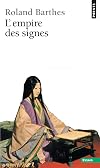
Empire of Signs
by Roland Barthes
On This Page
Description
Brief appreciations of things Japanese, of the "richness, mobility, and subtlety" of the Japanese "exchange of signs": published in France in 1970, and Barthes at his most seductive. These are the observations of every traveler, translated (without strain) into recognitions. "The dinner tray seems a picture of the most delicate order"; it is actually a palette, "with which you are going to play in the course of your meal. . ." (In the next piece: "by chopsticks, food becomes no longer a prey show more to which one does violence . . . but a substance harmoniously transferred.") And this sequence of thoughts leads Barthes to remark on the absence of a center, "a precious heart," a deep meaning ("food is never anything but a collection of fragments"). There then comes Tokyo: a city with an "empty" center, the forbidden grounds of the (figurehead) Emperor's palace. Japan not only affords Barthes a profusion of complex signs, it suites his penchant for the formal--and for non-meaning, the absence of a symbolic charge. "The haiku is not a rich thought reduced to a brief form, but a brief event which immediately finds its proper form." Thus, also, the reflections on bowing; on Bunraku puppets; on the Zengakuren riots ("a great scenario of signs" climaxing in a purely vocal exercise--"The Zengakuren are going to fight"--without a subject or stated cause.) There is more concentrated pleasure here, along with fewer stylistic and other impediments--than in major works of the canon. show lessTags
Recommendations































Member Reviews
Barthes's book on Japan belongs to the same genre as Swift's Gullivers’ Travels, Montesquieu’s Persian Letters, Voltaire's Candide and as Barthes himself signals, Micheax's Garabagne. In this genre, travellers to a foreign country which is largely mythical, fictional, fantastic, reflect on that country's institutions, casting light on the writers' own.
This may seems a strange assertion. Japan is a real place, and Barthes really visited it. But this book is more an examination of Western thought about Japan, especially about Zen, and about Western thought itself, about how Western thought and language is ceaselessly spinning out sign systems, is in fact, an infinite supplement of supernumerary signifiers which form the basis of show more Western consciousness. In Empire of Signs Barthes imagines the possibility of this ceaseless chatter ceasing, he imagines a system of emptiness, which he sees in Japanese/Zen culture.
The book is short, consisting of 26 very short chapters on different aspects of Japan: food, chopsticks, calligraphy, pachinko, the haiku, the eyelid and so on. Barthes's mediations are spot-on accurate, imaginative, fanciful, grounded in reality, and beautifully expressed.
The book is a kind of dialogue (between East and West), and this is reflected at sentence level; sentences seem to have two layers, the direct and the parenthetical:
A Frenchman (unless he is abroad) cannot classify French faces; doubtless he perceives faces in common, but the abstraction of these repeated faces (which is the class to which they belong) escapes him.
Barthes comments on his own comments. At the level of the discourse then, the book enacts that infinite supplement of supernumerary signifiers, nudging the reader into his own supernumerary signifiers.
I'm going to briefly summarize the four short chapters on haiku from this marvelous book….
Read more on The Lectern show less
This may seems a strange assertion. Japan is a real place, and Barthes really visited it. But this book is more an examination of Western thought about Japan, especially about Zen, and about Western thought itself, about how Western thought and language is ceaselessly spinning out sign systems, is in fact, an infinite supplement of supernumerary signifiers which form the basis of show more Western consciousness. In Empire of Signs Barthes imagines the possibility of this ceaseless chatter ceasing, he imagines a system of emptiness, which he sees in Japanese/Zen culture.
The book is short, consisting of 26 very short chapters on different aspects of Japan: food, chopsticks, calligraphy, pachinko, the haiku, the eyelid and so on. Barthes's mediations are spot-on accurate, imaginative, fanciful, grounded in reality, and beautifully expressed.
The book is a kind of dialogue (between East and West), and this is reflected at sentence level; sentences seem to have two layers, the direct and the parenthetical:
A Frenchman (unless he is abroad) cannot classify French faces; doubtless he perceives faces in common, but the abstraction of these repeated faces (which is the class to which they belong) escapes him.
Barthes comments on his own comments. At the level of the discourse then, the book enacts that infinite supplement of supernumerary signifiers, nudging the reader into his own supernumerary signifiers.
I'm going to briefly summarize the four short chapters on haiku from this marvelous book….
Read more on The Lectern show less
L'empire des Signs is a fruit of Barthes' 1966 travel to Japan. Observing Far East from an unusual perspective, totally unorientalistic Barthes explores signifiers and signifieds of a culture in a meditative way. A good book to start studying semiology, and understanding Asia.
Tr. Richard Howard. Literary Criticism. Semiology. Japan. Travel writing.
Roland Barthes est présenté par Wikipédia comme un philosophe, critique littéraire et sémiologue. Pas du tout le genre d’auteur que je fréquente habituellement. Mais, lu ici par Denis Podalydès, cela me paraissait moins inaccessible et mon petit côté intello se sentait flatté.
Certes, c’est une lecture ardue et je n’ai l’impression que d’avoir survolé le livre, mais j’ai aimé cette analyse du Japon. C’est l’analyse d’un européen, à n’en pas douter. L’analyse d’un occidental qui a passé un temps finalement assez court dans un pays étranger et qui, confronté à une culture radicalement différente, se laisse envoûter par son exotisme. C’est un livre tout en fascination, qui, probablement, ne show more supporterait pas le regard critique d’un spécialiste de la culture japonaise (si tant est que cela puisse être un titre dont quelqu’un se glorifie). Roland Barthes semble plus, dans son approche du Japon, refléter ses propres questionnements philosophiques, et c’est en creux l’analyse de sa propre culture qu’il fait en la confrontant à l’altérité.
Son analyse de l’espace de la maison japonaise, dans toute la splendeur de son dépouillement, ses réflexions sur les haïkus, leur apparente simplicité et ce qu’ils disent et ne disent pas sont intéressantes, mais, il faut que le lecteur en soit prévenu, écrit dans une langue recherchée, à grand renfort de répétitions et de périphrases. Le livre est intéressant, les idées stimulantes, mais je n’ai pu m’empêcher de sourire à l’ironie d’une forme finalement assez ampoulée pour raconter un fond fait de simplicité et d’épure. Bel exemple de contradiction dans cette réflexion très occidentale sur une culture éminemment orientale. show less
Certes, c’est une lecture ardue et je n’ai l’impression que d’avoir survolé le livre, mais j’ai aimé cette analyse du Japon. C’est l’analyse d’un européen, à n’en pas douter. L’analyse d’un occidental qui a passé un temps finalement assez court dans un pays étranger et qui, confronté à une culture radicalement différente, se laisse envoûter par son exotisme. C’est un livre tout en fascination, qui, probablement, ne show more supporterait pas le regard critique d’un spécialiste de la culture japonaise (si tant est que cela puisse être un titre dont quelqu’un se glorifie). Roland Barthes semble plus, dans son approche du Japon, refléter ses propres questionnements philosophiques, et c’est en creux l’analyse de sa propre culture qu’il fait en la confrontant à l’altérité.
Son analyse de l’espace de la maison japonaise, dans toute la splendeur de son dépouillement, ses réflexions sur les haïkus, leur apparente simplicité et ce qu’ils disent et ne disent pas sont intéressantes, mais, il faut que le lecteur en soit prévenu, écrit dans une langue recherchée, à grand renfort de répétitions et de périphrases. Le livre est intéressant, les idées stimulantes, mais je n’ai pu m’empêcher de sourire à l’ironie d’une forme finalement assez ampoulée pour raconter un fond fait de simplicité et d’épure. Bel exemple de contradiction dans cette réflexion très occidentale sur une culture éminemment orientale. show less
Apr 27, 2019French
Livre trop savant. Mais de belles pages sur la cuisine, le haïku. Trop difficile à lire. Il faudrait faire des extraits accessibles au vulgaire.
Oct 27, 2021French
Après avoir lu ce livre, vous ne verrez jamais plus un sushi de la même façon ! Permet de prendre conscience de la distance qui nous sépare de la civilisation japonaise.
May 10, 2007French
Roland Barthes, född 12 november 1915, död 25 mars 1980, fransk författare, litteraturforskare och semiotiker. Barthes var professor vid École Pratique des Hautes Études i Paris. Han avled efter att ha blivit påkörd av en tvättbil.
Barthes räknas till strukturalismens centralgestalter. Han skrev en rad tongivande texter inom semiotik, semantik och lingvistik. Barthes var tydligt påverkad av existentialismen.
Genom att introducera termen translingvistisk, kunde Barthes tillämpa semiotikens språkliga begreppsapparat på de flesta mänskliga aktiviteter - från myter och matvanor till visuella miljöer i vidaste bemärkelse. Men det är kanske med sin insats inom bildanalysen som Barthes fick sitt största inflytande: Hans show more klassiska artikel Rhétorique de l'image (Bildens retorik) i tidskriften Communications 1964 redogör för en bilds olika artikulationsnivåer, konnotationsförhållanden och retoriska figurer.
Senare texter, såsom Balzac-analysen i S/Z, har också varit centrala för den poststrukturalistiska utvecklingen inom litteraturvetenskapen. show less
Barthes räknas till strukturalismens centralgestalter. Han skrev en rad tongivande texter inom semiotik, semantik och lingvistik. Barthes var tydligt påverkad av existentialismen.
Genom att introducera termen translingvistisk, kunde Barthes tillämpa semiotikens språkliga begreppsapparat på de flesta mänskliga aktiviteter - från myter och matvanor till visuella miljöer i vidaste bemärkelse. Men det är kanske med sin insats inom bildanalysen som Barthes fick sitt största inflytande: Hans show more klassiska artikel Rhétorique de l'image (Bildens retorik) i tidskriften Communications 1964 redogör för en bilds olika artikulationsnivåer, konnotationsförhållanden och retoriska figurer.
Senare texter, såsom Balzac-analysen i S/Z, har också varit centrala för den poststrukturalistiska utvecklingen inom litteraturvetenskapen. show less
May 17, 2010Swedish
Members
- Recently Added By
Author Information

196+ Works 22,362 Members
Roland Barthes (1915-1980), a French critic and intellectual, was a seminal figure in late twentieth-century literary criticism. Barthes's primary theory is that language is not simply words, but a series of indicators of a given society's assumptions. He derived his critical method from structuralism, which studies the rules behind language, and show more semiotics, which analyzes culture through signs and holds that meaning results from social conventions. Barthes believed that such techniques permit the reader to participate in the work of art under study, rather than merely react to it. Barthes's first books, Writing Degree Zero (1953), and Mythologies (1957), introduced his ideas to a European audience. During the 1960s his work began to appear in the United States in translation and became a strong influence on a generation of American literary critics and theorists. Other important works by Barthes are Elements of Semiology (1968), Critical Essays (1972), The Pleasure of the Text (1973), and The Empire of Signs (1982). The Barthes Reader (1983), edited by Susan Sontag, contains a wide selection of the critic's work in English translation. (Bowker Author Biography) show less
Some Editions
Series
Belongs to Publisher Series
Common Knowledge
- Canonical title*
- L'impero dei segni
- Original title
- L'empire des signes
- Original publication date
- 1970
- Original language
- French
*Some information comes from Common Knowledge in other languages. Click "Edit" for more information.
Classifications
Statistics
- Members
- 820
- Popularity
- 33,749
- Reviews
- 7
- Rating
- (3.80)
- Languages
- 15 — Czech, Danish, Dutch, English, French, German, Greek, Italian, Japanese, Norwegian (Bokmål), Polish, Portuguese, Spanish, Swedish, Turkish
- Media
- Paper, Ebook
- ISBNs
- 35
- ASINs
- 8