Ground Zero Man
by Bob Shaw
On This Page
Description
Lucas Hutchman is the Ground Zero Man The man who has his finger on the button, the man who can destroy the world - or save it, the man whose own life suddenly has no value, unless he can make the governments of Earth understand that he is the absolute master of the ultimate doomsday device - a device that can trigger every nuclear weapon in existence if Hutchman's demands are not met in time.Tags
Recommendations














Member Reviews
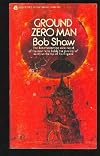
Originally published as Ground Zero Man (with a cover on the UK paperback depicting someone with the worst ever case of earache on record), this is a typical workmanlike novel by Shaw, with a protagonist trying to come to terms with his own personal issues whilst the world is going mad around him. Originally marketed as a mainstream thriller, this novel nonetheless has science-fictional echoes, both in its subject matter (the protagonist, Lucas Hutchman, realises he has a way to detonate simultaneously every nuclear weapon on the planet) and some of the plotting (Hutchman uses quirky and odd ways to outwit his pursuers, echoing the sf fan's mantra of 'fans are Slans'). I've always had a soft spot for this novel, in that it mentions my show more home town, Belper in Derbyshire, in passing. I once asked Bob about this and he said that according to the map, it was just in the right place for the way his character was taking the plot. That says a lot about the way Shaw worked.
=====================================================
(Re-read in November 2025)
My original review of Ground Zero Man/The Peace Machine was based on my memories of the novel from my last reading of it sometime in the late 1980s. I am now engaged on a wholesale re-read of Bob Shaw's work and have now reached this novel.
The book was originally written in 1971, and saw UK publication in 1976; it was set in around 1978. Bob revised the novel and changed the title in 1985, moving the setting forward to 1988; the revisions were mainly there to update some of the UK references to keep the book contemporary.
Much as I admired this book when I was younger, on this reading I found it seriously outdated. Its attitudes to relationships, office life, data privacy and police procedures are straight out of the 1960s, and no amount of fiddling with changing car badges can change that. Hutchman's encounter with the police would not be compliant with the 1984 Police and Criminal Evidence Act, and the novel also betrays its original publication in the USA by having a number of Americanisms in the text which stick out like sore thumbs in a story set in the UK. I am also a little dubious about the mechanics of nuclear weapons on show here; by 1985, Bob would have known that there was a 'go-to' person in British SF fandom, in the form of one-time weapons physicist David Langford, who could have advised him on this and made certain that Bob's technological details were up to scratch.
There are some loose ends in the story; one group of pursuers are never identified, and a character is kidnapped part-way through the story and their fate is never revealed. And yet...
Bob's prose and inventiveness remain on top form, and I found myself recollecting phrases (such as Hutchman's repeated inner reflection, "I can make neutrons dance to a new tune") and set-pieces. An incident where a Russian sleeper agent accidentally gouges his own eye out - another example of Bob Shaw's body horror that would have personally revulsed him whilst he was writing it - is based on something that Bob actually saw happen in his childhood. And the key features of the story have a chilling effect, even now. When Hutchman begins to understand that he can create 'neutron resonance' that will initiate a chain reaction in all nuclear weapon stockpiles worldwide, he at first does not take any further action, until his attitude is changed when a terrorist nuclear weapon is detonated over Damascus. The choice of target is never explained, but its relevance remains, more than fifty years later.
The whole novel is also an interesting exploration of the powers of the individual versus the power of the state. The protagonist is an ordinary person, a middle management type with a talent for mathematics that is under-used in his job. He lacks what would nowadays be called 'agency'. He hatches his plan for nuclear blackmail out of the highest of motives, but is completely out of his depth, only gaining the upper hand on his pursuers by accident. In order not to be disbelieved as a madman, he provides a detailed proof of his machine's viability; this proof contains the seeds of his downfall, as even in the 1970s, anyone purchasing the sort of equipment and materials needed for such a machine would come to light sooner or later. Chance plays a large part in Bob being able to drive the story forward, though the same can be said of so many other thrillers.
There is one other thing to note. Bob and Sadie Shaw were probably Irish fandom's original power couple; but many of Bob's earlier novels had protagonists with marital or relationship issues. This book is no exception; indeed, Hutchman's wife displays disproportionate degrees of jealousy and imagines that the default setting for her husband is that he is a serial adulterer, which he is not. I have met people like this (fortunately not many), so I know that this may be drawn from life; and it helps build a more rounded picture of Hutchman's character. But it did make me reflect, perhaps unfairly, on what this told me about Bob Shaw, someone who I personally respected.
Overall, then, not a book I would recommend to others coming to the works of Bob Shaw afresh, though I found the re-read personally interesting. show less
=====================================================
(Re-read in November 2025)
My original review of Ground Zero Man/The Peace Machine was based on my memories of the novel from my last reading of it sometime in the late 1980s. I am now engaged on a wholesale re-read of Bob Shaw's work and have now reached this novel.
The book was originally written in 1971, and saw UK publication in 1976; it was set in around 1978. Bob revised the novel and changed the title in 1985, moving the setting forward to 1988; the revisions were mainly there to update some of the UK references to keep the book contemporary.
Much as I admired this book when I was younger, on this reading I found it seriously outdated. Its attitudes to relationships, office life, data privacy and police procedures are straight out of the 1960s, and no amount of fiddling with changing car badges can change that. Hutchman's encounter with the police would not be compliant with the 1984 Police and Criminal Evidence Act, and the novel also betrays its original publication in the USA by having a number of Americanisms in the text which stick out like sore thumbs in a story set in the UK. I am also a little dubious about the mechanics of nuclear weapons on show here; by 1985, Bob would have known that there was a 'go-to' person in British SF fandom, in the form of one-time weapons physicist David Langford, who could have advised him on this and made certain that Bob's technological details were up to scratch.
There are some loose ends in the story; one group of pursuers are never identified, and a character is kidnapped part-way through the story and their fate is never revealed. And yet...
Bob's prose and inventiveness remain on top form, and I found myself recollecting phrases (such as Hutchman's repeated inner reflection, "I can make neutrons dance to a new tune") and set-pieces. An incident where a Russian sleeper agent accidentally gouges his own eye out - another example of Bob Shaw's body horror that would have personally revulsed him whilst he was writing it - is based on something that Bob actually saw happen in his childhood. And the key features of the story have a chilling effect, even now. When Hutchman begins to understand that he can create 'neutron resonance' that will initiate a chain reaction in all nuclear weapon stockpiles worldwide, he at first does not take any further action, until his attitude is changed when a terrorist nuclear weapon is detonated over Damascus. The choice of target is never explained, but its relevance remains, more than fifty years later.
The whole novel is also an interesting exploration of the powers of the individual versus the power of the state. The protagonist is an ordinary person, a middle management type with a talent for mathematics that is under-used in his job. He lacks what would nowadays be called 'agency'. He hatches his plan for nuclear blackmail out of the highest of motives, but is completely out of his depth, only gaining the upper hand on his pursuers by accident. In order not to be disbelieved as a madman, he provides a detailed proof of his machine's viability; this proof contains the seeds of his downfall, as even in the 1970s, anyone purchasing the sort of equipment and materials needed for such a machine would come to light sooner or later. Chance plays a large part in Bob being able to drive the story forward, though the same can be said of so many other thrillers.
There is one other thing to note. Bob and Sadie Shaw were probably Irish fandom's original power couple; but many of Bob's earlier novels had protagonists with marital or relationship issues. This book is no exception; indeed, Hutchman's wife displays disproportionate degrees of jealousy and imagines that the default setting for her husband is that he is a serial adulterer, which he is not. I have met people like this (fortunately not many), so I know that this may be drawn from life; and it helps build a more rounded picture of Hutchman's character. But it did make me reflect, perhaps unfairly, on what this told me about Bob Shaw, someone who I personally respected.
Overall, then, not a book I would recommend to others coming to the works of Bob Shaw afresh, though I found the re-read personally interesting. show less
Ratings
Members
- Recently Added By
Author Information

118+ Works 6,002 Members
Some Editions
Series
Belongs to Publisher Series
Goldmann Science Fiction (0153)
Common Knowledge
- Original title
- Ground Zero Man
- Alternate titles
- The Peace Machine
- Original publication date
- 1971-09
- First words*
- Il mio dito sfiora il pulsante nero.
- Last words*
- (Click to show. Warning: May contain spoilers.)"E a che serve, provare?"
*Some information comes from Common Knowledge in other languages. Click "Edit" for more information.
Classifications
Statistics
- Members
- 204
- Popularity
- 160,230
- Reviews
- 1
- Rating
- (3.21)
- Languages
- 5 — English, French, German, Italian, Portuguese
- Media
- Paper, Ebook
- ISBNs
- 8
- ASINs
- 9