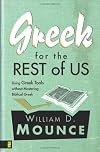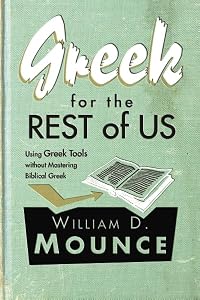
Greek for the Rest of Us
by William D. Mounce
On This Page
Description
Learn the Essentials of Biblical Greek So You Can Study the New Testament More Deeply This newly revised third edition of Greek for the Rest of Us by Greek instructor William Mounce is crash-course on "Greek for the rest of us" that acquaints the reader with the essentials of the language so they can study the New Testament more deeply. Readers will gain a sound knowledge of the fundamentals of Greek and learn how to use tools that will add muscle to their Bible studies. In Greek for the show more Rest of Us readers will learn to: Read and pronounce Greek words Learn the fundamentals of the Greek noun and verb system Conduct effective Greek word studies Learn the basics of Greek exegesis for biblical interpretation Understand why translations are different Read better commentaries Be comfortable using reverse and traditional interlinears Understand the information displayed by biblical software For anyone interested in seriously studying the New Testament, Greek for the Rest of Us is your gateway to learning the skills and tools you need to accomplish your goals. You can enhance your learning experience even more with the Greek for the Rest Us Workbook (sold separately) which contains exercises to help practice and reinforce the concepts you are learning in the main book. show lessTags
Recommendations



Member Reviews
Having read other works by Mounce and enjoyed his methodical and well-paced walkthrough of biblical languages with an audience who understood the need to care about the subject, I had some good confidence that this book would match his previous books. This is the case here. If you've read or gone through Mounce's probably more well-known book on the subject Basics of Biblical Greek Grammar this is going to be familiar and is in the same vein. Where that one is a focus on the grammar, Greek For the Rest of Us is a focus on the grammar as well as the syntax. Just as a note, I did read this in conjunction with a weekly church study that was using this book along with class activity and the use of Logos software to give an understanding of show more Greek in a more than surface-level undertaking and utilizing the Bible software to do a good amount of work for you as well. So individual results may vary.
Mounce starts off with the basics such as letters and Greek words to memorize are at the end of most chapters. Then the push to understand English grammar that will help the reader of non-native Greek understand the concepts of what will be talked about throughout the book. So, this study suddenly becomes a chest-clenching double study as you curse the government schools that failed to impress upon you your own language. Where Mounce's previous book had a chapter dedicated to that, this book has almost introduction chapters of English language to set the stage for the Greek of that same type. Mounce also sprinkles in Concordance software (as he has a controlling interest in that software) but the use of some type of Bible software capable of assisting with the learning is very helpful.
The layout in the chapters are methodical and well-laid out. The use of a sub-numbering system to make going back through easier for reference. This section does a good job of showing biblical examples and here's where I would say is a negative of the book. While an example is given, it is usually a simple one and a few more examples showing different appearances of the syntax in question would have been really helpful to almost triangulate you into what you may be missing or helping find a relationship between the examples and your understanding of the section. Also, there are times where a concept is defined and the example is given, it may have been helpful to add a line or two going over the example and really driving home the point to help the reader understand the concept. Here are there, there are grammar and syntax concepts that need to be looked up if you don't understand it, and some circling back to previous points or definitions would have been helpful.
This isn't a book you'll be able to read passively and be good overall. Going through examples and making this a study will be the most beneficial use of this resource and your time. Having the benefit of struggling with a group and being dedicated was a huge benefit to me. I also had the benefit of a teacher who was far enough along in seminary and knew Greek well enough to develop the curriculum around the use of this book. So the recommendation and grade should be understood in light of that interaction with the book. Final Grade - B show less
Mounce starts off with the basics such as letters and Greek words to memorize are at the end of most chapters. Then the push to understand English grammar that will help the reader of non-native Greek understand the concepts of what will be talked about throughout the book. So, this study suddenly becomes a chest-clenching double study as you curse the government schools that failed to impress upon you your own language. Where Mounce's previous book had a chapter dedicated to that, this book has almost introduction chapters of English language to set the stage for the Greek of that same type. Mounce also sprinkles in Concordance software (as he has a controlling interest in that software) but the use of some type of Bible software capable of assisting with the learning is very helpful.
The layout in the chapters are methodical and well-laid out. The use of a sub-numbering system to make going back through easier for reference. This section does a good job of showing biblical examples and here's where I would say is a negative of the book. While an example is given, it is usually a simple one and a few more examples showing different appearances of the syntax in question would have been really helpful to almost triangulate you into what you may be missing or helping find a relationship between the examples and your understanding of the section. Also, there are times where a concept is defined and the example is given, it may have been helpful to add a line or two going over the example and really driving home the point to help the reader understand the concept. Here are there, there are grammar and syntax concepts that need to be looked up if you don't understand it, and some circling back to previous points or definitions would have been helpful.
This isn't a book you'll be able to read passively and be good overall. Going through examples and making this a study will be the most beneficial use of this resource and your time. Having the benefit of struggling with a group and being dedicated was a huge benefit to me. I also had the benefit of a teacher who was far enough along in seminary and knew Greek well enough to develop the curriculum around the use of this book. So the recommendation and grade should be understood in light of that interaction with the book. Final Grade - B show less
The Answer to One of My Oldest Dreams
Ever since I was in high school, I have harbored a desire to learn ancient Greek.
Since my rapid fire synapses that ease the learning of a foreign language have long since stopped firing, I had pretty relegated this desire to the unfulfilled list. That is, until I discovered this book. William Mounce, with this book, places a rudimentary mastery of Greek within my reach.
The book is an incredible resource. Let me caution, finishing the course will not make me a Greek master. Rather, Mounce teaches enough Greek to enhance Bible study.
The book is more, however. The author provides several chapters showing how a novice can apply his or her limited knowledge of a little Greek.
• "What are Translations?" show more is an insightful look into a bible translators mind.
• "Phrasing - An Introduction to our Bible Study Method" / "Fine-tuning Phrasing." These two chapters are worth what you are asked to pay for this book.
• “What Are Word Studies?" An excellent explanation of how to perform a word study.
• "How to Read a Commentary." The author explains the differences in commentaries; what do and do not do.
Gratefully, the grammar portion of the book is short and manageable. This makes it ideal for the type of self-study I am attempting. Another study aid is the CD-ROM, which comes with the book. Each week’s lesson is reinforced by a lecture, complete with slides, delivered by William Mounce to a group of lay-people attempting to do what I have undertaken.
If you have a desire to learn Greek, but do not have the time or the fortitude to undertake an academic approach to language, this is the book for you. Who knows, I might even tackle Hebrew appendix contained in this book. show less
Ever since I was in high school, I have harbored a desire to learn ancient Greek.
Since my rapid fire synapses that ease the learning of a foreign language have long since stopped firing, I had pretty relegated this desire to the unfulfilled list. That is, until I discovered this book. William Mounce, with this book, places a rudimentary mastery of Greek within my reach.
The book is an incredible resource. Let me caution, finishing the course will not make me a Greek master. Rather, Mounce teaches enough Greek to enhance Bible study.
The book is more, however. The author provides several chapters showing how a novice can apply his or her limited knowledge of a little Greek.
• "What are Translations?" show more is an insightful look into a bible translators mind.
• "Phrasing - An Introduction to our Bible Study Method" / "Fine-tuning Phrasing." These two chapters are worth what you are asked to pay for this book.
• “What Are Word Studies?" An excellent explanation of how to perform a word study.
• "How to Read a Commentary." The author explains the differences in commentaries; what do and do not do.
Gratefully, the grammar portion of the book is short and manageable. This makes it ideal for the type of self-study I am attempting. Another study aid is the CD-ROM, which comes with the book. Each week’s lesson is reinforced by a lecture, complete with slides, delivered by William Mounce to a group of lay-people attempting to do what I have undertaken.
If you have a desire to learn Greek, but do not have the time or the fortitude to undertake an academic approach to language, this is the book for you. Who knows, I might even tackle Hebrew appendix contained in this book. show less
Have you ever wanted to learn Greek? A good number of Bible students and faithful church attenders have given a yes to this question. But these same people are often perplexed as to how they can actually learn Greek, Some may find themselves overwhelmed in a intorductory Greek class and conclude that it will have to always be “just Greek to me.”
Bill Mounce, perhaps more than anyone else, has made it his mission to make the study of biblical Greek accessible to everyone. Not content to be the author of the most widely used introductory Greek textbook ("Basics of Biblical Greek"), Mounce has provided a wonderful resource for those of a less scholastic bent with his excellent book "Greek for the Rest of Us: The Essentials of Biblical show more Greek". Now in its second edition, "Greek for the Rest of Us" is more useful than ever and comes complete with a host of online and additional resources to guide the reader into a greater understanding of biblical Greek.
Why study Greek?
Some may wonder why all the fuss about Greek. If the English of the King James Bible was good enough for the Apostle Paul, why do we need to study Greek? In all seriousness, why exactly should we bother with the study of Greek? Mounce sees at least five benefits from the study of biblical Greek:
"•making sense of the information that Bible software shows
•finding what the Greek words mean
•seeing the author’s flow of thought and his cental message
•understanding why translations are different
•reading good commentaries and using other biblical tools that make use of Greek" (p. viii)
Three books in one
Mounce’s plan of attack is to teach the reader just enough Greek for what they need. His book is divided into three sections which will teach the reader foundational Greek, church Greek, and finally functional Greek. Those making it through the entire book, with the online homework assignments, will actually cover the equivalent of two years of Greek. But many will not need that level of detail. Here is how Mounce delineates what each level of Greek will cover:
"•Foundational Greek teaches you enough Greek so you can use the Bible study software, understand a Strong’s Bible, and do Greek word studies.
•Church Greek teaches you more Greek so you can understand a reverse interlinear and use better reference works, especially commentaries.
•Functional Greek teaches you even more Greek so you can be comfortable working with a traditional interlinear and go even deeper into the best commentaries." (p. viii)
Greek on the bottom shelf
Mounce is a teacher extraordinaire. He has a gift in bringing concepts down to the bottom shelf where anyone can understand them. Illustrations, charts, pictures and examples abound. In everything he stays very practical and helpful. The layout of the book is easy to read and clear. He gives sample entries in Greek dictionaries that are recommended for those in foundational Greek. He provides screenshots from a variety of Bible software programs (some accessible freely online) and explains how to use them. And he covers interlinears and references a host of Greek tools that would be a benefit for those aiming to keep their Greek.
One of the best features of this book is his development of phrasing. He shows how to break down a passage of Scripture into meaningful phrases and examine how they are strung together in the text. As the level of Greek understanding grows, he returns again and again to the phrasing model adding more and more to the exegetical strategy he is teaching. Finally he provides a wonderful group of semantic tags for the functional Greek student to use in selecting which relationships different phrases have to each other in a given text. This method has immediate relevancy for Bible teachers, students and pastors.
Helpful cautions for the budding scholar
Along the way, Mounce offers careful cautions to those just stumbling into the stimulating world of Greek. He reins in the tendency to find meaning in a word’s etymology and make too much of word studies divorced from the actual context of a given passage. He also provides some helpful thoughts as he begins to expand on verb tenses:
"[After covering this material,] does this mean you can look at a verb and decide for yourself what its nuance is? Probably not…. Does this mean you can argue with a commentary or translation based on your knowledge of Greek. Absolutely not. You just don’t know enough Greek…. Will you be able to see why translations are different and be able to follow the discussion in commentaries? Yes." (p. 126)
He also gives a thorough treatment of Bible translation differences and the differences between the different Greek text families (Byzantine manuscripts vs. Alexandrian, etc.). There again he cautions those who are not fluent in Greek from presuming to know more than they do when it comes to the realm of textual criticism. As a Bible translator himself, he explains how all Bible translations are interpretive by their very nature and highlights the difficulties inherent in translation. Even so, he does not recommend dynamic translations for serious Bible study (p. 268).
Mounce also details what to look for and how to use good Bible commentaries. In short, Mounce doesn’t leave you with Greek on the brain, but brings you to where you can apply the Greek you have in ongoing Bible study.
Evaluation
This book is the most helpful introduction to Greek I’ve seen. It can be used for a wide variety of contexts, and would make a perfect resource for a church-led Bible institute class. It would allow some to be exposed to Greek and give others the tools to pursue it at a greater level. There is also a nice laminated resource sheet with declensions and common vocabularly words that is available along with this title and would make a great learning aid suitable for such an institude class.
The book would also serve well as a reference tool in its own right for those trying to remember some Greek fact which has been muddied by the passage of time. There are online tools and even vidoe sessions that go along with the book, making it ideal for personal study, and it could even work for a homeschooling family aiming to introduce biblical Greek to their children.
One point to bring out here, is that this book will highlight differences in BIble translations and while it doesn’t answer every question raised, his explanation does favor the modern scholarly consensus favoring the Alexandrian texts. It can still be used with great benefit by those favoring a Majority text view, in my opinion, however. There may be various points where one may disagree with Mounce’s approach, but in the whole he is to be thanked for giving the church such a useful resource.
Disclaimer: this book was provided by Zondervan. The reviewer was under no obligation to offer a positive review. show less
Bill Mounce, perhaps more than anyone else, has made it his mission to make the study of biblical Greek accessible to everyone. Not content to be the author of the most widely used introductory Greek textbook ("Basics of Biblical Greek"), Mounce has provided a wonderful resource for those of a less scholastic bent with his excellent book "Greek for the Rest of Us: The Essentials of Biblical show more Greek". Now in its second edition, "Greek for the Rest of Us" is more useful than ever and comes complete with a host of online and additional resources to guide the reader into a greater understanding of biblical Greek.
Why study Greek?
Some may wonder why all the fuss about Greek. If the English of the King James Bible was good enough for the Apostle Paul, why do we need to study Greek? In all seriousness, why exactly should we bother with the study of Greek? Mounce sees at least five benefits from the study of biblical Greek:
"•making sense of the information that Bible software shows
•finding what the Greek words mean
•seeing the author’s flow of thought and his cental message
•understanding why translations are different
•reading good commentaries and using other biblical tools that make use of Greek" (p. viii)
Three books in one
Mounce’s plan of attack is to teach the reader just enough Greek for what they need. His book is divided into three sections which will teach the reader foundational Greek, church Greek, and finally functional Greek. Those making it through the entire book, with the online homework assignments, will actually cover the equivalent of two years of Greek. But many will not need that level of detail. Here is how Mounce delineates what each level of Greek will cover:
"•Foundational Greek teaches you enough Greek so you can use the Bible study software, understand a Strong’s Bible, and do Greek word studies.
•Church Greek teaches you more Greek so you can understand a reverse interlinear and use better reference works, especially commentaries.
•Functional Greek teaches you even more Greek so you can be comfortable working with a traditional interlinear and go even deeper into the best commentaries." (p. viii)
Greek on the bottom shelf
Mounce is a teacher extraordinaire. He has a gift in bringing concepts down to the bottom shelf where anyone can understand them. Illustrations, charts, pictures and examples abound. In everything he stays very practical and helpful. The layout of the book is easy to read and clear. He gives sample entries in Greek dictionaries that are recommended for those in foundational Greek. He provides screenshots from a variety of Bible software programs (some accessible freely online) and explains how to use them. And he covers interlinears and references a host of Greek tools that would be a benefit for those aiming to keep their Greek.
One of the best features of this book is his development of phrasing. He shows how to break down a passage of Scripture into meaningful phrases and examine how they are strung together in the text. As the level of Greek understanding grows, he returns again and again to the phrasing model adding more and more to the exegetical strategy he is teaching. Finally he provides a wonderful group of semantic tags for the functional Greek student to use in selecting which relationships different phrases have to each other in a given text. This method has immediate relevancy for Bible teachers, students and pastors.
Helpful cautions for the budding scholar
Along the way, Mounce offers careful cautions to those just stumbling into the stimulating world of Greek. He reins in the tendency to find meaning in a word’s etymology and make too much of word studies divorced from the actual context of a given passage. He also provides some helpful thoughts as he begins to expand on verb tenses:
"[After covering this material,] does this mean you can look at a verb and decide for yourself what its nuance is? Probably not…. Does this mean you can argue with a commentary or translation based on your knowledge of Greek. Absolutely not. You just don’t know enough Greek…. Will you be able to see why translations are different and be able to follow the discussion in commentaries? Yes." (p. 126)
He also gives a thorough treatment of Bible translation differences and the differences between the different Greek text families (Byzantine manuscripts vs. Alexandrian, etc.). There again he cautions those who are not fluent in Greek from presuming to know more than they do when it comes to the realm of textual criticism. As a Bible translator himself, he explains how all Bible translations are interpretive by their very nature and highlights the difficulties inherent in translation. Even so, he does not recommend dynamic translations for serious Bible study (p. 268).
Mounce also details what to look for and how to use good Bible commentaries. In short, Mounce doesn’t leave you with Greek on the brain, but brings you to where you can apply the Greek you have in ongoing Bible study.
Evaluation
This book is the most helpful introduction to Greek I’ve seen. It can be used for a wide variety of contexts, and would make a perfect resource for a church-led Bible institute class. It would allow some to be exposed to Greek and give others the tools to pursue it at a greater level. There is also a nice laminated resource sheet with declensions and common vocabularly words that is available along with this title and would make a great learning aid suitable for such an institude class.
The book would also serve well as a reference tool in its own right for those trying to remember some Greek fact which has been muddied by the passage of time. There are online tools and even vidoe sessions that go along with the book, making it ideal for personal study, and it could even work for a homeschooling family aiming to introduce biblical Greek to their children.
One point to bring out here, is that this book will highlight differences in BIble translations and while it doesn’t answer every question raised, his explanation does favor the modern scholarly consensus favoring the Alexandrian texts. It can still be used with great benefit by those favoring a Majority text view, in my opinion, however. There may be various points where one may disagree with Mounce’s approach, but in the whole he is to be thanked for giving the church such a useful resource.
Disclaimer: this book was provided by Zondervan. The reviewer was under no obligation to offer a positive review. show less
While nothing beats actually taking a full 2-3 year NT Greek class, this book comes close. While the are so many things that are missing, it does enable the student glean very useful knowledge of "the Greek behind the English". If you do not have time to take at least 2 years of Greek, this is the way to go.
You don't have to be a Greek student to understand biblical Greek. If you'd love to learn Greek so you can study your Bible better, but you can't spare two years for college or seminary courses, then Greek for the Rest of Us is for you. Developed by renowned Greek teacher William Mounce, this revolutionary crash-course on 'baby Greek' will acquaint you with the essentials of the language and deepen your understanding of God's Word. You'll gain a sound knowledge of basic Greek, and you'll learn how to use tools that will add muscle to your Bible studies. In six sections, Greek for the Rest of Us will help you: * Recite the Greek alphabet * Read and pronounce Greek words * Learn the Greek noun and verbal system * Conduct Greek word show more studies * Decipher why translations are different * Read better commentaries Greek for the Rest of Us broadens your knowledge still further with an appendix on biblical Hebrew. show less
Includes CD-Rom "Talk-through-the-book"
Greek Concordance
Members
- Recently Added By
Author Information

50+ Works 11,891 Members
William D. Mounce (PhD, Aberdeen University) is the founder and president of BiblicalTraining.org, a nonprofit organization offering world-class educational resources for discipleship in the local church. He is the author of the bestselling textbook Basics of Biblical Greek Grammar and many other resources. He was the New Testament chair of the show more English Standard Version's Translation Oversight Committee and currently serves on the New International Version's Committee for Bible Translation. show less
Work Relationships
Has as a reference guide/companion
Common Knowledge
- Dedication
- for Big Terry
who deeply desires to know God's Word better
but who does not have the time to learn traditional Greek - First words
- [Preface] When people learn that I am a Greek teacher, one of the most common responses is, "I have always wanted to learn Greek."
The Greek language has a long and rich history stretching all the way from the thirteenth century BC to the present. - Last words
- (Click to show. Warning: May contain spoilers.)[Preface] I trust that you will find this a valuable resource as you work to understand the Word of God better.
Classifications
Statistics
- Members
- 596
- Popularity
- 48,839
- Reviews
- 8
- Rating
- (4.19)
- Languages
- English
- Media
- Paper, Ebook
- ISBNs
- 8
- UPCs
- 5
- ASINs
- 1