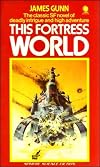
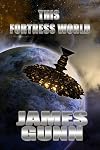
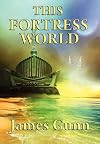
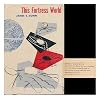
This Fortress World
by James Gunn
On This Page
Description
William Dane is a man with a nasty but valuable secret, one that all the cutthroats in the galaxy are itching to get their hands on. Dane must perfect the art of concealing himself from the crazed factions yearning for the power that this secret can give them; otherwise he will die an unspeakable death at their hands. He is a man on the run from the entire galaxy, and he must be constantly vigilant to ensure that the key to ruling the universe does not fall into the wrong hands. This classic show more science fiction masterpiece satisfies readers' every desire for adventure and intrigue. show lessTags
Recommendations








Member Reviews
This first noticeable thing about this book is that it wears its influences heavily. Obviously Asimov's Foundation books have been an important influence since this is set in a decaying galactic empire milieu, but perhaps so too is Alfred Bester. Published in 1955, it is also a work of its times in its treatment of gender (which is not to say its Heinleinesque, just that some of the tropes at work may seem a little shop-worn to the modern-day reader).
The story follows Dane an acolyte living in a monastery who one day witnesses a beautiful woman on the run from a bunch of mercenaries. Before she is cut down and carried away she hides something in the Cathedral's donation box which is then recovered by Dane. Needless to say this item show more places Dane's life in danger and before he knows it he is forced to abandon his cloistered life and on the run for his life in the big bad city, picking up some pretty handy survival skills along the way and slowing learning that he has stumbled into a cat and mouse game the outcome of which might change the universe forever.
Its a decent read and there are flashes of more than just an adventure tale. But at least for me they didn't really coalesce into anything very much more significant. show less
The story follows Dane an acolyte living in a monastery who one day witnesses a beautiful woman on the run from a bunch of mercenaries. Before she is cut down and carried away she hides something in the Cathedral's donation box which is then recovered by Dane. Needless to say this item show more places Dane's life in danger and before he knows it he is forced to abandon his cloistered life and on the run for his life in the big bad city, picking up some pretty handy survival skills along the way and slowing learning that he has stumbled into a cat and mouse game the outcome of which might change the universe forever.
Its a decent read and there are flashes of more than just an adventure tale. But at least for me they didn't really coalesce into anything very much more significant. show less
review of
James E. Gunn's This Fortress World
by tENTATIVELY, a cONVENIENCE - December 25, 2014
Somewhat to my surprise, this is the SEVENTH bk I've read by Gunn, the earliest, & my least favorite so far. Of these 7, I've reviewed 4: Future Imperfect ( http://www.goodreads.com/book/show/6256260-future-imperfect ), The Listeners ( http://www.goodreads.com/book/show/1028305.The_Listeners ), The Magicians ( http://www.goodreads.com/book/show/3033767-the-magicians ), & Kampus ( http://www.goodreads.com/book/show/2144066.Kampus ).
The "PROLOGUE" sets the tone:
"The Second Empire. Say it aloud. Let it inflame the imagination. Let its meaning sink into the soul.
"An empire. Within it the numberless worlds of the inhabited galaxy united, show more working together, living together, trading together. The name alone tells us that much. But how did it work? How was it held together? How were disputes decided, wars avoided? We don't know. We will never know. Only the name comes down to us. We remember it, and we remember, dimly, a golden time, a time of freedom and peace and plenty, and we weep sometimes for what is gone and will not come again." - p 1
Empire.. a double-edged sword. Don't all empires have centers from wch war is constantly waged to feed these centers? Empires are like robber barons, they have visions, they steal so that they can give back on their own terms. The Roman Empire enforced an international language, Latin. The Roman Empire spread advanced knowledge of sanitation, mining, building.
Robber Barons, like Frick & Carnegie, monopolize industry, depress wages, create museums & libraries & parks. Would the workers have created such a huge steel industry w/o these greedy visionaries? Maybe not. Would the workers have set up museums & libraries & parks? Maybe, maybe not. There are impressive union halls, impressive whole bldgs for unions.
The British Empire renounced slavery long before the USA did & set up anti-slaving blockades off the coast of Africa to try to stop it. But, of course, they built their empire using slaves & conquering - they imposed opium on China. Nonetheless, I'm grateful that English is an international language to the extent that it is - but one shdn't forget that it, & its predecessor Latin, were imposed.
I have little faith in 'human nature' - w/ or w/o empire humans will be cruel & brutal. I don't think that the Taliban left to their own devices are going to create a better society for those around them than the USA World Cop - far from it. Let's hope these aren't the only 2 choices. I'll choose Fair Trade over 'Free' Trade anyday - every little bit helps - but I'm not optimistic or naive enuf to believe in a unified humanity working peacefully together for mutual benefit or in a visionary dictator imposing some facsimile thereof that keeps the more monstrous in check.
The story takes place on an Earth-like planet w/ slight differences: "six hours of study, research, and exercise; evening prayers beside the bed at twenty-five; sleep." (p 13): there are at least 25 hrs in the day.
There's a somewhat amateurish youthfulness to the writing:
""The solution?" I said.
""A simultaneous revolution all over the galaxy," Siller said quietly. "No power will be able to take advantage of the confusion. Afterwards, a confederation of worlds which will gradually develop into full union."" - p 53
This Fortress World was published in 1955. I didn't remember when Gunn was born. It occurred to me that this might've been his 1st novel, maybe even written by a precocious teenager, a young fantasist. Then I researched his birthdate & found it to be July 12, 1923. I was a bit surprised to realize that he wd've been 31 or 32 when this came out, maybe it was written much earlier. Don't get me wrong, I admire most things I cdn't've done myself - I cdn't've written such a novel when I was 31, I cdn't write it now - but that doesn't mean I wasn't doing things much more sophisticated at that age - so the admiration doesn't run that deep. The writing still seems pretty consistently corny & amateur:
""Wait for me," Laurie had said. Wait? Wait here to bring death to you? Wait here like death to draw you close with bony arms and press your face with fleshless lips? Wait? No. Laurie. There may be peace and quiet here, but you are better off back there. Death is peace, too; death is quietness." - p 78
"Riches and poverty, I thought, here they meet in the court of justice where all are equal. And why, I asked myself, are there no nobles here or Peddlers? I remember an old saying, "The law is for the poor; it is the only thing they can afford."" - p 174
OR, as I like to say:
When Money's God
Poor People
are the Human Sacrifices
&
We are all UNEQUAL
under the LAW
& THAT is its PURPOSE
In other words, juvenile or not, I tend to agree w/ some of the sentiments of the bk:
""The basic necessity of the fortress is the ignorance of the people. An intelligent, educated people can't be kept inside a fortress. Knowledge is a physical force which would burst the walls from within. The rulers know that. the first principle of their political philosophy is to keep their subjects weak; the second is to keep them ignorant. One is physical, the other is mental;" - p 193
"["]They never quite starve. They have their free teevee theaters. And we can't reach them. The rulers control every method of communication except one. And they've blocked that very effectively."
""Books?" I asked.
"He nodded gloomily. "there's only one way to stop the people from reading, and they've done it. They've kept them ignorant and illiterate. If the people could read, they would have words and ideas to think with. We could educate them, organize them.["]" - p 53
& I reckon many of us here at GoodReads agree w/ that, eh?! show less
James E. Gunn's This Fortress World
by tENTATIVELY, a cONVENIENCE - December 25, 2014
Somewhat to my surprise, this is the SEVENTH bk I've read by Gunn, the earliest, & my least favorite so far. Of these 7, I've reviewed 4: Future Imperfect ( http://www.goodreads.com/book/show/6256260-future-imperfect ), The Listeners ( http://www.goodreads.com/book/show/1028305.The_Listeners ), The Magicians ( http://www.goodreads.com/book/show/3033767-the-magicians ), & Kampus ( http://www.goodreads.com/book/show/2144066.Kampus ).
The "PROLOGUE" sets the tone:
"The Second Empire. Say it aloud. Let it inflame the imagination. Let its meaning sink into the soul.
"An empire. Within it the numberless worlds of the inhabited galaxy united, show more working together, living together, trading together. The name alone tells us that much. But how did it work? How was it held together? How were disputes decided, wars avoided? We don't know. We will never know. Only the name comes down to us. We remember it, and we remember, dimly, a golden time, a time of freedom and peace and plenty, and we weep sometimes for what is gone and will not come again." - p 1
Empire.. a double-edged sword. Don't all empires have centers from wch war is constantly waged to feed these centers? Empires are like robber barons, they have visions, they steal so that they can give back on their own terms. The Roman Empire enforced an international language, Latin. The Roman Empire spread advanced knowledge of sanitation, mining, building.
Robber Barons, like Frick & Carnegie, monopolize industry, depress wages, create museums & libraries & parks. Would the workers have created such a huge steel industry w/o these greedy visionaries? Maybe not. Would the workers have set up museums & libraries & parks? Maybe, maybe not. There are impressive union halls, impressive whole bldgs for unions.
The British Empire renounced slavery long before the USA did & set up anti-slaving blockades off the coast of Africa to try to stop it. But, of course, they built their empire using slaves & conquering - they imposed opium on China. Nonetheless, I'm grateful that English is an international language to the extent that it is - but one shdn't forget that it, & its predecessor Latin, were imposed.
I have little faith in 'human nature' - w/ or w/o empire humans will be cruel & brutal. I don't think that the Taliban left to their own devices are going to create a better society for those around them than the USA World Cop - far from it. Let's hope these aren't the only 2 choices. I'll choose Fair Trade over 'Free' Trade anyday - every little bit helps - but I'm not optimistic or naive enuf to believe in a unified humanity working peacefully together for mutual benefit or in a visionary dictator imposing some facsimile thereof that keeps the more monstrous in check.
The story takes place on an Earth-like planet w/ slight differences: "six hours of study, research, and exercise; evening prayers beside the bed at twenty-five; sleep." (p 13): there are at least 25 hrs in the day.
There's a somewhat amateurish youthfulness to the writing:
""The solution?" I said.
""A simultaneous revolution all over the galaxy," Siller said quietly. "No power will be able to take advantage of the confusion. Afterwards, a confederation of worlds which will gradually develop into full union."" - p 53
This Fortress World was published in 1955. I didn't remember when Gunn was born. It occurred to me that this might've been his 1st novel, maybe even written by a precocious teenager, a young fantasist. Then I researched his birthdate & found it to be July 12, 1923. I was a bit surprised to realize that he wd've been 31 or 32 when this came out, maybe it was written much earlier. Don't get me wrong, I admire most things I cdn't've done myself - I cdn't've written such a novel when I was 31, I cdn't write it now - but that doesn't mean I wasn't doing things much more sophisticated at that age - so the admiration doesn't run that deep. The writing still seems pretty consistently corny & amateur:
""Wait for me," Laurie had said. Wait? Wait here to bring death to you? Wait here like death to draw you close with bony arms and press your face with fleshless lips? Wait? No. Laurie. There may be peace and quiet here, but you are better off back there. Death is peace, too; death is quietness." - p 78
"Riches and poverty, I thought, here they meet in the court of justice where all are equal. And why, I asked myself, are there no nobles here or Peddlers? I remember an old saying, "The law is for the poor; it is the only thing they can afford."" - p 174
OR, as I like to say:
When Money's God
Poor People
are the Human Sacrifices
&
We are all UNEQUAL
under the LAW
& THAT is its PURPOSE
In other words, juvenile or not, I tend to agree w/ some of the sentiments of the bk:
""The basic necessity of the fortress is the ignorance of the people. An intelligent, educated people can't be kept inside a fortress. Knowledge is a physical force which would burst the walls from within. The rulers know that. the first principle of their political philosophy is to keep their subjects weak; the second is to keep them ignorant. One is physical, the other is mental;" - p 193
"["]They never quite starve. They have their free teevee theaters. And we can't reach them. The rulers control every method of communication except one. And they've blocked that very effectively."
""Books?" I asked.
"He nodded gloomily. "there's only one way to stop the people from reading, and they've done it. They've kept them ignorant and illiterate. If the people could read, they would have words and ideas to think with. We could educate them, organize them.["]" - p 53
& I reckon many of us here at GoodReads agree w/ that, eh?! show less
The Empire may still exist, at least it does on the fortress orbiting the planet, where the bulk ofthe population toils to preserve the privileges of the few administrators. Cracks are appearing in the administration, and we are left with a few rebels who are working to overthrow the system. I read this paperback in 1963, though it was published in 1951.
Our hero, Dane, is an acolyte monk, having lived all his life within the huge walls of the monastery. The monastery itself is a ‘fortress world’, a motif which recurs throughout the book and one which I’ll talk about later. In strange and violent circumstances he comes into possession of a mysterious artifact that is believed to hold a secret that could bring great power to whoever can unlock it.
Complete review at: The Great Gnome Press Science Fiction Odyssey, and a close-up examination of the book itself.
Complete review at: The Great Gnome Press Science Fiction Odyssey, and a close-up examination of the book itself.
Ratings
Members
- Recently Added By
Author Information

86+ Works 3,066 Members
Some Editions
Series
Belongs to Publisher Series
Work Relationships
Is contained in
Common Knowledge
- Canonical title*
- Questo mondo inespugnabile
- Original title
- This Fortress World
- Original publication date
- 1955
- People/Characters
- Dane
- Original language*
- Inglés
*Some information comes from Common Knowledge in other languages. Click "Edit" for more information.
Classifications
Statistics
- Members
- 98
- Popularity
- 329,791
- Reviews
- 4
- Rating
- (2.88)
- Languages
- 6 — Dutch, English, German, Italian, Polish, Spanish
- Media
- Paper, Audiobook, Ebook
- ISBNs
- 9
- ASINs
- 9