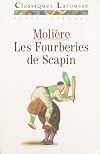
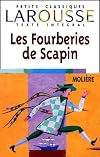
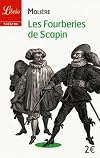
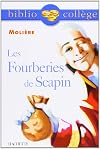
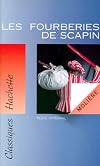
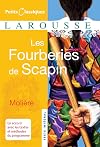
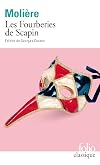
Scapin
by Molière
On This Page
Description
Scapin constantly lies and tricks people to get ahead. He is an arrogant, pompous man who acts as if nothing were impossible for him. However, he is also a diplomatic genius. He manages to play the other characters off of each other very easily, and yet manages to keep his overall goal--to help the young couples--in sight.Tags
Recommendations

































Member Reviews
Moliere, possibly one of the greatest French play writes, has produced a brilliant comedy. This is one of the first examples of a trickster figure thinking ahead. He (Scapin) uses deceit, flattery, deductive reasoning and fast paced language to develop his trick. The plot is quite comical, lending itself to be read again and again.
Gros comique qui, à mon avis, a moins d'intérêt que certaines de ses autres pièces
May 22, 2006French
Les Fourberies de Scapin est une pièce de théâtre de Molière, créée au Théâtre du Palais Royal le 24 mai 1671. Venant juste après les créations de pièces plus sombres comme Tartuffe ou Dom Juan, Molière revient à la comédie fortement empreinte de comédie italienne. Le spectacle n'obtient pas alors un grand succès public, et Nicolas Boileau lui reproche son côté populaire, Fénelon l'exagération des caractères. De cette œuvre est pourtant passée non seulement à la postérité, mais encore dans le langage populaire, la réplique : « Mais qu'allait-il faire dans cette galère ? » que l'on retrouve jusque dans l'expression triviale « Quelle galère ! »...
Nov 12, 2010French
Ratings
Members
- Recently Added By
Lists

100 Books to Read in a Lifetime (That Are Older Than 200 Years)
415 works; 176 members

My Play Collection
769 works; 3 members
Author Information

1,116+ Works 22,719 Members
The French dramatist Moliere was born Jean-Baptiste Poquelin on January 15, 1622, in Paris. The son of a wealthy tapestry merchant, he had a penchant for the theater from childhood. In 1636, he was sent off to school at the Jesuit College of Claremont and in 1643, he embarked upon a 13-year career touring in provincial theater as a troupe member show more of Illustre Theatre, a group established by the family Bejarts. He married a daughter of the troupe, Armande Bejart, in 1662 and changed his name to Moliere. The French King Louis XIV, becoming entranced with the troupe after seeing a performance of The Would-Be Gentleman, lent his support and charged Moliere with the production of comedy ballets in which he often used real-life human qualities as backdrops rather than settings from church or state. Soon, Moliere secured a position at the Palais-Royal and committed himself to the comic theater as a dramatist, actor, producer, and director. Moliere is considered to be one of the preeminent French dramatists and writers of comedies; his work continues to delight audiences today. With L'Ecole des Femmes (The School for Wives) Moliere broke with the farce tradition, and the play, about the role played by women in society and their preparation for it, is regarded by many as the first great seriocomic work of French literature. In Tartuffe (1664), Moliere invented one of his famous comic types, that of a religious hypocrite, a character so realistic that the king forbade public performance of the play for five years. Moliere gave psychological depth to his characters, engaging them in facial antics and slapstick comedy, but with an underlying pathos. Jean Baptiste Moliere died in 1673. (Bowker Author Biography) show less
Some Editions
Series
Belongs to Publisher Series
Gallimard, Folio (3231)
Wereldbibliotheek (16)
Work Relationships
Is contained in
Has the adaptation
Common Knowledge
- Canonical title
- Scapin's Schemings; Scapin
- Original title
- Les Fourberies De Scapin
- Alternate titles*
- De aerdige bedriegeryen van Schapin
- Original publication date
- 1671 (1e représentation française) (1e représentation française)
- People/Characters*
- Scapin; Scapino; Schapin
- Important places*
- Parijs, Île-de-France, Frankrijk
- Original language*
- Frans
*Some information comes from Common Knowledge in other languages. Click "Edit" for more information.
Classifications
Statistics
- Members
- 596
- Popularity
- 49,295
- Reviews
- 4
- Rating
- (3.53)
- Languages
- 7 — Catalan, Dutch, English, French, German, Italian, Spanish
- Media
- Paper, Audiobook, Ebook
- ISBNs
- 74
- UPCs
- 1
- ASINs
- 15