On This Page
Description
Literaturverz. S. [313] - [314]Tags
Recommendations




















Member Reviews
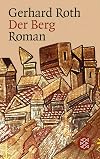
Der Berg is the third volume in Austrian author Gerhard Roth’s “Orkus” series, and like the previous ones it is formally a variation on the crime novel – while Der See was a police procedural, Der Plan a noir novel, Der Berg is a spy thriller.
The novel’s protagonist, Gartner (I don’t think we ever get to find out his first name), is a journalist ostensible writing a piece on Athos (the mountain of the title) but only uses this as a cover for his real, secret mission. That mission consists of attempting to meet the elusive poet Goran R. (whose last name I am fairly certain we never get to find out) who is in hiding because he supposedly witnessed a massacre in Bosnia and now has several secret services searching for him. show more Again, Gartner purports to want to track down Goran R. to find out the truth about the massacre, but in the course of the novel seems much more interested the man’s poetry; pictures of, pages from and other references to Goran R.’s only book of poetry keep popping up wherever Gartner goes.
Like the previous novels in the series, Der Berg is pervaded by a sense of the narrative not to be trusted, of reality squirming and shifting beneath us; but unlike the previous novels, this times it is not so much the novel’s narrator that is unreliable but rather reality itself. It might seem differently at first – when right at the start of the novel Gartner looks through a car window and notices that the world outside looks like a movie, then this appears to be a case of subjective perception distorting the objective world (a classic modernist trope). But by the time when, right at the end of the novel, Gartner settles down in a cinema and the film playing opens with exactly the scene he was watching from the car at the novel’s beginning, it has become clear that Gartner’s perception was correct, and that the world is objectively fictional (a classic postmodernist trope).
True to the spy novel genre, Der Berg charts its course through a field of conflicting forces, all of which hunt after an elusive truth (although not necessarily to uncover it) and are quite ruthless in the means they apply to reach their end. The novel’s protagonist is inextricably caught up in this, his own life possibly in danger, and in the end he becomes persona non grata in two countries. Goran R. might be dead at this stage, or he might not, we never really get any certainty about that. What we are certain about, however, is that Gartner has failed in his mission, that he didn’t find out the truth about the massacre in Bosnia and will not write the big scoop on it. In fact, that truth might not have been there in the first place, and this is where Roth gives the espionage genre a distinct literary twist (not unlike what he did with Noir in Der Plan). There is one key scene in the novel where one of the many shady characters populating it tries to uncover the true, original state of an icon, chemically scrubbing away layer after layer of forgeries that have been added to the original; when he finally reaches the lowermost layer it turns out to be nothing but a smear of colour across the canvas and he dismisses the icon as a forgery. But the reader at this stage in the novel might already have become sensitive to a proliferation of images that are scratched, blurred, half-melted or in other ways damaged and robbed of their representational functions, images that, precisely by virtue of their not showing anything seem in oblique ways to hint at a truth that eludes a more direct grasp, a truth that is accessible only by way of a certain fuzziness, in allusion and metaphor, abstract painting and poetry.
Stylistically, Der Berg is the most sparse in Roth’s “Orkus” series so far, it is completely missing the colourful bursts that exploded into extended poetical flights on the page, and is completely given over to a dry, report-like style of writing – there might not be as much as a single metaphor in the entire novel. At the same, however, Roth weaves a very tight net of interrelations and cross-references, connecting themes and motifs, charging the text with implied significance until it is almost humming with its energy, making this the densest novel in the series so far. While I think that overall Der Plan was slightly more successful as a work of art, the series as a whole continues to excite, and I’m very curious where else Roth is going to take it. show less
The novel’s protagonist, Gartner (I don’t think we ever get to find out his first name), is a journalist ostensible writing a piece on Athos (the mountain of the title) but only uses this as a cover for his real, secret mission. That mission consists of attempting to meet the elusive poet Goran R. (whose last name I am fairly certain we never get to find out) who is in hiding because he supposedly witnessed a massacre in Bosnia and now has several secret services searching for him. show more Again, Gartner purports to want to track down Goran R. to find out the truth about the massacre, but in the course of the novel seems much more interested the man’s poetry; pictures of, pages from and other references to Goran R.’s only book of poetry keep popping up wherever Gartner goes.
Like the previous novels in the series, Der Berg is pervaded by a sense of the narrative not to be trusted, of reality squirming and shifting beneath us; but unlike the previous novels, this times it is not so much the novel’s narrator that is unreliable but rather reality itself. It might seem differently at first – when right at the start of the novel Gartner looks through a car window and notices that the world outside looks like a movie, then this appears to be a case of subjective perception distorting the objective world (a classic modernist trope). But by the time when, right at the end of the novel, Gartner settles down in a cinema and the film playing opens with exactly the scene he was watching from the car at the novel’s beginning, it has become clear that Gartner’s perception was correct, and that the world is objectively fictional (a classic postmodernist trope).
True to the spy novel genre, Der Berg charts its course through a field of conflicting forces, all of which hunt after an elusive truth (although not necessarily to uncover it) and are quite ruthless in the means they apply to reach their end. The novel’s protagonist is inextricably caught up in this, his own life possibly in danger, and in the end he becomes persona non grata in two countries. Goran R. might be dead at this stage, or he might not, we never really get any certainty about that. What we are certain about, however, is that Gartner has failed in his mission, that he didn’t find out the truth about the massacre in Bosnia and will not write the big scoop on it. In fact, that truth might not have been there in the first place, and this is where Roth gives the espionage genre a distinct literary twist (not unlike what he did with Noir in Der Plan). There is one key scene in the novel where one of the many shady characters populating it tries to uncover the true, original state of an icon, chemically scrubbing away layer after layer of forgeries that have been added to the original; when he finally reaches the lowermost layer it turns out to be nothing but a smear of colour across the canvas and he dismisses the icon as a forgery. But the reader at this stage in the novel might already have become sensitive to a proliferation of images that are scratched, blurred, half-melted or in other ways damaged and robbed of their representational functions, images that, precisely by virtue of their not showing anything seem in oblique ways to hint at a truth that eludes a more direct grasp, a truth that is accessible only by way of a certain fuzziness, in allusion and metaphor, abstract painting and poetry.
Stylistically, Der Berg is the most sparse in Roth’s “Orkus” series so far, it is completely missing the colourful bursts that exploded into extended poetical flights on the page, and is completely given over to a dry, report-like style of writing – there might not be as much as a single metaphor in the entire novel. At the same, however, Roth weaves a very tight net of interrelations and cross-references, connecting themes and motifs, charging the text with implied significance until it is almost humming with its energy, making this the densest novel in the series so far. While I think that overall Der Plan was slightly more successful as a work of art, the series as a whole continues to excite, and I’m very curious where else Roth is going to take it. show less
Ratings
Members
- Recently Added By
Published Reviews
Roth macht sich auf die Suche nach seiner Aufgabe als Schriftsteller, nach seiner Funktion, den Dingen auf den Grund zu gehen, Verdrängtes ins Bewusstsein zurück zu holen; somit befasst sich der österreichische Autor angesichts der jüngsten Geschichte im ehemaligen Jugoslawien auch wieder mit den "Archiven des Schweigens", mit den Verdrängungsmechanismen, der falschen show more Vergangenheitsbewältigung und der Geschichtsfälschung einer Generation - verkörpert in Goran R.
So gesehen ist "Der Berg" keine literarische Flucht vor der Wirklichkeit, eher eine Stellungnahme, sich nicht einnehmen zulassen und stattdessen über die Lage der österreichischen Nation zumindest literarisch zu schweigen. show less
So gesehen ist "Der Berg" keine literarische Flucht vor der Wirklichkeit, eher eine Stellungnahme, sich nicht einnehmen zulassen und stattdessen über die Lage der österreichischen Nation zumindest literarisch zu schweigen. show less
added by Indy133
Author Information

54+ Works 547 Members
Series

Common Knowledge
- Original publication date
- 2000
- People/Characters
- Victor Gartner
- First words
- Der Wagen setzte ihn an der Ecke vor dem Haupteingang zur Aristoteles-Universität in der Panepistimiou ab.
Classifications
Statistics
- Members
- 24
- Popularity
- 1,112,494
- Reviews
- 1
- Rating
- (3.67)
- Languages
- German
- Media
- Paper, Ebook
- ISBNs
- 2
- ASINs
- 2