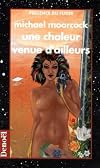
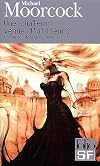
An Alien Heat
by Michael Moorcock
The End of Time (1), The Dancers at the End of Time (01), The Eternal Champion (The End of Time book 1)
On This Page
Description
Vol. one of a trilogy "The dancers at the end of time."Tags
Recommendations





















Member Reviews
In the far future, humankind has gained the power of gods, and has stopped worrying about silly things like morality. The word "decadent" doesn't even have any meaning, because everything is decadent. Jherek Carnelian is no exception to this, but he does have some odd interests: he is fascinated by late 19th century culture, or at least what he perceives to be late nineteenth century culture. Since he knows about as much about the 19th century as we know about the stone age, some of his perceptions are odd, to say the least: he seems to be convinced, for example, that parrots and buffalo are natural enemies.
Jherek and his compatriots are always in search of new, exciting experiences to alleviate the boredom that comes with being show more godlike. Much of their entertainment stems from various alien visitors and time travelers, who appear in their time either on purpose or by some freakish time warp. When Jherek proposes to "fall in love" with a lovely young traveler from the 19th century, it is welcomed as the most exciting new game. But Jherek is disconcerted when he begins to realize that this is perhaps no game at all...
This is a funny, odd novel, a sort of science fictional comedy of manners. Parts of it made me think that if Oscar Wilde wrote science fiction, he may have come up with something like this. I totally loved it, but it's such an all around weird novel that it's definitely not for everyone. show less
Jherek and his compatriots are always in search of new, exciting experiences to alleviate the boredom that comes with being show more godlike. Much of their entertainment stems from various alien visitors and time travelers, who appear in their time either on purpose or by some freakish time warp. When Jherek proposes to "fall in love" with a lovely young traveler from the 19th century, it is welcomed as the most exciting new game. But Jherek is disconcerted when he begins to realize that this is perhaps no game at all...
This is a funny, odd novel, a sort of science fictional comedy of manners. Parts of it made me think that if Oscar Wilde wrote science fiction, he may have come up with something like this. I totally loved it, but it's such an all around weird novel that it's definitely not for everyone. show less
My feelings on this book are mixed. Purely as a story, I did not much like it. It was painful watching Jherek, unaware of the social conventions of Victorian England, attempt to woo Mrs. Underwood, and even worse watching him stumble through Victorian London, utterly oblivious to the inappropriateness of his behavior. This left me feeling a kind of vicarious embarrassment that made reading An Alien Heat a chore, not a pleasure. I also found myself agreeing with Li Po, a captive from the 23rd century, as he berated the humans living in the very distant future: "What ghosts you are. What pathetic fantasies you pursue. You play mindless games, without purpose or meaning, while the universe dies around you." Based only on the plot, and the show more main thread of the narrative, I'd probably have given An Alien Heat two stars.
However, the book is somewhat redeemed for me by its background detail: its world-building. There were many references to the storied past of humanity. Dozens of past ages, usually with tantalizingly evocative names, are mentioned in just a few paragraphs, leaving me wishing that Moorcock had written something more about them. Of course, given that the remaining humans at the end of time are more concerned with spectacle, their own peculiar sense of aesthetics, and above all, with avoiding boredom, and don't care much about historical accuracy, those past ages might end up being less interesting than they sounded. But this was sufficiently intriguing that I gave the book overall three stars. show less
However, the book is somewhat redeemed for me by its background detail: its world-building. There were many references to the storied past of humanity. Dozens of past ages, usually with tantalizingly evocative names, are mentioned in just a few paragraphs, leaving me wishing that Moorcock had written something more about them. Of course, given that the remaining humans at the end of time are more concerned with spectacle, their own peculiar sense of aesthetics, and above all, with avoiding boredom, and don't care much about historical accuracy, those past ages might end up being less interesting than they sounded. But this was sufficiently intriguing that I gave the book overall three stars. show less
The few beings left on Earth at the End of Time amuse themselves by re-arranging the molecules around them into artistic scenes and collecting space and time travelers. Jherek Carnelian, unique by virtue of being born instead of created, decides to fall in love on a lark and pursues the object of his affections through time to the 19th century.
This is very gentle science fiction: the world-ending apocalypse (the end of time) is laughed at by Jherek and his friends, and everyone is so good-natured that you can't help liking them, as Mrs. Amelia Underwood discovers. Pairing the innocence of Jherek (who gets so nervous during his heist of Mrs. Amelia Underwood that he almost ruins it) with the innocence that young women like Mrs. Amelia show more Underwood were supposed to have at the turn of the 19th/20th century is comic, but also very sweet. show less
This is very gentle science fiction: the world-ending apocalypse (the end of time) is laughed at by Jherek and his friends, and everyone is so good-natured that you can't help liking them, as Mrs. Amelia Underwood discovers. Pairing the innocence of Jherek (who gets so nervous during his heist of Mrs. Amelia Underwood that he almost ruins it) with the innocence that young women like Mrs. Amelia show more Underwood were supposed to have at the turn of the 19th/20th century is comic, but also very sweet. show less
This almost got four stars. I had just escaped from an endless lame overblown self indulgent tome of great vapidity. This was a near perfect palate cleanser. For the whole day and a half it took me to read I was giddy with glee over Moorcock's ability to actually tell a story concisely and with humor! Incidents! Characters! Scenery! Its not six hundred pages long! Things actually happen! What? You can make me see Jerek Carnelian and the Duke of Queens and the Eternal Concubine in just a few sentences? Amazing! Exhilarating!!
When I came down off the high, I realized it may have borrowed some glamour from just not being as awful as what had come before. So deducting for the borrowed glamor, I come down on liked it, but not loved it. Not show more that this isn't fun. It is fun. But for me the hijinks are just a little bit labored. It made me smile, but it didn't actually make me laugh. Plus it telegraphs that there will be a sequel, and I'm not a huge fan of that particular maneuver.
Still, well done Mr. Moorcock, well done. I am grateful that you don't think you are too important and full of deep existential angst to deign to entertain your readers. show less
When I came down off the high, I realized it may have borrowed some glamour from just not being as awful as what had come before. So deducting for the borrowed glamor, I come down on liked it, but not loved it. Not show more that this isn't fun. It is fun. But for me the hijinks are just a little bit labored. It made me smile, but it didn't actually make me laugh. Plus it telegraphs that there will be a sequel, and I'm not a huge fan of that particular maneuver.
Still, well done Mr. Moorcock, well done. I am grateful that you don't think you are too important and full of deep existential angst to deign to entertain your readers. show less
Jherek Carnelian has a problem. Technically, the entire human race has a problem. Their needs have been met with the help of power rings and an essentially unlimited power source. Their wants have also been met thanks to a technology that allows every person on earth to modify anything on earth to suit their whims. Blue sun and orange sky? Done. Want to be a monkey today? Done. Want to jump off a cliff, experience death and get resurrected? Done and done. The problem that Jherek has is boredom. Humans play little games of intrigue without any true purpose and without any true passion. They don't need to win because there is no cost to failure. They don't need morals because society has evolved to the point where they don't need any. show more People inherently respect one another and do not violate one another. And between two consenting adults, anything is fair game. Nothing brings this point home quite like a little incest in the first five pages.
Into this exceptionally free environment is introduced a married missionary's daughter from 1896. Our young Jherek is infatuated with Mrs. Amelia Underwood and goes to some exceptional lengths to win her and the woo her. And just when they are about to confess their love for one another, an intrigue plays itself out and Mrs. Underwood is returned to her own time. Jherek follows and tries to rescue her. Hilarity ensues as Jherek discovers that his own recreations of the 19th century are very, very different from actual history.
I found this book to be one that I enjoyed a great deal. There is quite a lot that is truly funny here. Like the old whispering game where things get completely mangled as they travel down a line of people - well even the most well known of historical events and names get mangled over millions of years of history. I also found the relatively light-heartedness of this story to be a welcome relief from some of the heavier stories from some of the other incarnations of the Eternal Champion. I'm really looking forward to reading more of the adventures of our young Carnelian. show less
Into this exceptionally free environment is introduced a married missionary's daughter from 1896. Our young Jherek is infatuated with Mrs. Amelia Underwood and goes to some exceptional lengths to win her and the woo her. And just when they are about to confess their love for one another, an intrigue plays itself out and Mrs. Underwood is returned to her own time. Jherek follows and tries to rescue her. Hilarity ensues as Jherek discovers that his own recreations of the 19th century are very, very different from actual history.
I found this book to be one that I enjoyed a great deal. There is quite a lot that is truly funny here. Like the old whispering game where things get completely mangled as they travel down a line of people - well even the most well known of historical events and names get mangled over millions of years of history. I also found the relatively light-heartedness of this story to be a welcome relief from some of the heavier stories from some of the other incarnations of the Eternal Champion. I'm really looking forward to reading more of the adventures of our young Carnelian. show less
Michael Moorcock is a blast from the past. In this 70's satire of a future where all is possible an permissible, he wastes no time in getting to the mo-fo-ery. Jherek is playing games to find new emotions when the realities of space aliens, the end of the universe and time travel are just too boring for words. It's goofy and light-hearted and weird and I wonder where it will head next.
I've made a point of buying several Moorcock books in my various trips to library sales. Given his outspokenness about various science fiction and fantasy writers, such as Heinlein and Tolkien, one might think that his own fiction would be a worthy counterpoint to such. Alas, if this book is an example of Moorcock's best work – as some have claimed – then I am loath to read any of the other books that I have picked up. (Though, I will still probably read some of the Elric series...at some point, maybe.)
The story is confused, and somewhat confusing, at least at the beginning. While there are a few clever turns of phrase and droll ironies of clashing culture (some of the historical inaccuracies believed by the characters reminds me of show more Poe's "Mellonta Tauta"), there is little to motivate the reader to discover what happens to the characters in the story. In fact, had it not been so short of a book – just shy of 150 pages – I likely wouldn't have bothered to finish it. I don't expect to read any of the sequels.
I will say that Moorcock has a way with description. Probably the best aspect of the book is his ability to evoke images, often incredibly fantastic ones. show less
The story is confused, and somewhat confusing, at least at the beginning. While there are a few clever turns of phrase and droll ironies of clashing culture (some of the historical inaccuracies believed by the characters reminds me of show more Poe's "Mellonta Tauta"), there is little to motivate the reader to discover what happens to the characters in the story. In fact, had it not been so short of a book – just shy of 150 pages – I likely wouldn't have bothered to finish it. I don't expect to read any of the sequels.
I will say that Moorcock has a way with description. Probably the best aspect of the book is his ability to evoke images, often incredibly fantastic ones. show less
Members
- Recently Added By
Author Information

657+ Works 64,856 Members
Michael Moorcock, 1939 - Writer Michael Moorcock was born December 18, 1939 in Mitcham, Surrey, England. Moorcock was the editor of the juvenile magazine Tarzan Adventures from 1956-58, an editor and writer for the Sexton Blake Library and for comic strips and children's annuals from 1959-61, an editor and pamphleteer for Liberal Party in 1962, show more and became editor and publisher for the science fiction magazine New Worlds in 1964. He has worked as a singer-guitarist, has worked with the rock bands Hawkwind and Blue Oyster Cult and is a member of the rock band Michael Moorcock and the Deep Fix. Moorcock's writing covers a wide range of science fiction and fantasy genres. "The Chronicles of Castle Brass" was a sword and sorcery novel, and "Breakfast in the Ruins: A Novel of Inhumanity" uses the character Karl Glogauer as a different person in different times. Karl participates in the political violence of the French Revolution, the Paris Commune, and a Nazi concentration camp. Moorcock also wrote books and stories that featured the character Jerry Cornelius, who had no consistent character or appearance. "The Condition of Muzak" completed the initial Jerry Cornelius tetralogy and won Guardian Literary Prize in 1977. "Byzantium Endures" and "The Laughter of Carthage" are two autobiographical novels of the Russian emigre Colonel Pyat and were the closest Moorcock came to conventional literary fiction. "Byzantium Endures" focuses on the first twenty years of Pyat's life and tells of his role in the Russian revolution. Pyat survives the revolution and the subsequent civil war by working first for one side and then another. "The Laughter of Carthage" covers Pyat's life from 1920-1924 telling of his escape from Communist Russia and his travels in Europe and America. It's a sweeping picture of the world during the 1920's because it takes the character from living in Constantinople to Hollywood. Moorcock returned to the New Wave style in "Blood: A Southern Fantasy" (1994) and combined mainstream fiction with fantasy in "The Brothel of Rosenstrasse," which is set in the imaginary city of Mirenburg. MoorCock won the 1967 Nebula Award for Behold the Man and the 1979 World Fantasy Award for his novel, Gloriana. (Bowker Author Biography) show less
Some Editions
Series

The End of Time
9 works (1)

The Dancers at the End of Time
3 works (01)

The Eternal Champion
63 works (The End of Time book 1)
Belongs to Publisher Series
Ullstein Science Fiction (31064)
Gallimard, Folio SF (174)
Work Relationships
Common Knowledge
- Canonical title
- An Alien Heat
- Original title
- An alien heat
- Alternate titles*
- Die Zeitmenagerie
- Original publication date
- 1972-10
- People/Characters
- Jherek Carnelian; Amelia Underwood; Lord Jagged of Canaria; Mongrove; Snoozer Vine; My Lady Charlotina (show all 15); The Iron Orchid; Mr Griffiths; Li Pao; The Duke of Queens; Yusharisp; Brannart Morphail; Reverend Lowndes; O'Kala Incarnadine; Mistress Christia, the everlasting concubine
- Epigraph
- The silver lips of lilies virginal, The full deep bosom of the enchanted rose Please less than flowers glass-hid from frosts and snows For whom an alien heat makes festival. THEODORE WRATISLAW Hothouse Flowers 1896
- Dedication
- For Nik Turner, Dave Brock, Bob Calvert, DikMik, Del Dettmar, Terry Ollis, Simon King and Lemmy of Hawkwind.
- First words
- The cycle of the Earth (indeed, the universe, if the truth had been known) was nearing its end and the human race had at last ceased to take itself seriously.
- Last words
- (Click to show. Warning: May contain spoilers.)'And then you will be happy!' He looked at her in mild surprise. 'How do you mean, mother, "Happy"?'
- Original language*
- Englisch
*Some information comes from Common Knowledge in other languages. Click "Edit" for more information.
Classifications
Statistics
- Members
- 798
- Popularity
- 34,450
- Reviews
- 15
- Rating
- (3.62)
- Languages
- 5 — Dutch, English, French, German, Swedish
- Media
- Paper, Ebook
- ISBNs
- 14
- ASINs
- 18