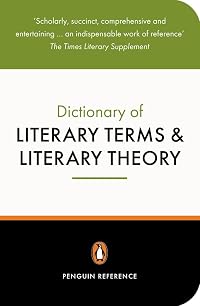
The Penguin Dictionary of Literary Terms and Literary Theory
by J. A. Cuddon
On This Page
Description
With new entries and sensitive edits, this fifth edition places J.A. Cuddon's indispensable dictionary firmly in the 21st Century. Written in a clear and highly readable style Comprehensive historical coverage extending from ancient times to the present day Broad intellectual and cultural range Expands on the previous edition to incorporate the most recent literary terminology New material is particularly focused in areas such as gender studies and queer theory, post-colonial theory, show more post-structuralism, post-modernism, narrative theory, and cu show lessTags
Recommendations












Member Reviews
I have been dipping in and out of this behemoth during our year of plague. What a remarkable volume it is! Cuddon was a true intellect, a storehouse of literary knowledge, and he here tosses scraps of his enduring wisdom to we poor beggars at the feast. There are two things that make this stand out. First, Cuddon reminds us that we have forgotten how to be true literary omnivores. He will throw in half of a poem by Dryden or Crabbe or Manley Hopkins or Housman, reflect briefly on works from the Ancient Era through to the 1980s, and encourage us to be better, more accommodating readers. To treat Milton and Eliot on the same level, or Brecht and Osborne. Second, Cuddon reminds us that we have - in our own dispiriting 21st century way - show more forgotten how to love. Or, conversely, we have forgotten the theory of "aesthetic distance" - you'll need to look that up in this dictionary, but at heart it covers the notion of how attached we should get to a text's ideology and meaning to us personally, as opposed to its literary value and meaning intended by the author. Cuddon is not hung up on whether a movement, author, or philosophy quoted within fits with our modern sensibilities, nor whether it ticks a box on some well-meaning checklist. This is about quality and intent, nothing more.
Well, almost. Cuddon is also unashamedly personal; this is his work, and he'll damn sure make you aware of that! (At one point, he rather cheekily refers to "those poets who suffered from Imagism"!)
Bravo. show less
Well, almost. Cuddon is also unashamedly personal; this is his work, and he'll damn sure make you aware of that! (At one point, he rather cheekily refers to "those poets who suffered from Imagism"!)
Bravo. show less
Ok, the book is quite *hefty*, but it does become very handy if you are studying for an English degree. I had a smaller one, but I ended up buying this one because I was losing out on some literary criticism terms. Some entries do takes a certain number of pages, and can be quite confusing, but other ones are fine, and the terms allowed me to understand some particularly complicated terms. This book will be kept on my shelves, because it has become an essential tool for my studies.
This is a fantastic resource for English teachers and students. Most entries are easily accessible for students at the college level.
Invaluable resource for a literature undergrad. Tells you the answers to all those questions you felt too stupid to ask in class!
Over the past twenty years J. A. Cuddon's "Dictionary of Literary Terms and Literary Theory" has become firmly established as a classic work of reference. Now in its fourth edition, complete with many new entries and insights, it remains the most comprehensive and accessible work of its kind and constitutes essential reading for students, teachers and general readers alike.
* Contains over 2000 articles on all aspects of literary terminology and theory
* Gives definitions of technical terms (iamb, hamartia, zeugma) and critical jargon (intertextuality, aporia, binary opposition)
* Explores literary movements (neo-classicism, romanticism, vorticism) and schools of literary theory (new historicism, structuralism, feminist criticism)
* Covers show more genres (elegy, fabliau, pastoral) and literary forms (sonnet, haiku, ottava, rima)
'Scholarly, succinct, comprehensive and entertaining, this is an important book, an indispensable work of reference. It draws on literature of many languages and quotes aptly and freshly from our own'
- The Times Educational Supplement
'Some entries accomplish cameo wonders of literary history. Others are funny ... generously and urbanely compiled'
- The New York Times
Read more at http://www.penguin.co.uk/nf/Book/BookDisplay/0,,9780140513639,00.html#yYWLhojZBg... show less
* Contains over 2000 articles on all aspects of literary terminology and theory
* Gives definitions of technical terms (iamb, hamartia, zeugma) and critical jargon (intertextuality, aporia, binary opposition)
* Explores literary movements (neo-classicism, romanticism, vorticism) and schools of literary theory (new historicism, structuralism, feminist criticism)
* Covers show more genres (elegy, fabliau, pastoral) and literary forms (sonnet, haiku, ottava, rima)
'Scholarly, succinct, comprehensive and entertaining, this is an important book, an indispensable work of reference. It draws on literature of many languages and quotes aptly and freshly from our own'
- The Times Educational Supplement
'Some entries accomplish cameo wonders of literary history. Others are funny ... generously and urbanely compiled'
- The New York Times
Read more at http://www.penguin.co.uk/nf/Book/BookDisplay/0,,9780140513639,00.html#yYWLhojZBg... show less
Helpful resource.
Members
- Recently Added By
Author Information

14+ Works 1,760 Members
Series
Belongs to Publisher Series
Common Knowledge
- Canonical title
- The Penguin Dictionary of Literary Terms and Literary Theory
- Original title
- A Dictionary of Literary Terms
- Original publication date
- 1977
- Dedication
- TO THE MASTER AND FELLOWS OF MAGDALENE COLLEGE, CAMBRIDGE, IN GRATITUDE FOR THEIR KINDNESS AND HOSPITALITY
- First words
- Preface to the Third Edition: As is usual in the making of anything one of the main problems at the outset in compiling this dictionary was to decide what to put in and what to omit.
A
Abbey Theater The most famous of Irish theaters and one of the most famous in the British Isles, if not in Europe. It was the centre of the Irish Dramatic movement founded in 1899 by W.B. Yeats and Lady ... (show all)Gregory. - Last words
- (Click to show. Warning: May contain spoilers.)Zhdanovshehina: Later, comparable pressures were put on Alexander Solzhenitsyn, who in 1969 was expelled from the Union of Soviet Writers (q.v.) and in 1974 was deported to West Germany. See also "Dissident Writers".
- Canonical DDC/MDS
- 803
- Canonical LCC
- PN41.C83
Classifications
Statistics
- Members
- 1,403
- Popularity
- 16,846
- Reviews
- 7
- Rating
- (4.07)
- Languages
- English, Norwegian
- Media
- Paper, Ebook
- ISBNs
- 16
- ASINs
- 8