The Contours of American History
by William Appleman Williams
On This Page
Description
William Appleman Williams was one of America's greatest critics of US imperialism. The Contours of American History, first published in 1961, reached back to seventeenth-century British history to argue that the relationship between liberalism and empire was in effect a grand compromise, with expansion abroad containing class and race tensions at home. Coming as it did before the political explosions of the 1960s, Williams's message was a deeply heretical one, and yet the Modern Library show more ultimately chose Contours as one of the best 100 nonfiction books of the 20th Century. show lessTags
Recommendations




















Member Reviews
If you want history from an anti-individualist slant this is the book for you. While criticizing Locke and Smith for their "laissez-faire" outlook he praises the limits they place on the economy. He is basically a mercantilist at heart and this comes through most clearly when he praises Keynes and the "Progressive Movement" for their adherence to the mercantilist tradition.(p446) He concludes his history (ending as the sixties began) with praise for the "socialist reassertion of the . . . ancient ideal of a Christian Commonwealth (as) a viable utopia".(p487) With that and a dollop of praise for Eugene V. Debs he, mercifully, closes the book on his progressive take on American history.
Ratings
Members
- Recently Added By
Lists

Modern Library 100 Best Nonfiction Books
100 works; 8 members
Author Information
23+ Works 805 Members
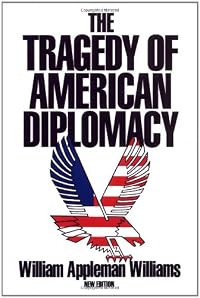
The leading "revisionist" historian during the years of the cold war, William Appleman Williams played a major role in shaping the perceptions of a generation of young historians. His best-known book, The Tragedy of American Diplomacy (1959), established themes he would pursue throughout his career as a writer and a teacher---the contradictions show more between ideals and "practicality" in the conduct of U.S. foreign policy and the centrality of economic factors in the nation's world outlook. Product of a solidly rural Iowa background and a graduate of the U.S. Naval Academy at Annapolis, Williams nonetheless became a figure of controversy because of his unconventional, often iconoclastic, observations about the American experience and his subjection of capitalism to a searching criticism that borrowed freely from Karl Marx, even as it rejected doctrinaire Marxism. At a time when most historians subscribed to a generally benevolent view of the nation's past and of its role in world affairs, Williams's freewheeling critiques often irritated the older generation of scholars. Yet they also opened the way for younger historians to break from the "consensus" school of history and enter into previously unexplored pathways to the American past. (Bowker Author Biography) show less
Some Editions
Awards and Honors
Notable Lists
Common Knowledge
- Canonical title
- The Contours of American History
- Epigraph
- One may easily see history as only a succession of chances or conjunctures -- but, if so, there is nothing to study, there are no correlations to be made between events, and in fact there is only a rope of sand, a series o... (show all)f non sequiturs which one can do nothing but narrate...
But it is the optical illusion or the occupational disease of the research student to imagine that only the details matter, and that the details are all of equal value -- that the statesman has no cohesive purpose but is merely a bundle of contradictions -- and that everything is under the rule of chance, under the play of absurdly little chances -- history reducing itself at the finish to an irony of circumstance.
Herbert Butterfiled, 1959
I have always thought that the basic division among human beings is between those preoccupied with the question "How" and those preoccupied with the question "Why." This is a great "How" age. But "Why" questions remain u... (show all)nanswered, and will doubtless in due course again claim attention.
Malcolm Muggeridge, 1958 - Dedication
- In memory of my father, and for my mother;
parents who gave me by example the wisdom and
the life inherent in both meanings
of Napoleon's neglected axiom:
You commit yourself, and then -- you se... (show all)e. - First words
- Anthony Ashley Cooper, more usually known as Lord Ashley or the first Earl of Shaftesbury, was a man of the world in an age when the world had become immense.
- Last words
- (Click to show. Warning: May contain spoilers.)Otherwise, they would ultimately fall victims of a nostalgia for their childhood.
Classifications
Statistics
- Members
- 160
- Popularity
- 203,643
- Reviews
- 1
- Rating
- (3.80)
- Languages
- English
- Media
- Paper, Ebook
- ISBNs
- 9
- ASINs
- 6