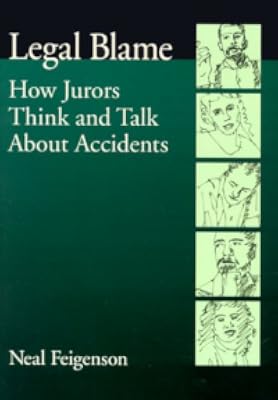
Legal Blame: How Jurors Think and Talk About Accidents (Law and Public Policy: Psychology and the Social Sciences)
by Neal Feigenson
On This Page
Description
This text explores how jurors try to do justice in the wake of accidents, and reveals much about the overall psychology of jury decision-making. Neal Feigenson, a professor of law, offers a framework for how jurors deploy their common sense, together with the law and the facts, to produce what the author refers to as ""total justice"". Feigenson analyzes both the words lawyers use to help jurors assign blame and the words jurors themselves use as they make decisions. With a minimal use of show more jargon, he summarizes the leading research from social and cognitive psychology to show how everyday habits of thought and feeling inform jurors' decisions. Contrary to common stereotypes about jurors, jurors integrate their thoughts and feelings to reach decisions that are usually correct enough by legal standards, although not always for what the law would consider the right reasons. This text provides a nuanced appreciation of the civil jury, with examples and in-depth analysis of how jurors help make tort law. show lessTags
Members
- Recently Added By
Author Information
3 Works 21 Members
Neal Feigenson, JD, is Professor of Law at Quinnipiac College School of Law in Hamden, CT
Classifications
- Genres
- Politics and Government, Nonfiction
- DDC/MDS
- 347.73 — Society, government, & culture Law U.S. Supreme Court - Judicial Decisions North America Civil procedure and courts of the United States
- LCC
- KF8972 .F45 — Law Law of the United States Law of the United States (Federal) Courts. Procedure Civil procedure
Statistics
- Members
- 9
- Popularity
- 2,311,658
- Languages
- English
- Media
- Paper
- ISBNs
- 2