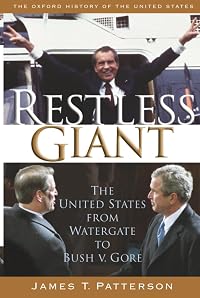
Restless Giant: The United States from Watergate to Bush vs. Gore
by James T. Patterson
Oxford History of the United States (11)
On This Page
Description
'Two Billion Cars' is both a concise history of America's love affair with cars and an overview of the global auto industry. The authors, both leading transport specialists, contend that two chief polluters - California and China - are taking the lead in embracing eco-friendly policies.Tags
Recommendations















Member Reviews
Historical author James Patterson assesses the twenty-seven years between the resignation of Richard Nixon and the contested election of George W. Bush. This narrative encompasses social, cultural, political, economic, and international developments in a context of "culture wars" between liberals and conservatives. At times, such as calling Gulf War Syndrome a "conspiracy" and with criticisms of sex, etc. in art I feel Patterson is possibly much more conservative than I, yet I feel this does not detract from his historical review and indeed I feel this book, which was for me a very natural and good follow-up to Write It When I'm Gone: Remarkable Off-the-Record Conversations With Gerald R. Ford, does more to explain the basis for and show more path to the current divisiveness in popular political views. I feel this will even be worth re-reading for the detail and connections contained herein. show less
A perfectly readable summary of political and cultural happenings between, as the subtitle puts it, the end of Nixon to the start of Bush II. Readable, but deeply unsatisfying, since Patterson is unwilling to actually exercise any judgement--this is a chronicle, not history. There's no causation here and no suggestion that people may have done good or bad things, just events and more events. The general tenor is "So and so said that this happened. But thus and thus said that that happened. Moving right along..." So you never know what Patterson actually thinks happened, or why you should care, or, indeed, if even he cares. This is all the more offensive when you think about what was about to happen to the U.S.: 9/11 had just passed, and show more he opted not to write about it at all. I imagine he'd make the same decision about the great financial crash. So, particularly in the last few chapters, this becomes an extremely odd read: you know that all the 'steady financial growth' is based on garbage, and that it's all about to fall down, but Patterson doesn't give you any reason to believe that he thought anything other than what the most fatuous optimists of the time thought. America was strong, and would remain strong and so on and so on. There's no hint that he's unhappy with the electoral process that gave us Bush v Gore. No hint that he was disturbed by Reagan's lunacy or Clinton's cynicism.
I skype-reading-grouped this with an historian friend, who summed it up very well. The first wave of books about historical events will be violently partisan. The second wave will revise the partisan arguments. The third will be post-revisionist and almost entirely neutral in tone. Patterson's tried to skip a couple of steps, but because there's no obvious idiotic background against which he can appear reasonable, he himself just looks morally bankrupt. Too bad, because the man can write, and you'll certainly learn a lot from his book. I can easily imagine recommending it as a first stop, but certainly not a state-of-the-art work on the time period. show less
I skype-reading-grouped this with an historian friend, who summed it up very well. The first wave of books about historical events will be violently partisan. The second wave will revise the partisan arguments. The third will be post-revisionist and almost entirely neutral in tone. Patterson's tried to skip a couple of steps, but because there's no obvious idiotic background against which he can appear reasonable, he himself just looks morally bankrupt. Too bad, because the man can write, and you'll certainly learn a lot from his book. I can easily imagine recommending it as a first stop, but certainly not a state-of-the-art work on the time period. show less
This is the last of the Oxford history of the U.S. --- chronologically, though not in order of publication -- and provides a helpful overview of the period from 1975 to 2000. It does not, however, provide the sweep or narrative strength of some of the other volumes in the series. In large part, that may the inevitable result of attempting an historical approach so recent a period. With so many of the key issues of the period still very much unresolved, and so many of its effects still unfolding, it may not be possible to form a compellingly coherent view of what was "really" going on.
But this is still a very valuable book. It traces events on a presidency-by-presidency basis, while sticking with several underlying themes -- cultural show more confrontation at home, the collapse of communism abroad, and increasing political rancor across the board. It treats the very different presidencies of Ronald Reagan and Bill Clinton in an impressively even handed manner, exploring the strengths and failures of each man without evident bias. And it clarifies what too often seems the jumble of recent events. For example, the foreign policy effects of Vietnam are made clear (no troops at risk), as is the gradual move back to military activism. I think that it is too soon for a definitive history of this period to be written. In the meantime, "Restless Giant" serves very well. show less
But this is still a very valuable book. It traces events on a presidency-by-presidency basis, while sticking with several underlying themes -- cultural show more confrontation at home, the collapse of communism abroad, and increasing political rancor across the board. It treats the very different presidencies of Ronald Reagan and Bill Clinton in an impressively even handed manner, exploring the strengths and failures of each man without evident bias. And it clarifies what too often seems the jumble of recent events. For example, the foreign policy effects of Vietnam are made clear (no troops at risk), as is the gradual move back to military activism. I think that it is too soon for a definitive history of this period to be written. In the meantime, "Restless Giant" serves very well. show less
James Patterson's second contribution to the Oxford History of the United States (after his Bancroft Award-winning Grand Expectations: The United States, 1945-1974) is by far the weakest volume of the series. Part of it is the result of the problem posed by contemporary history, which lacks the perspective provided by distance from events and an ability to render an assessment based on knowing what were the long term consequences. Patterson recognizes this difficulty, yet his response exacerbates the problem by refusing to render pretty much any judgments. Instead he provides a bland summary of events, heavily supplemented by statistics, with none of the valuable analysis that characterizes the other volumes of the series. This limits show more the book's utility and ensures that the volume about the most recent events is sure to be the first to outlive its usefulness. show less
5519. Restless Giant The United States from Watergate to Bush v. Gore, by James T. Patterson (read 15 Dec 2017) This is the 11th volume of The Oxford History of the United States, and I have read nine of the 11 and no doubt will seek to read the ones I have not read. This volume deals with a period I lived through and had strong opinions concerning all that went on. I found I did not enjoy reading about things that went wrong during .during the years from 1974 to 2005. The author spends a lot of time on social trends and tends to accentuate the bad. whereas I, having lived through them and not in an area exemplifying the bad, did not view them as dolorously as the author paints them. His coverage of the political events of those years show more is super-interesting even though one does squirm over some of what is related, especially Bill Clinton's personal life which was no doubt what inflicted on us George W. Bush and his disastrous presidency. And since the book was written in 2005 we do not have the pleasure of reading about Obama's election in 2008 and his so satisfying re-election in 2012. But the book is well worth reading and does relate some good things.. show less
Ratings
Members
- Recently Added By
Lists

r/AskHistorians' Recommended Books
1,068 works; 18 members
Author Information
23 Works 1,926 Members
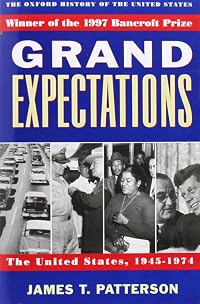
James T. Patterson is an American historian, and Ford Foundation Professor of History emeritus at Brown University. He wrote "Grand Expectations: the United States, 1945-1974," which received the 1997 Bancroft Prize in American history. (The Bancroft prize is one of the most prestigious honors a book of history can received and was established at show more Columbia University in 1948. It's considered to be on par with the Pulitzer Prize because an anonymous jury of peers judges it.) "Grand Expectations" is an interpretation of the explosive growth, high expectations and unusual optimism that Americans experienced after World War II that went into the 1960's. It follows the social, economic and cultural trends, and foreign policy issues, which became less optimistic after the assassinations, the Vietnam War and Watergate. (Bowker Author Biography) show less
Series

Belongs to Publisher Series
Common Knowledge
- Canonical title
- Restless Giant: The United States from Watergate to Bush vs. Gore
Classifications
- Genres
- History, Nonfiction, General Nonfiction
- DDC/MDS
- 973.92 — History & geography History of North America United States 1901- Cold War, Vietnam War, Digital Age (1953-2001)
- LCC
- E839 .P38 — History of the United States United States Later twentieth century, 1961-2000 Political history Un-American activities
- BISAC
Statistics
- Members
- 567
- Popularity
- 52,323
- Reviews
- 5
- Rating
- (3.74)
- Languages
- English, Spanish
- Media
- Paper, Audiobook, Ebook
- ISBNs
- 8
- ASINs
- 6