Diary of a writer
by Fyodor Dostoyevsky
On This Page
Description
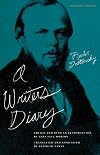
The essential entries from Dostoevsky's complete Diary, called his boldest experiment in literary form, are now available in this abridged edition; it is a uniquely encyclopedic forum of fictional and nonfictional genres. A Writer's Diary began as a column in a literary journal, but by 1876 Dostoevsky was able to bring it out as a complete monthly publication with himself as an editor, publisher, and sole contributor, suspending work on The Brothers Karamazov to do so. The Diary's radical show more format was matched by the extreme range of its contents. In a single frame it incorporated an astonishing variety of material: short stories; humorous sketches; reports on sensational crimes; historical predictions; portraits of famous peop≤ autobiographical pieces; and plans for stories, some of which were never written while others appeared later in the Diary itself. A range of authorial and narrative voices and stances and an elaborate scheme of allusions and cross-references preserve and present Dostoevsky's conception of his work as a literary whole. Selected from the two-volume set, this abridged edition of A Writer's Diary appears in a single paperback volume, along with a new condensed introduction by editor Gary Saul Morson. show lessTags
Recommendations
























Member Reviews
Dit deel van Dostojewski's Verzamelde werken bevat het Dagboek van een schrijver. In 1873 werd Dostojewski redacteur van het weekblad Grazdanin (De burger), waarin hij dit dagboek in maandelijkse afleveringen publiceerde. Het bevat zowel persoonlijke notities, anekdotes en columnachtige stukken als korte verhalen.
Sep 18, 2015Dutch
Très décousu
Oct 26, 2016French
B. Jaquette.
Nov 24, 2013French
Ratings
Members
- Recently Added By
Lists

Best Autobiographies and Memoirs
370 works; 67 members

Books Referenced by Izetbegovic's Islam Between East and West
233 works; 2 members
Author Information

1,521+ Works 181,304 Members
One of the most powerful and significant authors in all modern fiction, Fyodor Dostoevsky was the son of a harsh and domineering army surgeon who was murdered by his own serfs (slaves), an event that was extremely important in shaping Dostoevsky's view of social and economic issues. He studied to be an engineer and began work as a draftsman. show more However, his first novel, Poor Folk (1846), was so well received that he abandoned engineering for writing. In 1849, Dostoevsky was arrested for being a part of a revolutionary group that owned an illegal printing press. He was sentenced to be executed, but the sentence was changed at the last minute, and he was sent to a prison camp in Siberia instead. By the time he was released in 1854, he had become a devout believer in both Christianity and Russia - although not in its ruler, the Czar. During the 1860's, Dostoevsky's personal life was in constant turmoil as the result of financial problems, a gambling addiction, and the deaths of his wife and brother. His second marriage in 1887 provided him with a stable home life and personal contentment, and during the years that followed he produced his great novels: Crime and Punishment (1886), the story of Rodya Raskolnikov, who kills two old women in the belief that he is beyond the bounds of good and evil; The Idiots (1868), the story of an epileptic who tragically affects the lives of those around him; The Possessed (1872), the story of the effect of revolutionary thought on the members of one Russian community; A Raw Youth (1875), which focuses on the disintegration and decay of family relationships and life; and The Brothers Karamazov (1880), which centers on the murder of Fyodor Karamazov and the effect the murder has on each of his four sons. These works have placed Dostoevsky in the front rank of the world's great novelists. Dostoevsky was an innovator, bringing new depth and meaning to the psychological novel and combining realism and philosophical speculation in his complex studies of the human condition. (Bowker Author Biography) show less

Fyodor Dostoyevsky has a Legacy Library. Legacy libraries are the personal libraries of famous readers, entered by LibraryThing members from the Legacy Libraries group.
Some Editions
Series
Belongs to Publisher Series
Work Relationships
Is abridged in
Common Knowledge
- Canonical title
- Diary of a writer
- Original title
- Dnevnik pisatelya; Дневник писателя
- Original publication date
- 1876
Classifications
- Genres
- Fiction and Literature, General Fiction
- DDC/MDS
- 891.78307 — Literature & rhetoric Literatures of other languages East Indo-European and Celtic literatures Russian and East Slavic languages Authors, Russia and Russian miscellany 1800–1917
- LCC
- PG3326 .A16 .B7 — Language and Literature Slavic languages and literatures. Baltic languages. Albanian language Slavic. Baltic. Albanian Russian literature Individual authors and works 1800-1870 Dostoyevsky
- BISAC
Statistics
- Members
- 459
- Popularity
- 66,744
- Reviews
- 3
- Rating
- (3.90)
- Languages
- 15 — Danish, Dutch, English, Finnish, French, German, Italian, Japanese, Norwegian (Bokmål), Portuguese, Russian, Serbian, Spanish, Swedish, Turkish
- Media
- Paper, Ebook
- ISBNs
- 41
- ASINs
- 14