Verse
by John Updike
On This Page
Tags
Recommendations
























Member Reviews
Updike's verse offers a breezy read, but like Lewis Carroll or maybe Pynchon, there seems something thoughtful behind the lunacy and manic wordplay. The characteristic personality of these verses is play, but with a sincerity that belies any sense of frivolity or throw-away farce. I've been revisiting Monty Python's Flying Circus of late, and I recognise a similar stance of commentary on the human condition there as in Updike's poems --though Python are much more absurdist.
I'd love to have a few couplets memorised (like his description of an umbrella), but that never works for me. Instead, I should just pick this up from time to time: poems are short and immediately rewarding.
I'd love to have a few couplets memorised (like his description of an umbrella), but that never works for me. Instead, I should just pick this up from time to time: poems are short and immediately rewarding.
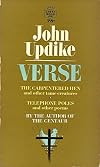
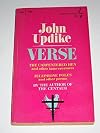
It’s a little paperback book published by Fawcett (1965), called simply Verse cost me 75¢. As best I remember, it may have been the first volume of poetry I ever owned on my own. It brought together two previous collections by John Updike, he Carpentered Hen and Telephone Poles.
How many times I’ve read selections from this little volume aloud to my classes. How many times, in the wee hours of the morning, I’ve chuckled over pages where the book fell open automatically. Back in those days, when the New Criticism was at its height and heady with demands for complexity, this work would indeed have been considered “verse,” not serious poetry. Most of it is humorous, or at least playful.
Just a few quotations as examples:
He show more begins “A Cheerful Alphabet of Pleasant Objects”
Apple
Since Time began, such alphabets begin
With Apple, source of Knowledge and of Sin.
My child, take heart: the fruit that undid Man
Brought out as well the best in Paul Cézanne.
Many of his verses take off from a brief newspaper item. “Youth’s Progress” plays with an announcement that a young man had been elected “Greek god: for an interfraternity ball":
Just turned nineteen, a nicely molded lad,
I said goodbye to Sis and Mother; Dad
Drove me to Wisconsin and set me loose.
At twenty-one, I was elected Zeus.
Igor Stravinsky is quoted as saying, “I despise mountains, they don’t tell me anything.” “Mountain Impasse” concludes
The hill is still before Stravinsky.
The skies in silence glisten.
At last, a rumble, then the mountain:
“Igor, you never listen.”
But Updike, the versifier, occasionally does get serious. There is perhaps his most famous and most frequently anthologized poem, “Ex-Basketball Player.” (It would certainly go in my anthology of the poetry of a lifetime!) There is his version of Horace’s Ode III.ii (“Let the boy, timber-tough from vigorous soldiering, / learn to endure lack amicably”). There’s a tribute to George Washington (“merely Caesar”) and a reflection on “Seagulls” and the moment when he sees a flight of birds in October as “The Great Scarf of Birds.” And, near the end of the collection, there are those carefully structured “Seven Stanzas at Easter”:
Make no mistake: if He rose at all
it was as His body;
if the cells’ dissolution did not reverse, the molecules reknit, the amino acids rekindle,
the Church will fall.
But generally Updike’s verse is light. Fun to browse in, this little book will fit right inside your hip pocket. Enjoy! show less
How many times I’ve read selections from this little volume aloud to my classes. How many times, in the wee hours of the morning, I’ve chuckled over pages where the book fell open automatically. Back in those days, when the New Criticism was at its height and heady with demands for complexity, this work would indeed have been considered “verse,” not serious poetry. Most of it is humorous, or at least playful.
Just a few quotations as examples:
He show more begins “A Cheerful Alphabet of Pleasant Objects”
Apple
Since Time began, such alphabets begin
With Apple, source of Knowledge and of Sin.
My child, take heart: the fruit that undid Man
Brought out as well the best in Paul Cézanne.
Many of his verses take off from a brief newspaper item. “Youth’s Progress” plays with an announcement that a young man had been elected “Greek god: for an interfraternity ball":
Just turned nineteen, a nicely molded lad,
I said goodbye to Sis and Mother; Dad
Drove me to Wisconsin and set me loose.
At twenty-one, I was elected Zeus.
Igor Stravinsky is quoted as saying, “I despise mountains, they don’t tell me anything.” “Mountain Impasse” concludes
The hill is still before Stravinsky.
The skies in silence glisten.
At last, a rumble, then the mountain:
“Igor, you never listen.”
But Updike, the versifier, occasionally does get serious. There is perhaps his most famous and most frequently anthologized poem, “Ex-Basketball Player.” (It would certainly go in my anthology of the poetry of a lifetime!) There is his version of Horace’s Ode III.ii (“Let the boy, timber-tough from vigorous soldiering, / learn to endure lack amicably”). There’s a tribute to George Washington (“merely Caesar”) and a reflection on “Seagulls” and the moment when he sees a flight of birds in October as “The Great Scarf of Birds.” And, near the end of the collection, there are those carefully structured “Seven Stanzas at Easter”:
Make no mistake: if He rose at all
it was as His body;
if the cells’ dissolution did not reverse, the molecules reknit, the amino acids rekindle,
the Church will fall.
But generally Updike’s verse is light. Fun to browse in, this little book will fit right inside your hip pocket. Enjoy! show less
stamp inside front cover
Ratings
Members
- Recently Added By
Author Information

339+ Works 53,362 Members
American novelist, poet, and critic John Updike was born in Reading, Pennsylvania on March 18, 1932. He received an A.B. degree from Harvard University, which he attended on a scholarship, in 1954. After graduation, he accepted a one-year fellowship to study painting at the Ruskin School of Drawing and Fine Art in Oxford, England. After returning show more from England in 1955, he worked for two years on the staff of The New Yorker. This marked the beginning of a long relationship with the magazine, during which he has contributed numerous short stories, poems, and book reviews. Although Updike's first published book was a collection of verse, The Carpentered Hen and Other Tame Creatures (1958), his renown as a writer is based on his fiction, beginning with The Poorhouse Fair (1959). During his lifetime, he wrote more than 50 books and primarily focused on middle-class America and their major concerns---marriage, divorce, religion, materialism, and sex. Among his best-known works are the Rabbit tetrology---Rabbit, Run (1960), Rabbit Redux (1971), Rabbit Is Rich (1981), and Rabbit at Rest (1988). Rabbit, Run introduces Harry "Rabbit" Angstrom as a 26-year-old salesman of dime-store gadgets trapped in an unhappy marriage in a dismal Pennsylvania town, looking back wistfully on his days as a high school basketball star. Rabbit Redux takes up the story 10 years later, and Rabbit's relationship with representative figures of the 1960s enables Updike to provide social commentary in a story marked by mellow wisdom and compassion in spite of some shocking jolts. In Rabbit Is Rich, Harry is comfortably middle-aged and complacent, and much of the book seems to satirize the country-club set and the swinging sexual/social life of Rabbit and his friends. Finally, in Rabbit at Rest, Harry arrives at the age where he must confront his mortality. Updike won the Pulitzer Prize for both Rabbit Is Rich and Rabbit at Rest. Updike's other novels range widely in subject and locale, from The Poorhouse Fair, about a home for the aged that seems to be a microcosm for society as a whole, through The Court (1978), about a revolution in Africa, to The Witches of Eastwick (1984), in which Updike tries to write from inside the sensibilities of three witches in contemporary New England. The Centaur (1963) is a subtle, complicated allegorical novel that won Updike the National Book Award in 1964. In addition to his novels, Updike also has written short stories, poems, critical essays, and reviews. Self-Consciousness (1989) is a memoir of his early life, his thoughts on issues such as the Vietnam War, and his attitude toward religion. He was elected to the American Academy of Arts and Letters in 1977. He died of lung cancer on January 27, 2009 at the age of 76. (Bowker Author Biography) John Updike was born in 1932, in Shillington, Pennsylvania. Since 1957 he has lived in Massachusetts. His novels have won the Pulitzer Prize, the National Book Award, the National Book Critics Circle Award, & the Howells Medal. (Publisher Provided) John Updike was born in 1932 and attended Harvard College and the Ruskin School of Drawing and Fine Art in Oxford, England. Form 1955 to 1957 he was a staff member of The New Yorker, which he contributed numerous writings. Updike's art criticism has appeared in publications including Arts and Antiques, The New Republic, The New York Times Book Review, and Realites, among many others. He is the author of such best-selling novels as Rabbit Run and Rabbit is Rich. His many works of fiction, poetry and criticism have been awarded the Pulitzer Prize, the National Book Award, the American Book Award, and the National Book Critics Circle Award. For the past 40 years he has lived in Massachusetts. (Publisher Provided) John Updike is the author of some 50 books, including collections of short stories, poems, & criticism. His novels have won the Pulitzer Prize, the National Book Award, the National Book Critics Circle Award, & the Howells Medal. Born in Shillington, Pennsylvania, in 1932, he has lived in Massachusetts since 1957. (Publisher Provided) show less
Work Relationships
Classifications
Statistics
- Members
- 89
- Popularity
- 358,827
- Reviews
- 3
- Rating
- (3.21)
- Media
- Paper
- ASINs
- 10