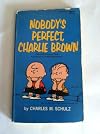
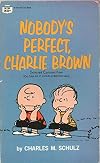
Nobody's Perfect, Charlie Brown
by Charles M. Schulz
Peanuts Fawcett Half-Books (21), Peanuts (Fawcett Half-Books — FC 21)
On This Page
Description
It's rare for someone to emerge in America who can change our attitudes, our beliefs, and our very culture. It's even rarer when that someone is a middle-aged, six-foot three-inch woman whose first exposure to an unsuspecting public is cooking an omelet on a hot plate on a local TV station.nbsp; And yet, that's exactly what Julia Child did.nbsp; The warble-voiced doyenne of television cookery became an iconic cult figure and joyous rule-breaker as she touched off the food revolution that has show more gripped America for more than fifty years. Now, in Bob Spitz's definitive, wonderfully affectionate biography, the Julia we know and love comes vividly -- and surprisingly -- to life.nbsp; In Dearie, Spitz employs the same skill he brought to his best-selling, critically acclaimed book The Beatles, providing a clear-eyed portrait of one of the most fascinating and influential Americans of our time -- a woman known to all, yet known by only a few. At its heart, Dearie is a story about a woman's search for her own unique expression.nbsp; Julia Child was a directionless, gawky young woman who ran off halfway around the world to join a spy agency during World War II.nbsp; She eventually settled in Paris, where she learned to cook and collaborated on the writing of what would become Mastering the Art of French Cooking, a book that changed the food culture of America.nbsp;nbsp; She was already fifty when The French Chef went on the air -- nbsp;at a time in our history when women weren't making those leaps.nbsp; Julia became the first educational TV star, virtually launching PBS as we know it today; her marriage to Paul Child formed a decades-long love story that was romantic, touching, and quite extraordinary. A fearless, ambitious, supremely confident woman, Julia took on all the pretensions that embellished tony French cuisine and fricasseed them to a fare-thee-well, paving the way for everything that has happened since in American cooking, from TV dinners and Big Macs to sea urchin foam and the Food Channel.nbsp; Julia Child's story, however, is more than the tale of a talented woman and her sumptuous craft.nbsp; It is also a saga of America's coming of age and growing sophistication, from the Depression Era to the turbulent sixties and the excesses of the eighties to the greening of the American kitchen.nbsp; Julia had an effect on and was equally affected by the baby boom, the sexual revolution, and the start of the women's liberation movement. On the centenary of her birth, Julia finally gets the biography she richly deserves.nbsp; An in-depth, intimate narrative, full of fresh information and insights, Dearie is an entertaining, all-out adventure story of one of our most fascinating and beloved figures. show lessTags
Recommendations









Member Reviews
This is a detailed biography about Julia Child's life starting with her childhood in Pasadena California, her college years at Smith, work with the OAS in Asia during WWII to her discovery of a passion for French food, which did not come about until she was about 30. I read My Life in France, a biography published after she died, about her years living in France in the late 1940s and 1950s which was quite enjoyable but this paints a more complete picture of this important America icon. With this book I learned so much about how she changed the culinary landscape in America. I was never a regular viewer of any of her popular TV shows, especially those in the later part of her career, so I especially liked learning about how she show more influenced cooking through TV. The book is sprinkled with Julia's humor. She was a passionate woman about food and certain causes--she was staunch supporter of Planned Parenthood and became active in supporting organizations involved with HIV after a close friend and colleague died of AIDS. The author proclaimed he had a huge crush on her“If I have to admit to one prejudice confronting this book it is that I had a powerful crush on her,” Spitz writes in the acknowledgement section. “Sorry. Deal with it.” While it was interesting to learn about her life before WWII, it could have been shorter; a bit too much detail. I did not really enjoy the voice of the reader of this audio book. show less
Ratings
Members
- Recently Added By
Lists

1970s
657 works; 23 members
Author Information

2,321+ Works 69,640 Members
Charles Monroe Schulz, creator of the Peanuts comic strip, was born in Minneapolis, Minnesota on November 26, 1922. He started drawing at a young age, practicing with popular characters such as Popeye. When he was 15, one of his pictures appeared as an illustration in "Ripley's Believe It or Not!" He took a correspondence course with Art show more Instruction Inc., where he later taught, and served in the Army during World War II. The Peanuts (originally called Li'l Folks, a name that was changed by the United Feature Syndicate) began syndication on October 2, 1950, when it appeared in seven newspapers. Schulz's work went on to become the most popular syndicated comic strip of all time, appearing in 2600 papers in 75 countries around the world. Schulz drew everyone of the more than 18,250 Peanuts strips himself and his contract stipulated that no one else would ever draw them. Charlie Brown, Snoopy and the rest of the Peanuts Gang also appear in a number of television specials, the first of which was A Charlie Brown Christmas (1964), created with animator Bill Melendez. It is one of the most watched and best loved television shows in history and winner of an Emmy and a Peabody. Charles Schulz has been inducted into the Cartoonists Hall of Fame and won numerous awards. He was given Reuben Awards by the National Cartoonists Society in 1955 and 1964, the Yale Humor Award (1956), the School Bell Award from the National Education Society (1960), and the Ordre des Artes et des Lettres from the French Ministry of Culture. In 1990, his work was shown at the Louvre. Schulz retired after being diagnosed with colon cancer. The final daily Peanuts strip appeared in January 3, 2000 and the final Sunday strip, along with a letter of thanks to his editors and fans, appeared on February 13, 2000. Schulz died in his home in Santa Rosa, California on February 12, 2000 within hours of the publication of his farewell strip. (Bowker Author Biography) show less
Series


Work Relationships
Is an abridged version of
Common Knowledge
- Original publication date
- 1969
Classifications
- Genre
- Graphic Novels & Comics
- DDC/MDS
- 741.59 — Arts & recreation Drawing & decorative arts Drawing Comic books, graphic novels, fotonovelas, cartoons, caricatures, comic strips History, geographic treatment, biography
- LCC
- NC1429 .S43 — Fine Arts Drawing. Design. Illustration Drawing. Design. Illustration Pictorial humor, caricature, etc.
- BISAC
Statistics
- Members
- 165
- Popularity
- 197,842
- Reviews
- 1
- Rating
- (3.93)
- Languages
- English, German
- Media
- Paper, Audiobook
- ISBNs
- 6
- ASINs
- 9