On This Page
Description
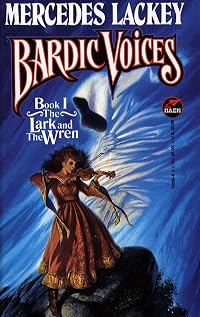
Young, brash, and impulsive, Rune backs up a brag by ascending Skull Hill to play fiddle for the malevolent spirit that resides there, striking a bargain with the ghost to surrender her soul if he tires of her playing before sunrise.Tags
Recommendations







Member Reviews
Rune's dream is to be part of the Bardic Guild, but her dream seems very distant. She's cursed to be working in a small inn and have a bad reputation just because her mother is a whore. What she can do is play a fiddle really, really well. And one day she makes a bet that she can go the Ghost of Skull Hill and survive the night. There the ghost arrives and she makes a deal with him that if she can play all night and not bore him, Rune will live. And all through that night, Rune played her soul out, and lived…with a bag full of silver.
Upon going back, she realizes that her dream to be part of the Guild will never come true if she stays, so she runs away with only the silver and her precious fiddle. In a town far away she meets up with show more her first music teacher named Tonno, where she also finds her a home in a place called Amber’s to work, which coincidently is a whorehouse and befriends all four of them (later two more) and a worker named Maddie.
For months she trained to be in the big competition to automatically become a Bard, but only one problem: women are frowned upon horribly. And what happens after the competition is over is just half of the book, the other half is a new situation full of new surprises and one great adventure.
Surprising, I loved this book. I didn’t expect much the first 100-150 pages or so, but I warmed up to it, and it was really good. The thing I thought I wouldn’t like about it, it turned out all right. In my review up above, Rune worked in a whorehouse as an entertainer. When I saw that, the first thing I thought was Really Lackey? You really want to go there? but the whores were made…not moral by all means, but very likable characters. It’s hard to explain without reading the book, but them and other later characters in the book I can’t say without putting a spoiler warning on it are very, very likable characters also.
So in short, kept me engaged in 3/5 of the book, and I'm reading for more!
Rating: Four Stars **** show less
Upon going back, she realizes that her dream to be part of the Guild will never come true if she stays, so she runs away with only the silver and her precious fiddle. In a town far away she meets up with show more her first music teacher named Tonno, where she also finds her a home in a place called Amber’s to work, which coincidently is a whorehouse and befriends all four of them (later two more) and a worker named Maddie.
For months she trained to be in the big competition to automatically become a Bard, but only one problem: women are frowned upon horribly. And what happens after the competition is over is just half of the book, the other half is a new situation full of new surprises and one great adventure.
Surprising, I loved this book. I didn’t expect much the first 100-150 pages or so, but I warmed up to it, and it was really good. The thing I thought I wouldn’t like about it, it turned out all right. In my review up above, Rune worked in a whorehouse as an entertainer. When I saw that, the first thing I thought was Really Lackey? You really want to go there? but the whores were made…not moral by all means, but very likable characters. It’s hard to explain without reading the book, but them and other later characters in the book I can’t say without putting a spoiler warning on it are very, very likable characters also.
So in short, kept me engaged in 3/5 of the book, and I'm reading for more!
Rating: Four Stars **** show less
Synopsis:
This book is set in a fantasy world that is very much like Europe sometime in the past.
Rune has spent her entire young life working at a small inn. When work slows down and customers request it, she can do what she loves - play her fiddle. After the inn's owner's kind wife dies, however, Rune gets fewer opportunities to play, and townsfolk start treating her worse. When her mother begins jockeying to become the inn's owner's next wife, Rune wonders what will become of her.
A dare prompts her to go and play for the Skull Hill Ghost, whorewards her for her music with more silver than she's ever seen in her life. Since her life at the inn appears to be little more than a dead end, Rune decides to take her silver and make a new show more life for herself. Her goal is to become a Guild Bard, but first she'll need to find teachers who can help her fill in the gaps in her musical training.
What Rune thinks she wants to do with her life may not actually be what's best for her, however. Eventually, she learns about the Free Bards and even finds love among them. As one of the Free Bards, she meets a young man with a gift for music. The young man could make an excellent Free Bard, but he won't survive long enough to do anything if Rune and her companions can't figure out how to protect him from the assassins that are after him.
Review:
If you think my synopsis seems a little “all over the place,” that's because the book itself kind of is. The Free Bard stuff doesn't even come up until maybe halfway through, although Lackey at least doesn't drop it in totally out of the blue, since readers will probably have noticed and wondered about all the musicians in Rune's life who seemed to mysteriously know who she was and what instrument she played. The stuff with the young musician who's being hunted by assassins doesn't come up until nearly the end. Surprisingly, he's not the setup for a second book – the entire thing is resolved, nicely and happily, by the end of this book.
Mercedes Lackey used to be one of my absolute favorite authors. I read everything by her that I could find. Then one day I read one of her newer Eric Banyon books and started to get annoyed by how black-and-white it seemed like her stories had become (although the last straw for me was really when Lackey wrote a thinly-veiled version of herself into her Valdemar books, but that's a story for another post). The good people were almost saintly, while the bad people were very, very bad. The good people might do things that supposed pillars of the community didn't like, but the idea was that those “pillars of the community” were wrong and weren't good in the ways that really counted.
I remembered loving this book when I first read it. I still enjoyed it, but I realized that the black-and-white worldview that I thought was brand new in Lackey's books must have always been there. What changed wasn't necessarily Lackey's writing. What changed was me.
Rune doesn't see her love of music as a waste of time. Music may not have concrete benefits, but she notes that, when she plays, the customers at the inn stay a bit longer and spend more money than they might otherwise have. Rune was born out of wedlock but doesn't see anything wrong with an unmarried person having sex, as long as everyone involved is willing and the appropriate birth control is used. Rune's steadiest and best job, upon leaving the inn, is as the musical background entertainment at a high class brothel. Although the prostitutes who work there make lots of comments about how, if they had the ability to do anything else, they would, it's the kind of place that reminds me of, say, Inara and other Companions in the world of Joss Whedon's Firefly – this is a prostitute's life at its cushiest. All the prostitutes of course have hearts of gold and are far nicer and kinder than most of the city and Church officials Rune encounters.
In the book, the Church is populated primarily by people who use their power for their own benefit. They help those who have money and have very definite negative opinions about Free Bards and Gypsies (both groups which may, in theory, contain bad people, but not a single one of those bad people makes an appearance in this book). The Bardic Guild, like the Church, is not presented in a good light: it is old-fashioned and still operates under the belief that women cannot and should not be Guild Bards. There are also several pages in which Rune and her first music teacher debate the value of taxes and tithes (taxes are good, because they pay for lots of things that people need, but it would be better if city officials were less corrupt; tithes are good in theory, but the Church is so corrupt that the tithes tend not to be used the way they're supposed to be).
Rune occasionally encounters or hears about people in the Church or in the Bardic Guild who don't quite fit the mold, but they're rare enough that it tends to look like those two groups are at least 95% corrupt. I don't suppose I entirely minded that – sometimes it's nice to read books in which there are clearly established “good” and “bad” groups – but it would have been nice if some of the Free Bards had occasionally complained about their lot in life or been a little lazy. It's not that I wanted laziness or complaining to be presented as “good,” I just didn't want those actions to be something that only bad people did. Good people should be allowed to have off moments.
I hadn't remembered that Talaysen didn't really show up until about halfway through the book (he made an earlier appearance, too, although first-time readers might not catch that), and I hadn't remembered that he and Rune went from “we essentially just met” to “let's get married” so quickly, but I still enjoyed reading about their romance. Some people may be a little put off by the age difference – I think Rune is 17 or 18 when she and Talaysen start their relationship, and Talaysen is more than 20 years older than her. The age difference is definitely something that's touched on. Talaysen worries about it a lot, while Rune pretty much dismisses it as a non-issue – there's some nice humor as Rune gets frustrated while trying to seduce Talaysen (although I think Lackey did this better in another one of her books: Magic's Price). I think Rune's reaction is part of the reason why the age difference didn't bother me when I first read the book and didn't bother me during this reread.
Overall, The Lark and the Wren still managed to stand the test of time for me. I enjoy reading about characters who start off in horrible situations and manage to survive and thrive when they set off for bigger and better things. I must say, though, that my absolute favorite book by Lackey with this type of character is Arrows of the Queen. I think “good” and “bad” are still fairly clearly defined in that book, but at least some of the good characters aren't completely perfect (one of the “good” characters has a pompous moment, for instance), and I remember the book being a tad more focused on the whole.
(Original review, with read-alikes, posted on A Library Girl's Familiar Diversions.) show less
This book is set in a fantasy world that is very much like Europe sometime in the past.
Rune has spent her entire young life working at a small inn. When work slows down and customers request it, she can do what she loves - play her fiddle. After the inn's owner's kind wife dies, however, Rune gets fewer opportunities to play, and townsfolk start treating her worse. When her mother begins jockeying to become the inn's owner's next wife, Rune wonders what will become of her.
A dare prompts her to go and play for the Skull Hill Ghost, who
What Rune thinks she wants to do with her life may not actually be what's best for her, however. Eventually, she learns about the Free Bards and even finds love among them. As one of the Free Bards, she meets a young man with a gift for music. The young man could make an excellent Free Bard, but he won't survive long enough to do anything if Rune and her companions can't figure out how to protect him from the assassins that are after him.
Review:
If you think my synopsis seems a little “all over the place,” that's because the book itself kind of is. The Free Bard stuff doesn't even come up until maybe halfway through, although Lackey at least doesn't drop it in totally out of the blue, since readers will probably have noticed and wondered about all the musicians in Rune's life who seemed to mysteriously know who she was and what instrument she played. The stuff with the young musician who's being hunted by assassins doesn't come up until nearly the end. Surprisingly, he's not the setup for a second book – the entire thing is resolved, nicely and happily, by the end of this book.
Mercedes Lackey used to be one of my absolute favorite authors. I read everything by her that I could find. Then one day I read one of her newer Eric Banyon books and started to get annoyed by how black-and-white it seemed like her stories had become (although the last straw for me was really when Lackey wrote a thinly-veiled version of herself into her Valdemar books, but that's a story for another post). The good people were almost saintly, while the bad people were very, very bad. The good people might do things that supposed pillars of the community didn't like, but the idea was that those “pillars of the community” were wrong and weren't good in the ways that really counted.
I remembered loving this book when I first read it. I still enjoyed it, but I realized that the black-and-white worldview that I thought was brand new in Lackey's books must have always been there. What changed wasn't necessarily Lackey's writing. What changed was me.
Rune doesn't see her love of music as a waste of time. Music may not have concrete benefits, but she notes that, when she plays, the customers at the inn stay a bit longer and spend more money than they might otherwise have. Rune was born out of wedlock but doesn't see anything wrong with an unmarried person having sex, as long as everyone involved is willing and the appropriate birth control is used. Rune's steadiest and best job, upon leaving the inn, is as the musical background entertainment at a high class brothel. Although the prostitutes who work there make lots of comments about how, if they had the ability to do anything else, they would, it's the kind of place that reminds me of, say, Inara and other Companions in the world of Joss Whedon's Firefly – this is a prostitute's life at its cushiest. All the prostitutes of course have hearts of gold and are far nicer and kinder than most of the city and Church officials Rune encounters.
In the book, the Church is populated primarily by people who use their power for their own benefit. They help those who have money and have very definite negative opinions about Free Bards and Gypsies (both groups which may, in theory, contain bad people, but not a single one of those bad people makes an appearance in this book). The Bardic Guild, like the Church, is not presented in a good light: it is old-fashioned and still operates under the belief that women cannot and should not be Guild Bards. There are also several pages in which Rune and her first music teacher debate the value of taxes and tithes (taxes are good, because they pay for lots of things that people need, but it would be better if city officials were less corrupt; tithes are good in theory, but the Church is so corrupt that the tithes tend not to be used the way they're supposed to be).
Rune occasionally encounters or hears about people in the Church or in the Bardic Guild who don't quite fit the mold, but they're rare enough that it tends to look like those two groups are at least 95% corrupt. I don't suppose I entirely minded that – sometimes it's nice to read books in which there are clearly established “good” and “bad” groups – but it would have been nice if some of the Free Bards had occasionally complained about their lot in life or been a little lazy. It's not that I wanted laziness or complaining to be presented as “good,” I just didn't want those actions to be something that only bad people did. Good people should be allowed to have off moments.
I hadn't remembered that Talaysen didn't really show up until about halfway through the book (he made an earlier appearance, too, although first-time readers might not catch that), and I hadn't remembered that he and Rune went from “we essentially just met” to “let's get married” so quickly, but I still enjoyed reading about their romance. Some people may be a little put off by the age difference – I think Rune is 17 or 18 when she and Talaysen start their relationship, and Talaysen is more than 20 years older than her. The age difference is definitely something that's touched on. Talaysen worries about it a lot, while Rune pretty much dismisses it as a non-issue – there's some nice humor as Rune gets frustrated while trying to seduce Talaysen (although I think Lackey did this better in another one of her books: Magic's Price). I think Rune's reaction is part of the reason why the age difference didn't bother me when I first read the book and didn't bother me during this reread.
Overall, The Lark and the Wren still managed to stand the test of time for me. I enjoy reading about characters who start off in horrible situations and manage to survive and thrive when they set off for bigger and better things. I must say, though, that my absolute favorite book by Lackey with this type of character is Arrows of the Queen. I think “good” and “bad” are still fairly clearly defined in that book, but at least some of the good characters aren't completely perfect (one of the “good” characters has a pompous moment, for instance), and I remember the book being a tad more focused on the whole.
(Original review, with read-alikes, posted on A Library Girl's Familiar Diversions.) show less
Loved the first part of the book, Rune's good nature while putting up with a hard life. She works hard and stays true to her inner calling. And the foreshadowing in the first part is nicely played out. Then the story falls apart. New plots are thrown in that seem disconnected to what has gone on before, Rune is extremely mature for someone who was only 14 in the first chapter, and there is too much fabulous magic. I was looking for a light read, but I do want my intelligence respected.
Rune, a talented but low-status fiddler, dreams of joining the prestigious Bardic Guild, leading her to make a dangerous pact with a ghost to get a chance at training and escape her harsh village life, ultimately discovering a wider world of magic, intrigue, and the opposition between the corrupt established Bards and the Free Bards
Spunky gal Rune is teased in her generic medieval European village! Oh noes, but at least she has her music. In fact, she's so good that she wins a fiddling contest against an ancient and malevolent ghost. Buoyed by her success, she enters the Bardic Trials to become a licensed bard. BUT! She's a girl! And girls can't be bards! OPRESHUN! She wins the competition, but when she reveals her gender they beat her and cast her out. Luckily, she impressed Talyeson and the Free Bards. They take her on, and she spends the rest of the book travelling the roads, making her living through music.
The first half of the story is a lot of fun. Rune is hard-working and good hearted, and her love of music is clear. There's a great bit during the Bardic show more Trials when she retools a song WHILE SINGING IT to ensure the judges don't think her too proud or female. The tension between the Bardic Guild and the Free Bards is great, and I liked the sequence of Rune discovering the hardships of the road. Unfortunately, all too soon the tension and quick-thinking devolve into a saccharine romance, with an easy victory thrown in.
As a middle schooler, I really enjoyed the Bardic Voices series. If I read it nowadays I probably wouldn't manage two pages. show less
The first half of the story is a lot of fun. Rune is hard-working and good hearted, and her love of music is clear. There's a great bit during the Bardic show more Trials when she retools a song WHILE SINGING IT to ensure the judges don't think her too proud or female. The tension between the Bardic Guild and the Free Bards is great, and I liked the sequence of Rune discovering the hardships of the road. Unfortunately, all too soon the tension and quick-thinking devolve into a saccharine romance, with an easy victory thrown in.
As a middle schooler, I really enjoyed the Bardic Voices series. If I read it nowadays I probably wouldn't manage two pages. show less
A well written tale. Enjoyed reading Rune's life as a musician, even the little scenes were fun to read. This was a reread and it was still a good read after all these years. I love how one can find their dreams coming true even if it's not they way they originally planned.
I had fun reading this book. It’s a light and fluffy fantasy story, but I enjoyed the writing, the story, and the characters. The main character, a girl named Rune, is a teenager living at an inn where her mother and she both work. From a young age she showed a gift for music and taught herself to play the fiddle, with the help of various traveling musicians who stopped by their inn and were remarkably generous in teaching her how to play different songs. She often played these songs for the inn patrons during normal nights when there wasn’t a musician staying there. She had a strained relationship with her self-centered mother, and she was looked down upon by most people in the village. Her dream was to win an apprenticeship with show more the Bardic Guild where she imagined she’d lead a life spent learning about music and playing music, all in the company of like-minded musicians who support and help each other.
Rune was a sympathetic character. She was smart and practical, and that made her easier to sympathize with as compared to the type of character found in many books who cause most of their own problems. Rune used common sense and she listened to advice. The other major characters in the story were likable also. My main complaint with Rune was that she had an awful lot of mental monologues about the corruptness of government agencies, the church, and rich people. The author did introduce a few decent people from these groups, so my problem wasn’t that it was a completely one-sided point of view. My problem was just the repetitiveness of it. I don’t want to listen to a character complain at length about an organization, certainly not more than once. If the organization is corrupt, I want to see them engage in corrupt activities. We did in fact see that, so I didn’t need the monologues to convince me they were corrupt. Fortunately, while this occurred often enough to annoy me, it really wasn’t all that frequent.
I had read an anthology by this author last June called Fiddler Fair. As it turned out, one of the short stories in that anthology was pretty much taken straight from a chapter in the middle of this book. The story made several references to earlier events in Rune’s life, so I found that I knew a lot of the major plot points from the first half of the book. Normally this would make a book less enjoyable for me because I liked to be surprised by where things go, but the story was much more enjoyable in a full-length novel where all the details were fleshed out so I enjoyed it anyway. Everything that happened after the first half was more of a surprise and it was nice to finally learn how things turned out after the events in the short story.
The book did get really romance-heavy in the second half and it happened awfully fast in terms of page count. Weeks and occasionally months of time often passed between sections of the book, so the romance did develop over a reasonable period of time, but I as a reader didn’t get to see the slow development so I only felt mildly invested. For a little while it became very angsty in a repetitive sort of way and I started to get thoroughly tired of it. The nice thing was that it wasn’t dragged out too long. I was afraid it would be dragged out until the end of the book, but it was resolved well before the end and then the story moved back to more interesting territory.
Although this is the first book in a series, the author told a complete story and this book could stand well on its own. I’m a little skeptical about whether the author will be able to sustain my interest in this setting for five books, but I plan to continue on to the second book and see where she goes with it. For some reason I kept passing over this series in favor of other books that looked more interesting to me, but I’m glad I finally got around to trying it. show less
Rune was a sympathetic character. She was smart and practical, and that made her easier to sympathize with as compared to the type of character found in many books who cause most of their own problems. Rune used common sense and she listened to advice. The other major characters in the story were likable also. My main complaint with Rune was that she had an awful lot of mental monologues about the corruptness of government agencies, the church, and rich people. The author did introduce a few decent people from these groups, so my problem wasn’t that it was a completely one-sided point of view. My problem was just the repetitiveness of it. I don’t want to listen to a character complain at length about an organization, certainly not more than once. If the organization is corrupt, I want to see them engage in corrupt activities. We did in fact see that, so I didn’t need the monologues to convince me they were corrupt. Fortunately, while this occurred often enough to annoy me, it really wasn’t all that frequent.
I had read an anthology by this author last June called Fiddler Fair. As it turned out, one of the short stories in that anthology was pretty much taken straight from a chapter in the middle of this book. The story made several references to earlier events in Rune’s life, so I found that I knew a lot of the major plot points from the first half of the book. Normally this would make a book less enjoyable for me because I liked to be surprised by where things go, but the story was much more enjoyable in a full-length novel where all the details were fleshed out so I enjoyed it anyway. Everything that happened after the first half was more of a surprise and it was nice to finally learn how things turned out after the events in the short story.
The book did get really romance-heavy in the second half and it happened awfully fast in terms of page count. Weeks and occasionally months of time often passed between sections of the book, so the romance did develop over a reasonable period of time, but I as a reader didn’t get to see the slow development so I only felt mildly invested. For a little while it became very angsty in a repetitive sort of way and I started to get thoroughly tired of it. The nice thing was that it wasn’t dragged out too long. I was afraid it would be dragged out until the end of the book, but it was resolved well before the end and then the story moved back to more interesting territory.
Although this is the first book in a series, the author told a complete story and this book could stand well on its own. I’m a little skeptical about whether the author will be able to sustain my interest in this setting for five books, but I plan to continue on to the second book and see where she goes with it. For some reason I kept passing over this series in favor of other books that looked more interesting to me, but I’m glad I finally got around to trying it. show less
Members
- Recently Added By
Lists

Best Young Adult
400 works; 101 members

Female Protagonist
1,056 works; 57 members

Books Read in 2023
5,638 works; 147 members

Saiyuki Reload Best Summer Reads
159 works; 2 members
Author Information

359+ Works 188,316 Members
Fantasy fiction author Mercedes Richie Lackey was born in Chicago on June 24, 1950, and she received a B.S. from Purdue University in 1972. She is also a professional lyricist and has rehabilitated raptors. Lackey started writing her own short stories when her favorite science fiction and fantasy authors weren't producing new books fast enough for show more her. She began writing professionally with the encouragement of author C. J. Cherryh, whom Lackey had met at a science fiction convention. Many of Lackey's books, including the Queen's Own trilogy, the Vows and Honor series, Valdemar: family Spies, and the Last Herald-Mage and Mage Winds trilogies, take place in the imaginary world of Valdemar. She has authored numerous series, including the Bardic Voices series and a series of occult mysteries featuring Diana Tregarde, a modern-day witch. Lackey enjoys collaborating and has co-written books with authors such as C.J. Cherryh, Anne McCaffrey, Piers Anthony, Marion Zimmer Bradley, Mark Shepherd, and Ru Emerson. Her title Redoubt made The New York Times Best Seller List for 2012. (Bowker Author Biography) show less
Some Editions
Awards and Honors
Distinctions
Series

Work Relationships
Common Knowledge
- Canonical title
- The Lark and the Wren
- Original publication date
- 1992 (copyright) (copyright)
- People/Characters
- Rune [Bardic Voices]; Talyasen; Gwyna; Kestrel [Bardic Voices]; Skull Hill Ghost
- Dedication
- Dedicated to Ellen Guon: writer, musician, and lady of quality
And to those who dream, then work to make their dream a reality - First words
- The attic cubicle was dark and stuffy, two conditions the tiny window under the eaves did little to alleviate.
- Last words
- (Click to show. Warning: May contain spoilers.)She just smiled, and waved to the vanishing Gypsies.
Classifications
Statistics
- Members
- 1,807
- Popularity
- 12,098
- Reviews
- 24
- Rating
- (3.80)
- Languages
- English
- Media
- Paper, Audiobook, Ebook
- ISBNs
- 5
- ASINs
- 16