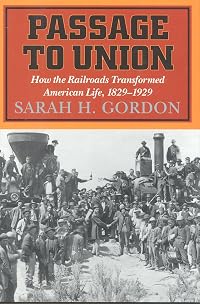
Passage to Union: How the Railroads Transformed American Life, 1829-1929
by Sarah H. Gordon
52 Members (3.25)
On This Page
Description
In Passage to Union, Sarah Gordon has written a richly informed narrative history of the growth of the railroads, an American icon. But her conclusions are surprising. Where the railroads and their entrepreneurs are ordinarily celebrated for their accomplishments, Ms. Gordon finds that the cost of their achievements was high. Conflicts of interest - at local, state, and regional levels - characterized railroad growth at every stage. Despite the stated aims of government. And the railroad show more corporations to promote settlement and commerce, Ms. Gordon shows that the states lost control of these enterprises and lost the economic benefits of their traffic. Smaller towns withered as people and money flowed to larger cities. By 1900 the union that had emerged reflected the worst fears of railroad critics. The South and West had been settled, but wealth had flowed so heavily to the cities that rural life had lost its attraction. Passage to Union. Is compelling reading because Ms. Gordon has drawn from diaries, memoirs, literature, advertisements, newspapers and magazines, public records, and railroad history to construct her narrative. The impact of the railroads on people and their communities is powerfully illustrated in this absorbing story of apparent triumph and real loss. show lessTags
Recommendations









































Member Reviews
Members
- Recently Added By
Author Information
1 Work 52 Members
Classifications
- Genres
- Nonfiction, History, Economics, General Nonfiction
- DDC/MDS
- 385.0973 — Society, government, & culture Commerce, communications & transportation regulations Railroad transportation Subdivisions History, geographic treatment, biography North America United States
- LCC
- HE2751 .G64 — Social sciences Transportation and communications Transportation and communications Railroads. Rapid transit systems
- BISAC
Statistics
- Members
- 52
- Popularity
- 583,350
- Rating
- (3.25)
- Languages
- English
- Media
- Paper
- ISBNs
- 2