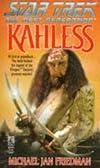
Kahless
by Michael Jan Friedman
Star Trek: The Next Generation (Unnumbered Novels — 1996.07), Star Trek (novels) (1996.07), Star Trek (1996.07)
On This Page
Description
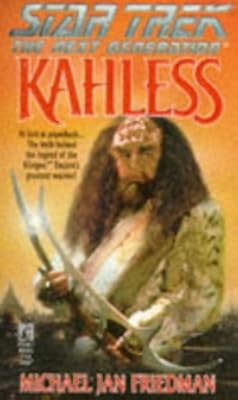
For the last fifteen hundred years, the KlingonsTM have revered him as the first Klingon emperor, the legendary warrior who united their people and taught them the meaning of honor. Myths and fables have grown around the memory of Kahless, but the truth of his incredible life has remained a mystery . . . until now. A clone of the original Kahless now holds the title of emperor. He thinks he knows all there is to know about his mighty ancestor, until the discovery of an ancient scroll throws show more the ancient stories into doubt and threatens to tear the Klingon Empire apart. Surrounded by treachery and rumors of revolt, he can trust no one -- except Captain Jean-Luc Picard and Lieutenant Worf of the U.S.S. EnterpriseTM. The past collides with the present as the true story of the historical Kahless sparks a battle for control of the entire Klingon Empire. Yet even if Worf and Picard can prevent a civil war, the revelations contained by the scroll ensure that the Klingon Empire -- and the rest of the galaxy -- will never be the same. show lessTags
Recommendations






Member Reviews
I loved Kahless. I wasn't sure that I would, because as much as I love Worf as a character, the Klingon race has often times been a little too raw for me in my time as a Star Trek fan. But as the book progressed, I realized in "Kahless" we are treated to a complicated and fair look at who the Klingon are. And the word complicated is appropriate here, because that's also part of the plot -- as Klingons grapple with what the truth of their legendary hero "Kahless" really was like, you get a layered and deeper look at both a character and a whole race. It's not just snarls, angry confrontations, and nasty food (like what sometimes we got with the Klingons on the shows), but a beautiful look at characters.
The book alternates, chapter by show more chapter, between the modern world where the Klingon (as well as Picard) are dealing with new information, and the "heroic era" which tells the story of the actual Kahless. We flip back and forth and move forward through both stories, and it's pretty riveting. show less
The book alternates, chapter by show more chapter, between the modern world where the Klingon (as well as Picard) are dealing with new information, and the "heroic era" which tells the story of the actual Kahless. We flip back and forth and move forward through both stories, and it's pretty riveting. show less
Michael Jan Friedman’s Star Trek: The Next Generation – Kahless takes place between the events of “All Good Things…”, the finale episode of Star Trek: The Next Generations, and the seventh feature film, Star Trek: Generations. At the beginning of the story, a cleric discovers a scroll which purportedly disproves the historicity of Kahless the Unforgettable, upon whose teachings Klingon society is founded and whose clone is the current Emperor, helping to legitimize Gowron’s power as Chancellor. Meanwhile, in the Federation, Worf finds his faith shaken as he had always looked to the stories of Kahless as a guide to help him with his crisis of identity, growing up on Earth and becoming the only Klingon in Starfleet. Captain show more Jean-Luc Picard worries about how this scroll might destabilize the Klingon Empire now that relations between the Federation and the Empire are normalized following his diplomatic efforts. The Kahless clone reaches out to Worf and Picard, seeking their help when he discovers a conspiracy within the Klingon Defense Force to overthrow Gowron.
Friedman alternates between the Heroic Age around the 9th century, in which he retells the legends of Kahless, and the Modern Age of 2371, where he follows the story of the conspiracy and the involvement of Picard and Worf as they investigate it. The two narratives examine nuances of Klingon culture while deconstructing the nature of myth and its power to shape societies as well as the essential truths it can communicate, despite the factual accuracy of the story. As Picard observes in the story, “Kahless was the Klingon Everyman, a mirror in which every last son of Qo’noS might find the noblest parts of himself” (pg. 292). To that end, Friedman’s narrative will appeal to those interested in Klingon culture and the power of myth. Though the Star Trek novels rarely impact the canon of the films and series, this one is particularly enjoyable and unlikely to find itself pre-empted by a later show or film. show less
Friedman alternates between the Heroic Age around the 9th century, in which he retells the legends of Kahless, and the Modern Age of 2371, where he follows the story of the conspiracy and the involvement of Picard and Worf as they investigate it. The two narratives examine nuances of Klingon culture while deconstructing the nature of myth and its power to shape societies as well as the essential truths it can communicate, despite the factual accuracy of the story. As Picard observes in the story, “Kahless was the Klingon Everyman, a mirror in which every last son of Qo’noS might find the noblest parts of himself” (pg. 292). To that end, Friedman’s narrative will appeal to those interested in Klingon culture and the power of myth. Though the Star Trek novels rarely impact the canon of the films and series, this one is particularly enjoyable and unlikely to find itself pre-empted by a later show or film. show less
Even though the audio book says it's unabridged, it feels so short (only 3 hours) compared to full length books in audio for other companies. Yet this is what Simon and Schuster has done. The shortening and the narrator have thoroughly unimpressed me to this point. I think this would have been much better if Michael Dorn had read it.
I can usually get into Star Trek books pretty fast. I already know most of the characters, the situations and so generally I’m able get into the story and the plot pretty fast. That wasn’t the case with this book. I’m not exactly sure why it was harder, perhaps because it went back and forth between the ‘Modern age’, i.e. the present, and the ‘heroic age’ which was when Kahless the Main Character of this book was literally alive. I sometimes felt as though I would just get into the story and it would change to the other time period.
Both stories were about Kahless saving the Klingon Empire. Just, different Kahlesses, one the original, and the other the clone.
I’ve never really been into Klingon society, Language, etc., and show more how it complements the rest of the Star Trek universe, so I’m not sure how the Klingon stuff turned out, but, it seemed to work really well and when there were Klingonese words even though I didn’t know exactly what their definitions was, I definitely knew what they meant.
Overall a solid three star Star Trek novel, just a bear to get into, oh, and there weren’t in the narrative either. show less
Both stories were about Kahless saving the Klingon Empire. Just, different Kahlesses, one the original, and the other the clone.
I’ve never really been into Klingon society, Language, etc., and show more how it complements the rest of the Star Trek universe, so I’m not sure how the Klingon stuff turned out, but, it seemed to work really well and when there were Klingonese words even though I didn’t know exactly what their definitions was, I definitely knew what they meant.
Overall a solid three star Star Trek novel, just a bear to get into, oh, and there weren’t in the narrative either. show less
A well-conceived plot highlights this "Star Trek - the Next Generation" novel which covers two ages: ancient Klingon, where the first emperor Kahless is forging his first conquests, and present time, where a clone of the ancient emperor has called upon Picard and Worf as the only people he can trust to help thwart a plot to tear the Klingon Empire apart.
Friedman is prolific, but, like many other writers in this genre, he leaves me a little disappointed. (Not disappointed enough to stop buying what he writes just because his name is on it ...)
In the box of books inherited from my brother, but I'm skipping this as it's not numbered, I'm not interested in the subject, and besides, didn't we see this as a tv episode?
Members
- Recently Added By
Author Information

Author Michael Jan Friedman was born in 1955. He has written approximately sixty books of fiction and nonfiction with the majority of them set in the Star Trek universe. His work has appeared on the New York Times bestseller list. He has also written more than 150 comic books and for television and radio. One of his best known television credits show more is the Star Trek: Voyager episode "Resistance." (Bowker Author Biography) show less
Series


Work Relationships
Is contained in
Common Knowledge
- Canonical title
- Kahless
- Original title
- Kahless
- Original publication date
- 1996-07
- People/Characters
- Kahless; Worf; Jean-Luc Picard
- Important places
- Qo'noS
- Dedication
- For
Valerie Elyse,
who was worth the wait - First words
- In ancient times, there was a road there.
- Last words
- (Click to show. Warning: May contain spoilers.)A very important part.
Classifications
Statistics
- Members
- 650
- Popularity
- 44,784
- Reviews
- 8
- Rating
- (3.29)
- Languages
- English
- Media
- Paper, Audiobook, Ebook
- ISBNs
- 13
- ASINs
- 3