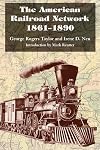
The American Railroad Network, 1861-1890
by George Rogers Taylor, Irene D. Neu
On This Page
Description
Rapid population growth in the Great Plains and the American West after the Civil War was the result not only of railroad expansion but of a collaboration among competing railroads to adopt a uniform width for track. This title shows how the consolidation of smaller railroads and the growth of capitalism worked to unify the railroad industry.Tags
Recommendations
































Member Reviews
The title of this 83 page book is such that the typical reader could be forgiven for assuming they were looking at a dry, technical exposition whose only possible saving grace might be an offering of enough factual information to allow one to thoroughly debunk the hoary internet urban legend concerning Roman chariot wheel ruts and horses asses as the “military specification” which supposedly dictated the current standard track gauge of 4 feet 8 and one half inches.
While the facts presented in this volume do, incidentally, put paid to that story the focus of the book is the history of the evolution of a technological standard.
The initial focus of railroad construction in the U.S. was on maintaining markets in narrowly defined show more economic spheres. Thus cities like Boston, New York, Philadelphia, and Baltimore built railroads to permit rapid movement of goods to local markets and to keep these local markets tied to the interest of the larger city which controlled the railroad. There was no interest in long distance commerce and no one could see any benefit in connecting one railroad from one large city to that of another railroad in another city. As part of the interest in maintaining control of the local markets the various cities made it a point to have different gauges in order to keep the competition at bay. The end result was almost as many track gauges as there were cities building railroads with the gauges spanning the range from 4 feet 3 inches to 6 feet.
It was only when cities and railroad builders began to realize there was an economic benefit to interchange that they began to think about gauge standardization. The advent of the American Civil War further encouraged their thinking in this direction and, as is often the case with many adopted standards, the choice of 4 feet 8 and one half inches as the American standard gauge, was determined largely by the fact of majority rule – at the time the decision was made to standardize more track had been laid to that particular gauge than any of the others.
Before standardization, but after it had become apparent that interchange traffic was economically worthwhile, numerous attempts were made to allow for interchange across gauges. Four that held the most promise were wheels with very wide tread, interchange points that removed one set of trucks from under freight and passenger cars and replaced them with a different gauge, track with three rails to allow different gauged cars to run in the same train, and cars with movable wheels. All are described in the book and their pros and cons (mainly cons) discussed.
I think the book is well written and provides an interesting study of the problems involved in the development and implementation of an industrial standard. (Text length - 83 pages, Total length 113 pages show less
While the facts presented in this volume do, incidentally, put paid to that story the focus of the book is the history of the evolution of a technological standard.
The initial focus of railroad construction in the U.S. was on maintaining markets in narrowly defined show more economic spheres. Thus cities like Boston, New York, Philadelphia, and Baltimore built railroads to permit rapid movement of goods to local markets and to keep these local markets tied to the interest of the larger city which controlled the railroad. There was no interest in long distance commerce and no one could see any benefit in connecting one railroad from one large city to that of another railroad in another city. As part of the interest in maintaining control of the local markets the various cities made it a point to have different gauges in order to keep the competition at bay. The end result was almost as many track gauges as there were cities building railroads with the gauges spanning the range from 4 feet 3 inches to 6 feet.
It was only when cities and railroad builders began to realize there was an economic benefit to interchange that they began to think about gauge standardization. The advent of the American Civil War further encouraged their thinking in this direction and, as is often the case with many adopted standards, the choice of 4 feet 8 and one half inches as the American standard gauge, was determined largely by the fact of majority rule – at the time the decision was made to standardize more track had been laid to that particular gauge than any of the others.
Before standardization, but after it had become apparent that interchange traffic was economically worthwhile, numerous attempts were made to allow for interchange across gauges. Four that held the most promise were wheels with very wide tread, interchange points that removed one set of trucks from under freight and passenger cars and replaced them with a different gauge, track with three rails to allow different gauged cars to run in the same train, and cars with movable wheels. All are described in the book and their pros and cons (mainly cons) discussed.
I think the book is well written and provides an interesting study of the problems involved in the development and implementation of an industrial standard. (Text length - 83 pages, Total length 113 pages show less
Ratings
Members
- Recently Added By
Author Information
10 Works 279 Members
2 Works 39 Members
Irene D. Neu is Professor Emerita of History at Indiana University and coauthor, with George Rogers Taylor, of The American Railroad Network, 1861-1890.
Some Editions
Common Knowledge
- Important events
- Growth and Development of the U.S. railroad network; American Civil War (1861 | 1865)
- Dedication
- None
- First words
- The American economy, already expanding rapidly before the Civil War, continued growing with almost explosive force during the following decades.
- Quotations
- As the rail net spread in the fifties and with both freight and passenger traffic greatly increased, the need to permit the railroads to traverse the steets of the port cities became apparent. Spark arresters attached to the ... (show all)smokestacks of locomotives reduced the danger of fires, and the advantages of bringing the railroads into the commercial sections and down to the wharves influenced most towns to permit the practice. Nevertheless, in the chief river and seaport cities of the South Atlantic States the railroads were not permitted to make the actual connections which would permit an exchange of rolling stock or facilitate transfer of freight from one line to another. This restriction was enforced by local business groups. Their interests were twofold: first, tavern keepers, teamsters, porters, forwarding agents, retail merchants, and others developed a vested interest in the transfer business which was dependent upon preserving a gap in the railroad line; second, the wholesale merchants wished to increase the business of their ports both for importing and exporting. As in the case of the merchants of Philadelphia, the Southern business groups did not wish their cities to become way stations with freight and passengers merely passing through. The reasoning was quite similar to that of merchants who, until fairly late in the automobile age, objected to the construction of highways which would by-pass the business districts of towns along a main road.
- Last words
- (Click to show. Warning: May contain spoilers.)Under the leadership of financiers and promoters whose interests trancended local loyalties, there emerged a national economy which, on the one hand, was made possible by the railroads and which, on the other, moulded the railroads themselves into a unified transportation system.
Classifications
- Genres
- Nonfiction, History
- DDC/MDS
- 385.0973 — Society, government, & culture Commerce, communications & transportation regulations Railroad transportation Subdivisions History, geographic treatment, biography North America United States
- LCC
- HE2751 .T28 — Social sciences Transportation and communications Transportation and communications Railroads. Rapid transit systems
- BISAC
Statistics
- Members
- 35
- Popularity
- 819,720
- Reviews
- 1
- Rating
- (3.63)
- Languages
- English
- Media
- Paper, Ebook
- ISBNs
- 4
- ASINs
- 1