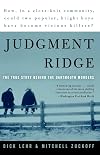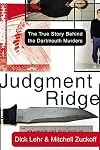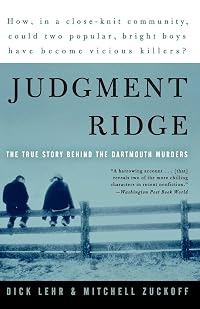
Judgment Ridge: The True Story Behind the Dartmouth Murders
by Dick Lehr, Mitchell Zuckoff
On This Page
Description
On a cold night in January 2001, the idyllic community of Dartmouth College was shattered by the discovery that two of its most beloved professors had been hacked to death in their own home. Investigators searched helplessly for clues linking the victims, Half and Susanne Zantop, to their murderer or murderers. A few weeks later, across the river, in the town of Chelsea, Vermont, police cars were spotted in front of the house of high school senior Robert Tulloch. The police had come to show more question Tulloch and his best friend, Jim Parker. Soon , the town discovered the incomprehensible reality that Tulloch and Parker, two of Chelsea's brightest and most popular sons, were now fugitives, wanted for the murders of Half and Susanne Zantop. Authors Mitchell Zuckoff and Dick Lehr provide a vivid explication of a murder that captivated the nation, as well as dramatic revelations about the forces that turned two popular teenagers into killers. Judgement Ridge conveys a deep appreciation for the lives (and the devastating loss) of Half and Susanne Zantop, while also providing a clear portrait of the killers, their families, and their community-and, perhaps, a warning to any parent about what evil may lurk in the hearts of boys. show lessTags
Recommendations


Member Reviews
At times this book is extraordinary: so well-written it's like watching a painting being created and, even though you know what it will look when complete, you can't turn away. The artistry is that masterful.
Another great aspect of this book is that you are not left wondering: you come to know the killers and understand their arrogance.
Where "Judgment Ridge" fails is the same place it succeeds: the details.
Many times non-fiction fails because it doesn't provide enough of those seemingly small items that, in fact, tell you everything you want to know: what did the killer have for breakfast? What music did he like? What did he see when he looked in the mirror?
"Judgment Ridge" is so well-researched that it's positively swimming in details. show more But sometimes, those plentiful details begin to obscure the story itself. The authors write on and on and on about one of the killer's interest in debate, for example, and I promise I got it - I understood how it shaped Robert, and it was important. But there's so much about it that it becomes tedious.
I wish this book had had a better editor. Clearly the authors know their material and they are wonderful writers. But an outside, objective eye is needed in any text. Had there been a competent editor in this case, "Judgment Ridge" could have been a book of genius. show less
Another great aspect of this book is that you are not left wondering: you come to know the killers and understand their arrogance.
Where "Judgment Ridge" fails is the same place it succeeds: the details.
Many times non-fiction fails because it doesn't provide enough of those seemingly small items that, in fact, tell you everything you want to know: what did the killer have for breakfast? What music did he like? What did he see when he looked in the mirror?
"Judgment Ridge" is so well-researched that it's positively swimming in details. show more But sometimes, those plentiful details begin to obscure the story itself. The authors write on and on and on about one of the killer's interest in debate, for example, and I promise I got it - I understood how it shaped Robert, and it was important. But there's so much about it that it becomes tedious.
I wish this book had had a better editor. Clearly the authors know their material and they are wonderful writers. But an outside, objective eye is needed in any text. Had there been a competent editor in this case, "Judgment Ridge" could have been a book of genius. show less
Having lived near Dartmouth College for a good portion of my life, I became very interested in the Zantop case in 2001: two Dartmouth professors slashed to death in their homes for no apparent reason. But then the story took an unusual turn when it was announced that two teenagers from Vermont -- with apparently no ties to the professors -- may have been involved. And things just kept getting stranger when it was reported that those two kids were generally well-liked in their community, and aside from a few "boys will be boys" moments, had nothing in their past to give any hints they might become killers.
Two Boston Globe reporters stayed on the case. They cover impressive ground in this book, providing background information about the show more murdered victims as well as a thorough retelling of the boys' early lives. They take a little literary license in moving a few things out of chronology to get in some frightening chapters to keep the story moving -- the first chapter, for example, tells of the boys' aborted plan to kill a neighbor six months before the Dartmouth murders.
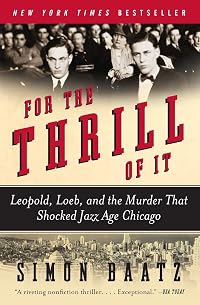
Interestingly, the book makes only passing reference to the Leopold and Loeb case from the 1920s, using it only to show how a simple piece of evidence (then, glasses; now, a special knife sheath) could be the undoing of a carefully-planned murder. It seemed strange not to make further connections, as Robert Tulloch, whom the authors paint as the more guilty party, shared with Leopold a fascination with the writings of Nietzsche, believing that laws don't apply to the super-men of the world. Both in this case and in the earlier one, the young men hoped to commit a "perfect" crime, mostly just for the fun of it.
Over and over, the authors tantalize the reader by giving little pieces of information about the boys' prior acts. Without the benefit of hindsight, Tulloch and Jim Parker (who pleaded for a lesser sentence; his tends to be the more sympathetic story of the follower caught up in a charismatic leader's evil plans) were perhaps more reckless and rowdy than their friends, but it's hard to connect teenage angst with murder. Many of the supplemental characters -- former teachers and friends -- are quoted as generally believing in the boys until the evidence proved to be too damning. And that may be the most chilling part of the book -- if cold-blooded killers can be found acting like normal Americans, how can anyone ever feel safe? show less
Two Boston Globe reporters stayed on the case. They cover impressive ground in this book, providing background information about the show more murdered victims as well as a thorough retelling of the boys' early lives. They take a little literary license in moving a few things out of chronology to get in some frightening chapters to keep the story moving -- the first chapter, for example, tells of the boys' aborted plan to kill a neighbor six months before the Dartmouth murders.
Interestingly, the book makes only passing reference to the Leopold and Loeb case from the 1920s, using it only to show how a simple piece of evidence (then, glasses; now, a special knife sheath) could be the undoing of a carefully-planned murder. It seemed strange not to make further connections, as Robert Tulloch, whom the authors paint as the more guilty party, shared with Leopold a fascination with the writings of Nietzsche, believing that laws don't apply to the super-men of the world. Both in this case and in the earlier one, the young men hoped to commit a "perfect" crime, mostly just for the fun of it.
Over and over, the authors tantalize the reader by giving little pieces of information about the boys' prior acts. Without the benefit of hindsight, Tulloch and Jim Parker (who pleaded for a lesser sentence; his tends to be the more sympathetic story of the follower caught up in a charismatic leader's evil plans) were perhaps more reckless and rowdy than their friends, but it's hard to connect teenage angst with murder. Many of the supplemental characters -- former teachers and friends -- are quoted as generally believing in the boys until the evidence proved to be too damning. And that may be the most chilling part of the book -- if cold-blooded killers can be found acting like normal Americans, how can anyone ever feel safe? show less
This is an examination of the murders of Half and Susanne Zantop, two popular faculty members of Dartmouth College, by Robert Tulloch and James Parker, two high-school students from a nearby town. The book is written by Dick Lehr and Mitchell Zuckoff, both of whom were reporters from the Boston Globe at the time of the killings, and are now professors of journalism at Boston University.
Judgment Ridge is an attempt to explain how two teenagers from a close-knit community could find themselves randomly looking for someone to kill, and how they happened to commit two heinous murders purely by chance. What also emerges is a picture of police investigation that managed - through two pieces of seemingly nondescript evidence - to identify the show more murderers.
The authors also manage to convey the unsettling nature of a crime that, through its pure randomness and lack of motive, is a true example of senseless violence. The reader cannot help but be taken aback by the complete lack of rationality behind this crime.
The only fault I find with the book is that it seemed to be written as if it were a murder mystery, which it is not. Since both authors are experienced journalists (who covered the story) I should think they could have managed to convey the incomprehensibility of the murders without some of the melodramatic elements they employ. The first chapter by itself shows just how terrifyingly inexplicable the murders were.
The authors do, however, give some excellent insights into the nature of the boys, the town in which they lived, and their families and friends.
An excellent description of an inexplicable event. show less
Judgment Ridge is an attempt to explain how two teenagers from a close-knit community could find themselves randomly looking for someone to kill, and how they happened to commit two heinous murders purely by chance. What also emerges is a picture of police investigation that managed - through two pieces of seemingly nondescript evidence - to identify the show more murderers.
The authors also manage to convey the unsettling nature of a crime that, through its pure randomness and lack of motive, is a true example of senseless violence. The reader cannot help but be taken aback by the complete lack of rationality behind this crime.
The only fault I find with the book is that it seemed to be written as if it were a murder mystery, which it is not. Since both authors are experienced journalists (who covered the story) I should think they could have managed to convey the incomprehensibility of the murders without some of the melodramatic elements they employ. The first chapter by itself shows just how terrifyingly inexplicable the murders were.
The authors do, however, give some excellent insights into the nature of the boys, the town in which they lived, and their families and friends.
An excellent description of an inexplicable event. show less
I liked this book overall. It was an interesting story with some interesting characters. It was, however, a little too long. As true crime books go, this one wasn't that thrilling. There was too much background information that didn't really seem to add much to the story. As an example, the authors went into a great deal of detail about Robert Tulloch and Jim Parker's high school exploits, which, beyond helping us understand why investigators were initially reticent to believe two high school kids could be killers, was not relevant. There was a lengthy and dramatic lead-up to Tulloch's big explosion at a high school debate tournament, but the actual incident itself, while noteworthy, was pretty anticlimactic for all the foreshadowing show more that took place before it.
I am giving the book three stars because it is an interesting story, but I think we could have gotten the same understanding of the crime, how shocking it was in this bucolic Vermont town, and how psycopathic one of the killers was in a 30-50% shorter book. show less
I am giving the book three stars because it is an interesting story, but I think we could have gotten the same understanding of the crime, how shocking it was in this bucolic Vermont town, and how psycopathic one of the killers was in a 30-50% shorter book. show less
A quite readable story of the pointless murder of two Dartmouth college professors - a crime that received considerable press in the Boston area. The book suffers slightly because the author very clearly choses "sides" and proclaims one criminal (and his parents) less culpable than another.
The story behind the murders of a beloved husband and wife, both professors at Dartmouth College in 2000. It was shocking that these murders took place because two seemingly "normal" high school students were bored. This was a true-crime read. 432 pages
Members
- Recently Added By
Author Information

12 Works 1,586 Members
Dick Lehr is a former reporter for the Boston Globe (1983-2003). In 1991-1992 he was a John S. Knight Journalism Fellow at Stanford University. Lehr was a Pulitzer finalist for investigative reporting. He won both the Hancock and Loeb awards. Currently, he is a professor of journalism at Boston University and codirector of an investigative show more reporting clinic. He and Gerald O'Neill are co-authors of Whitey: The Life of America's Most Notorious Mob Boss (2013). His other works include The Fence: A Police Cover-up Along Boston's Racial Dividemost (2010), Birth of a Nation: How a Legendary Filmmaker and a Crusading Editor Reignited America's Civil War (2014), The Under Boss: The Rise and fall of a Mafia Family (1989), and Judgement Ridge: The True Story Behind the Dartmouth Murders (2003) with Mitchell Zuckoff. He lives outside Boston with his wife and four children. show less

15+ Works 4,654 Members
Mitchell Zuckoff received a master's degree from the University of Missouri and was a Batten Fellow at the Darden School of Business Administration at the University of Virginia. He is currently a professor of journalism at Boston University. He has written several books including Frozen in Time: An Epic Story of Survival and a Modern Quest for show more Lost Heroes of World War II; Lost in Shangri-La: A True Story of Survival, Adventure and the Most Incredible Rescue Mission of World War II; Robert Altman: The Oral Biography; Ponzi's Scheme: The True Story of a Financial Legend; Judgment Ridge: The True Story Behind the Dartmouth Murders written with Dick Lehr; and 13 Hours: The Inside Account of What Really Happened in Benghazi. His work Choosing Naia: A Family's Journey received the Christopher Award. He was a reporter for twenty years, mostly as an investigative reporter and roving national correspondent for The Boston Globe. His articles have appeared in several publications including The New Yorker and Fortune. He received the Distinguished Writing Award from the American Society of Newspaper Editors, the Livingston Award for International Reporting, the Heywood Broun Award, and the Associated Press Managing Editors' Public Service Award. (Bowker Author Biography) show less
Awards and Honors
Awards
Common Knowledge
- People/Characters
- Half Zantop; Suzanne Zantop; James J. Parker; Robert W. Tulloch
- Important places
- Dartmouth College, Hanover, New Hampshire, USA; Etna, New Hampshire, USA; Chelsea, Vermont, USA
- Epigraph
- So there the go, Jim running slower to stay with Will,
Will running faster to stay with Jim,
Jim breaking two windows in a haunted house because Will's along,
Will breaking one window instead of none, ... (show all)because Jim's watching.
God, how we get our fingers into each other's clay.
That's friendship, each playing the potter to see what shapes we can make of the other.
From Something Wicked This Way Comes by Ray Bradbury - Dedication
- FOR
Suzanne
-- M.Z.
Family -- my sons, Nick and Christian,
and all the Lehrs and Rossis who are their grandparents,
aunts, uncles, and cousins.
-- D.L. - First words
- At just past ten on a cool summer night, Andrew Patti nestled with his eleven-year-old son on a worn blue sofa in the living room of their Vermont vacation home.
- Last words
- (Click to show. Warning: May contain spoilers.)One of them might as well have made it to Australia.
- Publisher's editor
- Conaway, Dan
Classifications
- Genre
- Nonfiction
- DDC/MDS
- 364.15 — Society, government, & culture Social problems and social services Crime Criminal offenses Offenses against the person
- LCC
- HV9067 .H6 .Z83 — Social sciences Social pathology. Social and public welfare. Criminology Social pathology. Social and public welfare. Criminal justice administration Penology. Prisons. Corrections The juvenile offender. Juvenile delinquency.
- BISAC
Statistics
- Members
- 160
- Popularity
- 204,555
- Reviews
- 7
- Rating
- (3.71)
- Languages
- English
- Media
- Paper, Audiobook, Ebook
- ISBNs
- 5
- ASINs
- 9