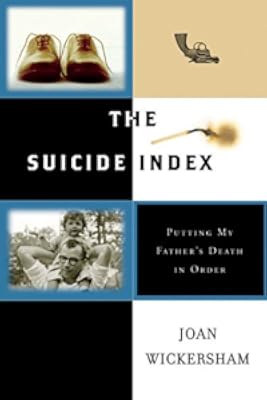
The Suicide Index: Putting My Father's Death in Order
by Joan Wickersham
On This Page
Description
One winter morning in 1991, Joan Wickersham's father shot himself in the head. The father she loved would never have killed himself, and yet he had. His death made a mystery of his entire life. Who was he? Why did he do it? And what was the impact of his death on the people who loved him? Using an index-that most formal and orderly of structures-Wickersham explores this chaotic and incomprehensible reality. Every bit of family history, every encounter with friends, doctors, and other show more survivors, exposes another facet of elusive truth. Dark, funny, sad, and gripping, at once a philosophical and a deeply personal exploration, The Suicide Index is, finally, a daughter's anguished, loving elegy to her father. show lessTags
Recommendations



Member Reviews
This is an extraordinary book, and one that is hard to sum up. The foundational events around which the memoir is built are easy to identify. One morning Joan Wickersham's father wakes up, gets dressed, makes his breakfast, makes decaf for himself and real coffee for his wife which he leaves at her bedside, brings in the paper, walks up to his study and sticks a gun in his mouth and pulls the trigger. No note and no real warning signs (though in hindsight there were many things that might be interpreted that way.) That act then came to define Wickersham's life, her husband's and to some extent her children's lives, her mother's and sister's lives, and the lives of everyone around them. People talk about suicide these days like it is a show more choice every person can make for themselves and there is so fallout. For those of us who are left behind (my loss to suicide was an ex-boyfriend of many years) we know this to be untrue. Wickersham says something in the book about the term "commit suicide" which resonated now that there is a movement afoot to erase that term from language and replace it with "died by suicide." She said that people "commit suicide" against those they leave behind, that even if it is not an act of aggression it is an act of reckless indifference to the impact on those left in the rubble, those who realize they never really knew a person who was one of the most important people in their lives. (This is obviously not intended on my part to cover suicides attributable to chronic and/or terminal illness. Nobody is left to wonder about the reasons for the choice to take ones life in that case, to feel like everything that came before was a lie.)
This book is about being left in that rubble. It is about the dozen or so years following Wickersham's father's suicide, and her driving need to find answers, to put order and meaning around something so disorderly and unexplainable. The book is brutally honest, and throws into relief fractures in the "happy family" people might think they had, it tears down the lies we tell ourselves about our parents and it humanizes them, it digs into the ugly side of mother-daughter and spousal relationships, it does not shy away from vanity and self-centeredness and anger. This is it, this is what suicide leaves in its wake. This is clear-eyed, not at all sentimental or sensational, it is almost terse, and it is creative in its structure not for creativity's sake, but because the structure enhances the communicative heft of the story without defining how you, the reader, should feel. Brilliant. show less
This book is about being left in that rubble. It is about the dozen or so years following Wickersham's father's suicide, and her driving need to find answers, to put order and meaning around something so disorderly and unexplainable. The book is brutally honest, and throws into relief fractures in the "happy family" people might think they had, it tears down the lies we tell ourselves about our parents and it humanizes them, it digs into the ugly side of mother-daughter and spousal relationships, it does not shy away from vanity and self-centeredness and anger. This is it, this is what suicide leaves in its wake. This is clear-eyed, not at all sentimental or sensational, it is almost terse, and it is creative in its structure not for creativity's sake, but because the structure enhances the communicative heft of the story without defining how you, the reader, should feel. Brilliant. show less
Make what you will of the book's eponymous title gimmick, which organizes the book as if it were an index. This is a thorough, heartfelt meditation on the author's decision to take his own life and how it rippled through his family decades afterwards. The author's honest about her desire to identify the one element that explains her father's final act, and, but, after failing to do so, offers an admirably complete portrait of the man she knew, the one she didn't get to know, and his family history. Clear-eyed but still emotional, this book seems like both scholarly endeavor and an act of personal bravery. What emerges is a portrait of a talented, interesting man who'd survived a few rough circumstances but somehow failed to make it all show more fit together. By the time I finished the book, I felt that his suicide was, of course, important to his story, but didn't really define him. This, I think,is what the author might have wanted: she complains early on how suicide seems to obscure the people who commit it, changing them from merely "troubled" into people who become social untouchables.
Of course, "The Suicide Index" is a lot of verbiage about one subject, and this may try a lot of readers' patience. She talks about her own family and even about her relationship with her therapist at length. She's also -- consciously -- a product of Connecticut's comfortable bourgeois, and this aesthetic may not be to some readers' taste, especially since her mother, especially in the last sections of the book, comes off as a rather unsympathetic example of this group. Still, the book succeeds. While she includes a lot of thinking about the act of suicide that looks at the topic from a number of philosophical perspectives, she seems to sense that there's something eternally opaque about the act and her father's decision to go through with it. What she finds out about before and after her father's decision to end his own life is still plenty worthwhile, though. Recommended to those with a special interest in death, dying, and the mechanics of family trauma. show less
Of course, "The Suicide Index" is a lot of verbiage about one subject, and this may try a lot of readers' patience. She talks about her own family and even about her relationship with her therapist at length. She's also -- consciously -- a product of Connecticut's comfortable bourgeois, and this aesthetic may not be to some readers' taste, especially since her mother, especially in the last sections of the book, comes off as a rather unsympathetic example of this group. Still, the book succeeds. While she includes a lot of thinking about the act of suicide that looks at the topic from a number of philosophical perspectives, she seems to sense that there's something eternally opaque about the act and her father's decision to go through with it. What she finds out about before and after her father's decision to end his own life is still plenty worthwhile, though. Recommended to those with a special interest in death, dying, and the mechanics of family trauma. show less
Can a narrative thread be imposed on someone else's life? Does the narrative that we inhabit bear much resemblance to any plausible reality? Are we ultimately limited in our attempts to understand others to discrete, disconnected, and opaque 'entries'? While the central point of reference in this book is Joan Wickersham's father's suicide, these are the questions that surface and resurface throughout. "Aren't lives apples and stories oranges?", asks the author. The literary conceit of the title, the 'index', is all that Wickersham is left with after many years of trying other ways to salvage some kind of narrative meaning from her father's life. Fictionalizing it does not work - the one chapter where she imagines her father's thoughts show more as he is reunited with his father after many years, is unconvincing. After so much insistence on how little she ultimately understands about her father, the artifice and inauthenticity of the fictionalized encounter cannot help but jump out at the reader. And yet we readers 'fall' for fiction and memoir all the time, we embrace the literary narratives that match the way we frame our own lives. We 'read' our own lives linearly from page one. We assume that we can 'read' other lives in the same way, but a suicide calls this into question. As Joan Wickersham does, we find ourselves working backwards from the index, trying to imagine others' intentions and creating an understandable story from it.
One of the admirable aspects of this book is also one of the most off-putting: Wickersham's writerly, critical detachment is on full display as she works her way through the aftermath of the suicide. We do not usually see a novelist wrestling with options for how to best create or recreate action, character, or dialogue - we just see the result. In this book though, we see inside the writing. We see her bravely but unsuccessfully struggling to somehow reach a literary resolution. When that diligence is brought to such an intimate arena, it can seem cold at times, and the reader feels like an uncomfortable intruder. Try as she might Wickersham cannot transform this apple into an orange.
The book did remind me of William Stafford's poem: "the signals we give — yes or no, or maybe — should be clear: the darkness around us is deep". The poet does assume though, that we can decode those signals. Joan Wickersham would beg to differ. show less
One of the admirable aspects of this book is also one of the most off-putting: Wickersham's writerly, critical detachment is on full display as she works her way through the aftermath of the suicide. We do not usually see a novelist wrestling with options for how to best create or recreate action, character, or dialogue - we just see the result. In this book though, we see inside the writing. We see her bravely but unsuccessfully struggling to somehow reach a literary resolution. When that diligence is brought to such an intimate arena, it can seem cold at times, and the reader feels like an uncomfortable intruder. Try as she might Wickersham cannot transform this apple into an orange.
The book did remind me of William Stafford's poem: "the signals we give — yes or no, or maybe — should be clear: the darkness around us is deep". The poet does assume though, that we can decode those signals. Joan Wickersham would beg to differ. show less
I'm not sure I have ever read a book so nearly unrelievedly grim as The Suicide Index. While there are flashes of humor here and there - of the gallows variety - the tone of this memoir is, for the most part, pretty sobering, sad and, most of all, I think, angry. The anger is directed at, in nearly equal parts, the author's father, who did the ghastly deed, and her mother, who may well have been at least partly responsible for her husband's poor career decisions, most certainly for their hopeless financial plight, and probably for his obvious feelings of inadequacy and despair. In any case, I can understand why the book was a finalist for the National Book Award. The writing is beautiful and conveys in both heartbreakingly personal and show more coldly objective terms the ever-widening ripples and repercussions of this oh-so desperate and final act. In that respect, it is an admirably professional piece of work. Even so, this book-long meditaion of self-murder could hardly be called a pleasant read, and not a book I could heartily recommend. It was, in my experience, one excruciatingly long wince. I can't even begin to imagine how painful it must have been for Wickersham to write it. Cathartic, I'm sure, but it also had to hurt like hell. show less
One of the reasons I love this book: the author's clear enormous love for her father. That, at times, feels like the point of The Suicide Index or one of the points. Joan Wickersham treats her dad with such care and love, and her descriptions and writing seem to soften whenever he enters a scene. He is immensely likable and it is impossible not to love him and feel some of the daughter's grief. That said, I wished a little that Wickersham had tried to imagine her father's immense pain. The book seems more focused on the pain of the survivors -- her own, her mother's, her sister's, but it does dothat fearlessly. Another reason I love this book: the relationship between the author and her mother is so complex and so honestly portrayed. I show more also love its structure - trying to order something (her father's suicide) which is impossible to order. I also love the ending, where the author draws a line and a boundary she will not cross and also seems to say that no proper ending is possible in this situation. show less
Structured according to index form (thus the title), THE SUICIDE INDEX delves into and catalogues the myriad complexities in a family of suicide, and between a father (who committed suicide) and daughter, and her urge to understand what has happened and how it's affected her and her family. It is a stunning structural feat, but one that is necessary for the trajectory of memoir—the history of his life and how she now regards it and their relationship, relying on memory, fictionalized accounting, vignettes of raw emotion, and a study of the mother-daughter relationship as well, and how the mother is coping. A compelling read, largely because of the narrator's search is so compelling, and we are so thoroughly engaged with her wisdom and show more observations. show less
It is the style of the narrative that makes this book so powerful, especially given the topic that it centers around--the author's father's suicide. The book stretches forwards and backwards in time, developing topics and letting others drift away. In many ways, it is an uncomfortable book to read--you wish you could see the individuals to better take a gauge of them, and yet, the book conveys them deeply, through brief, graceful strokes. It is not a book with answers. It has more dead-ends than anything else when it turns to coming to terms with the father's action, and the reader is given a sense of the long journey that all survivors must harrow through afterwards. The index format works well for this topic, allowing different show more aspects of what happened to be dealt with, even if no concrete resolution is ever reached for the author. show less
Members
- Recently Added By
Lists

2008-2012 Notable Books for Adults
127 works; 10 members
Author Information

7+ Works 510 Members
Joan Wickersham is the author of the novel The Paper Anniversary. Her work has appeared in The Best American Short Stories. An excerpt from The Suicide Index earned her Ploughshares's Cohen Award for Best Short Story of 2007. She lives in Cambridge, Massachusetts.
Awards and Honors
Awards
Common Knowledge
- First words
- In the airport, coming home from vacation, he stops at a kiosk and buys grapefruits, which he arranges to have sent to his daughters.
- Last words
- (Click to show. Warning: May contain spoilers.)And knowing that wherever I am, I am always moving, and I will never be in one place for long.
Classifications
- Genres
- Nonfiction, Biography & Memoir, Sociology, General Nonfiction
- DDC/MDS
- 155.937092 — Philosophy & psychology Psychology Differential and developmental psychology Environmental psychology Influences of Traumatic Experiences and Bereavement Death and Dying Biography; History By Place Biography
- LCC
- HQ799.95 .W53 — Social sciences The family. Marriage, Women and Sexuality The Family. Marriage. Women The family. Marriage. Home Adulthood
- BISAC
Statistics
- Members
- 274
- Popularity
- 117,831
- Reviews
- 12
- Rating
- (4.04)
- Languages
- English
- Media
- Paper, Ebook
- ISBNs
- 3
- ASINs
- 3