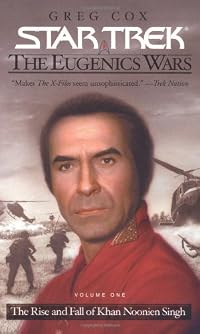
The Eugenics Wars: The Rise and Fall of Khan Noonien Singh, Volume One
by Greg Cox
Star Trek: The Eugenics Wars (1), Star Trek: The Original Series (– The Eugenics Wars — 1), Star Trek (novels) (2001.07), Star Trek (2001.07)
On This Page
Description
Even centuries later, the final decades of the twentieth century are still regarded as one of the darkest and most perilous chapters in the history of humanity Now, as an ancient and forbidden technology tempts mankind once more, Captain James T. Kirk of the Starship Enterprise must probe deep into the secrets of the past, to discover the true origins of the dreaded Eugenics Wars -- and of perhaps the greatest foe he has ever faced. 1974 A.D. An international consortium of the world's top show more scientists have conspired to create the Chrysalis Project, a top-secret experiment in human genetic engineering. The project's goal is the creation of a new super-race to take command of the entire planet. Gary Seven, an undercover operative for an advanced alien species, is alarmed by the project's objectives, he knows too well the apocalyptic consequences of genetic manipulation. But he may already be too late. One generation of super-humans has already been conceived. Seven watches as the children of Chrysalis-in particular, a brilliant youth named Khan Noonien Singh -- grow to adulthood. Can Khan's dark destiny be averted -- or is Earth doomed to fight Singh a global battle for supremacy? The Eugenics Wars Volume One is a fast-paced thriller that explores the rise of the conqueror known as Khan. show lessTags
Recommendations


Member Reviews
"It's all true!" Those words from Galaxy Quest fit for this stellar exercise in retconning!
I'd read this book when it came out, and recently got Kindle editions of the whole trilogy - it's a fun read. Carefully weaving 40+ years of Trek - and REAL - history into a narrative that explains how we didn't notice the "Eugenics War" and the rise (and fall) of Khan. Oh, and there's a story woven through with Kirk, Spock, McCoy, et al facing a new planet of genetic supermen.
On to the next volume!
I'd read this book when it came out, and recently got Kindle editions of the whole trilogy - it's a fun read. Carefully weaving 40+ years of Trek - and REAL - history into a narrative that explains how we didn't notice the "Eugenics War" and the rise (and fall) of Khan. Oh, and there's a story woven through with Kirk, Spock, McCoy, et al facing a new planet of genetic supermen.
On to the next volume!
***This book was purchased for my own reading pleasure***
I purchased the paired non-canon Eugenics Wars books by Greg Cox many, many moons ago. Khan is one of the most enduring and well-known of Kirk’s many adversaries. I was quite pleased when a version of Khan made an appearance in the new reboot of Star Trek.
This is the first of two books focused on the rise and subsequent fall of Khan Noonien Singh, one of several genetically augmented humans created by Dr Sarina Kaur and her Chrysalis team. This group of cultish scientists followed Kaur’s belief that what the world needed was an evolutionary boost. Khan was Kaur’s son, and told from birth that he was superior to 'regular’ humans. Baby Khan was adorable and precocious. He show more was calm, and protective to an extent, especially with Isis.
Gary Seven and Roberta Lincoln infiltrate Chrysalis and shut it down, ending the programme. This was 1974, and Khan was 4 years old. The first volume of this set follows Khan into the late 80s, seeing him grow to a young man. Gary and Roberta cross paths with Khan several times over the years. The question is- can these two agents coerce Khan to a more peaceful path? How different he might have been if raised outside of Chrysalis, if nurtured properly. There was evidence enough that he had plenty of empathy. He did care about humanity. Sarina had instilled in him a measure of steel that manifested as ruthlessness. Like Ozymandias and Ra's al Ghul, Khan wanted to protect and shepherd humanity, and felt the ends justified the means in achieving that goal.
I love this book. Rereading it after so many years brought with it a measure of nostalgia. Khan’s story is nested inside the story of the Enterprise's trip to the planet Sycorax, who wish to join the Federation. The only problem is that Sycorax is a colony of humans who practise genetic engineering, which is illegal within the Federation. To better prepare, Kirk spends the days approaching Sycorax reviewing the history of Khan, and Earth's Eugenics Wars. Rereading it also showed me my tastes had refined over the intervening years. Cox has a habit of 'head-jumping’, skipping character perspective in the same section, sometimes several times in a row. I can flow with it easily enough, but now know it is a less refined technique.
📚📚📚📚 Recommended for any Star Trek fan, and especially those who love the handsome canny Augment who shaped the path of the Federation, and became one of Kirk’s most fearsome adversaries. show less
I purchased the paired non-canon Eugenics Wars books by Greg Cox many, many moons ago. Khan is one of the most enduring and well-known of Kirk’s many adversaries. I was quite pleased when a version of Khan made an appearance in the new reboot of Star Trek.
This is the first of two books focused on the rise and subsequent fall of Khan Noonien Singh, one of several genetically augmented humans created by Dr Sarina Kaur and her Chrysalis team. This group of cultish scientists followed Kaur’s belief that what the world needed was an evolutionary boost. Khan was Kaur’s son, and told from birth that he was superior to 'regular’ humans. Baby Khan was adorable and precocious. He show more was calm, and protective to an extent, especially with Isis.
Gary Seven and Roberta Lincoln infiltrate Chrysalis and shut it down, ending the programme. This was 1974, and Khan was 4 years old. The first volume of this set follows Khan into the late 80s, seeing him grow to a young man. Gary and Roberta cross paths with Khan several times over the years. The question is- can these two agents coerce Khan to a more peaceful path? How different he might have been if raised outside of Chrysalis, if nurtured properly. There was evidence enough that he had plenty of empathy. He did care about humanity. Sarina had instilled in him a measure of steel that manifested as ruthlessness. Like Ozymandias and Ra's al Ghul, Khan wanted to protect and shepherd humanity, and felt the ends justified the means in achieving that goal.
I love this book. Rereading it after so many years brought with it a measure of nostalgia. Khan’s story is nested inside the story of the Enterprise's trip to the planet Sycorax, who wish to join the Federation. The only problem is that Sycorax is a colony of humans who practise genetic engineering, which is illegal within the Federation. To better prepare, Kirk spends the days approaching Sycorax reviewing the history of Khan, and Earth's Eugenics Wars. Rereading it also showed me my tastes had refined over the intervening years. Cox has a habit of 'head-jumping’, skipping character perspective in the same section, sometimes several times in a row. I can flow with it easily enough, but now know it is a less refined technique.
📚📚📚📚 Recommended for any Star Trek fan, and especially those who love the handsome canny Augment who shaped the path of the Federation, and became one of Kirk’s most fearsome adversaries. show less
Definitely a much more worthwhile read than Volume 1, but still a stinging disappointment. Sadly, Volume 1 is also substantially longer, leaving very little in the second book. Additionally, having the Eugenic "Wars" take place before the book was written is very strange. Maybe that is how the story was setup in other references, but it is altogether miserable to read. Generally, the events in the book are not strong enough for generations later to remember.
Not worth anybody's time and should probably be removed from the Star Trek timeline altogether. This is likely my first and last Star Trek book.
Not worth anybody's time and should probably be removed from the Star Trek timeline altogether. This is likely my first and last Star Trek book.
The Rise and Fall of Khan Noonien Singh is another terrific Star Trek novel by Greg Cox. It lays a foundation for the Eugenic Wars and provides a fascinating look at the childhood and teenage years of Khan Noonien Singh. Noon, as he was known as a child, was a genetically-enhanced child whose geneticist mother founded the Chrysalis Project (a cult of scientists working to improve the human race). However, Gary Seven and his assistants, Roberta Lincoln and the mysterious Isis, desperately attempt to prevent the apocalyptic consequences of genetic manipulation of the human race. Volume one of this trilogy describes the development of Khan into a young man of incredible physical and intellectual abilities. However, it also reveals his show more overwhelming ego and his ruthless desire to control society. Gary Seven struggles to guide Khan toward a more moderate role in society. However, Khan is a leader, not a follower, and his enhanced abilities make him extremely difficult to control. This is a very well-written, exciting and enjoyable science-fiction novel. I look forward to reading the next two volumes of this trilogy soon. show less
The Eugenics Wars is my first Star Trek novel and I came away pleased with it. Cox does a fine job of elaborating upon what was only alluded to in "Space Seed" and "The Wrath of Khan." While it is not amazing by any means, as a historian of biology, I appreciated the focus of this science fiction novel on biology rather than physics. Because the story of the novel (there is a Kirk-based TOS frame) begins in the 1970s, Cox is able to tie-in the burgeoning field of molecular biology to explain how the Chrysalis Project genetically engineered the supermen (of which Khan is one). As far as I could tell, the use of the science, although incredibly simplistic, was reasonable and well-explained (unlike infamous Treknobabble). Unfortunately, show more biological science fiction disappears as it becomes historical science fiction in the 1980s (when Khan is a teenager).. But because the action is well-written with a quick pace along with some twists and turns (and some cheese), I continued reading. Furthermore, unlike George Lucas's portrayal of Anakin's turn to evil,* or Nolan's Harvey Dent -> Two-Face, though, the path of Cox's Khan is much more reasonable (with respect to Khan's POV); his change makes sense. Although the biology has been lost, I look forward to Volume 2, in which the actual Eugenics Wars is the focus.
Note: Because I have yet to see the relevant episode, I cannot comment upon Cox's essential tie-in with the Star Trek episode "Assignment: Earth," which features the human alien Gary Seven and his sidekick Roberta Lincoln, both of whom are the protagonists of this novel.
* The reason I mention Anakin is because this book came out in 2001, the same year as The Phantom Menace, and the interaction between Gary Seven and Khan is eerily similar to the relationship between Anakin and Obi-Wan. show less
Note: Because I have yet to see the relevant episode, I cannot comment upon Cox's essential tie-in with the Star Trek episode "Assignment: Earth," which features the human alien Gary Seven and his sidekick Roberta Lincoln, both of whom are the protagonists of this novel.
* The reason I mention Anakin is because this book came out in 2001, the same year as The Phantom Menace, and the interaction between Gary Seven and Khan is eerily similar to the relationship between Anakin and Obi-Wan. show less
This book is little more than a vehicle for Greg Cox to demonstrate his knowledge of political and cultural history of the late 20th century, as well as his knowledge of the Star Trek universe. Khan and Gary Seven (with faithful sidekicks Roberta and Isis) tromp through world history a la Forrest Gump except with an agenda. Allegedly, their agenda is the same, to help humanity survive into the 21st century, although Khan already shows signs of being the anti-hero we know from episode and movie. How he goes from being so idealistic, if ruthless, to being exiled on the Botany Bay is a question left to Volume II, which I may find the patience to read one day.
A well-done Star Trek prequel, examining the origin and rise of Khan Noonien Singh, the genetically engineered super-human from the 20th century, who had run-ins with Kirk and the Enterprise crew after being awoken by them from his centuries-long exile-in-hibernation. The book focuses mainly on Gary Seven and Roberta Lincoln, characters from another Star Trek time travel adventure, and their efforts to stop the genetics engineering project that created Khan and his followers. After destroying the Chrysalis Project, Seven and Roberta try to enlist Khan into their ranks, but his arrogance and ambition are too powerful. One fascinating aspect of this book is how it incorporates other elements of the Trek mythos that have interacted with show more this time period - for example, Flint, the immortal genius whom Kirk butted horns with later in life. The book is interwoven with a "current" day Star Trek adventure with a similar theme, in which Kirk and the Enterprise crew investigate a far-flung colony that has been ignoring the Federation ban on human genetic engineering, but now wishes to join the Federation on its own terms. A good read, which successfully incorporates many aspects of a widely flung mythology. show less
Members
- Recently Added By
Author Information

99+ Works 9,103 Members
Writing in the popular science fiction/horror genre, Greg Cox knows how to please readers with the right combination of humor, action, and gore, with good inevitably triumphing over evil. Within the wide readership of Trekkies, Cox is probably best known for his ambitious trilogy written for the Star Trek: The Next Generation series. In Q-Space, show more Q-Strike and Q-Zone (1998), the Starship Enterprise visits the exotic locale and ever-present aliens of the Q Continuum. The author has also written and co-written more than eight other titles. Marvel Comics fans also recognize Cox's contributions to their series of cult heroes, avengers, and villains in titles such as Iron Man: Operation A.I.M (1996) and Spider-Man: Goblins Revenge (1996). Cox's approach is well-illustrated in two horror titles he has edited: Tomorrow Sucks (1994), a scientific history of vampirism and Tomorrow Bites (1995), a scientific history of lycanthropy. In the Transylvanian Library: A Consumer's Guide to Vampire Fiction the author has compiled a bibliography of 250 authors, dating from 1819 and including synopsis, critical evaluation, and notes on film and television adaptations. Greg Cox was born in 1959 and is an editor at Tor Books. He is a frequent contributor to The New York Review of Science Fiction. (Bowker Author Biography) Greg Cox is the author of the bestselling "Q Continuum" trilogy, as well as such popular "Star Trek" novels as "Assignment: Eternity", "The Black Shore", "Devil in the Sky" (with John Gregory Betancourt), & "Dragon's Honor" (with Kij Johnson). He has also written several novels featuring such characters as the Avengers, the X-Men, & Iron Man, & (with T.K.F. Weiskopf) edited two anthologies of science fiction horror. (Bowker Author Biography) show less
Series


Common Knowledge
- Canonical title
- The Eugenics Wars: The Rise and Fall of Khan Noonien Singh, Volume One
- Alternate titles
- Star Trek: The Eugenics Wars – The Rise and Fall of Khan Noonien Singh, Volume One
- Original publication date
- 2001-07
- People/Characters
- Khan Noonien Singh; James T. Kirk; Gary Seven; Roberta Lincoln; Isis, Gary Seven's cat; Flint [Star Trek]
- Important places
- USS Enterprise NCC-1701
- Epigraph
- "We want no Caesars" Jawaharlal Nehru, first prime minister of India
- Dedication
- For Cyn and Dave
- Publisher's editor
- Ordover, John
Classifications
Statistics
- Members
- 528
- Popularity
- 56,257
- Reviews
- 11
- Rating
- (3.58)
- Languages
- English, German
- Media
- Paper, Audiobook, Ebook
- ISBNs
- 9
- ASINs
- 6