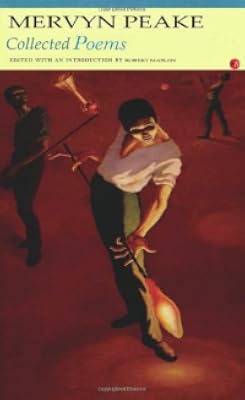
Collected Poems
by Mervyn Peake
On This Page
Description
"It is forty years since the death of Mervyn Peake (1911-68), the author of the much-loved Gormenghast novels. To mark the anniversary this first comprehensive edition of Peake's poetry is published. It includes every black-and-white illustration he made for his verse, together with unpublished drawings. Of the more than 230 poems in the collection, over 80 are printed for the first time. Robert Maslen's detailed work on the manuscripts reveals the poems as a dazzling link between the show more fantasy world of Gormenghast and the narrative of Peake's own life and of the turbulent times he lived in."--BOOK JACKET. show lessTags
Recommendations






























Member Reviews
Peake wrote many of these poems around the time of the Second World War, and that is the key to unlocking many of those that I would have otherwise found obscure. On the other hand, many of them are also overtly about the war, not least the magnificent Rhyme of the Flying Bomb.
As one of Britain's official war artists and one of the first into the Nazi death camp of Belsen, Peake's shock and horror at the atrocities he witnessed is palpable. His poem The Consumptive. Belsen 1945 describes the last wracking minutes of the life of a young woman and Peake's guilt at his fascination with her as an artistic subject - how can he find within her pain and suffering an object to be aesthetically appreciated? His war experiences as an artist and show more as a serving soldier badly affected him and he suffered a nervous breakdown.
While this collection shows Peake to have been a war poet of incredible power, that's only a part of his genius. There are poems about nature and art, people in streets and factories, childhood and parenthood, poems of aching melancholy and rapturous joy. And love. Several of the love poems are dedicated to Peake's wife, Maeve, but it's a fair bet that they're nearly all about her.
A Reverie of Bone is a gothic masterpiece, as on an imagined (I assume) journey through a desert, the poet sees the skeletons of a man and his horse momentarily uncovered by the shifting sands, which inspires a meditation on mortality that put me in mind (subject-wise, not stylistically) of Omar Khayyám.
I Sing a Hatred of the Black Machine is condemnation of industrialism, capitalism and greed: William Blake's dark, Satanic mills on a global scale.
I didn't understand all of the poems, and some critical apparatus from the editor might have helped but, on the other hand, you then run the danger of being ensnared in somebody else's interpretation. I'll certainly be dipping into this book over and over again, so maybe some of what is presently dark will become clear.
And if the words weren't enough, the poems are enhanced by Peake's own brilliant and bizarre illustrations. show less
As one of Britain's official war artists and one of the first into the Nazi death camp of Belsen, Peake's shock and horror at the atrocities he witnessed is palpable. His poem The Consumptive. Belsen 1945 describes the last wracking minutes of the life of a young woman and Peake's guilt at his fascination with her as an artistic subject - how can he find within her pain and suffering an object to be aesthetically appreciated? His war experiences as an artist and show more as a serving soldier badly affected him and he suffered a nervous breakdown.
While this collection shows Peake to have been a war poet of incredible power, that's only a part of his genius. There are poems about nature and art, people in streets and factories, childhood and parenthood, poems of aching melancholy and rapturous joy. And love. Several of the love poems are dedicated to Peake's wife, Maeve, but it's a fair bet that they're nearly all about her.
A Reverie of Bone is a gothic masterpiece, as on an imagined (I assume) journey through a desert, the poet sees the skeletons of a man and his horse momentarily uncovered by the shifting sands, which inspires a meditation on mortality that put me in mind (subject-wise, not stylistically) of Omar Khayyám.
I Sing a Hatred of the Black Machine is condemnation of industrialism, capitalism and greed: William Blake's dark, Satanic mills on a global scale.
I didn't understand all of the poems, and some critical apparatus from the editor might have helped but, on the other hand, you then run the danger of being ensnared in somebody else's interpretation. I'll certainly be dipping into this book over and over again, so maybe some of what is presently dark will become clear.
And if the words weren't enough, the poems are enhanced by Peake's own brilliant and bizarre illustrations. show less
Ratings
Members
- Recently Added By
Author Information

47+ Works 17,123 Members
All Editions
Series
Belongs to Publisher Series
Common Knowledge
- Canonical title
- Collected Poems
- Original publication date
- 2008
- Important events
- World War II
Classifications
Statistics
- Members
- 53
- Popularity
- 574,631
- Reviews
- 1
- Rating
- (4.30)
- Languages
- English, Finnish
- Media
- Paper, Ebook
- ISBNs
- 4
- ASINs
- 1