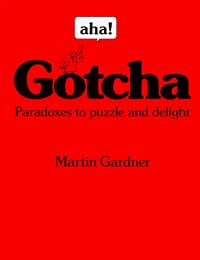
Aha! Gotcha: Paradoxes to Puzzle and Delight
by Martin Gardner
On This Page
Description
A collection of puzzles that challenge reasoning power and intuition and help develop problem solving ability.Tags
Recommendations
















Member Reviews
Maravilloso libro. Recuerdo haber devorado este libro a los 14 años. Recuerdo mi asombro al aprender sobre el hotel de Hilbert, que con sus infinitas habitaciones llenas de huéspedes era capaz de admitir a un huésped más (cada huésped en la habitación n pasa a la habitación n 1 y el huésped nuevo se queda con la habitación 1) e incluso admitía a infinitos huéspedes cuando las infinitas habitaciones estaban llenas (cada huésped de la habitacion n pasa a la 2n y quedan libres las infinitas habitaciones impares). Fue un descubrimiento, lo leí entero en la casa de la cultura de mi pueblo un día que me colé en la biblioteca porque me aburría. Grandísima introduccción a las matemáticas y al pensamiento abstracto.
Bad blurb - the hardcover is anything but pocket size, and there are no riddles in any common sense of the word. These are puzzles & provocations. They're aimed at youth who need just a little nudge to realize that they want to become mathematicians. It reminds me very strongly of the books that I enjoyed back in the day when I imagined I could get into higher math like topology and non-Euclidean geometry. Stuff happened, and now the best I can do is extend my understandings of probability and statistics. Anyway, this book introduces all of those different maths, and more, through brain-teasers, outlines of classic paradoxes, and other 1-3 page illustrated mini-lessons. Would that all children & teens had a teacher as lively & engaging show more as Gardner, or at least one who used his works in their math classes.
Gardner's Annotated Alice in Wonderland is also a delight, and I picked up a stack of his works from the university library so, if you're interested, watch for my reactions to them in these coming weeks.
Find a card or square scrap of stiff paper. Write on one side "The statement on the other side of this card is true." On the other side, write "The statement on the other side of this card is false." Set it out on the counter or coffee table. Watch reactions of those who pick it up.
I appreciate the shout out to [b:Anno's Alphabet|596838|Anno's Alphabet|Mitsumasa Anno|https://i.gr-assets.com/images/S/compressed.photo.goodreads.com/books/1381540168l/596838._SX50_.jpg|1391264] and other books by [a:Mitsumasa Anno|72077|Mitsumasa Anno|https://images.gr-assets.com/authors/1401698467p2/72077.jpg], and to science fiction writers including [a:Fredric Brown|51503|Fredric Brown|https://images.gr-assets.com/authors/1234483488p2/51503.jpg] and his [b:What Mad Universe|439246|What Mad Universe|Fredric Brown|https://i.gr-assets.com/images/S/compressed.photo.goodreads.com/books/1234710645l/439246._SY75_.jpg|428065].
This prompts me to try again to read [b:Gödel, Escher, Bach: An Eternal Golden Braid|24113|Gödel, Escher, Bach An Eternal Golden Braid|Douglas R. Hofstadter|https://i.gr-assets.com/images/S/compressed.photo.goodreads.com/books/1547125681l/24113._SY75_.jpg|850076]. I will however not look at the bibliography for fear of adding unavailable (due to age) titles to my wishlist.
A paraphrase: "To a statistician, coincidences are extremely probable. There are lots and lots of ways that a coincidence of *some* sort can arise in the course of all the events & interactions of a day. What we forget is that for each coincidence, there are*many more* possible ones that did *not* occur."
Get a grid of 20X20 graph paper, two colored pencils, and a coin (or a paint program other random binary number generator). Sequentially color in squares on the paper according to whether the red was cued by 'heads' or the green was cued by 'tails.' Note the clumps. Reassess your understanding of "random."
And, yes, I still want more fun w/ probability & statistics, so if you have titles to recommend please do comment! show less
Gardner's Annotated Alice in Wonderland is also a delight, and I picked up a stack of his works from the university library so, if you're interested, watch for my reactions to them in these coming weeks.
Find a card or square scrap of stiff paper. Write on one side "The statement on the other side of this card is true." On the other side, write "The statement on the other side of this card is false." Set it out on the counter or coffee table. Watch reactions of those who pick it up.
I appreciate the shout out to [b:Anno's Alphabet|596838|Anno's Alphabet|Mitsumasa Anno|https://i.gr-assets.com/images/S/compressed.photo.goodreads.com/books/1381540168l/596838._SX50_.jpg|1391264] and other books by [a:Mitsumasa Anno|72077|Mitsumasa Anno|https://images.gr-assets.com/authors/1401698467p2/72077.jpg], and to science fiction writers including [a:Fredric Brown|51503|Fredric Brown|https://images.gr-assets.com/authors/1234483488p2/51503.jpg] and his [b:What Mad Universe|439246|What Mad Universe|Fredric Brown|https://i.gr-assets.com/images/S/compressed.photo.goodreads.com/books/1234710645l/439246._SY75_.jpg|428065].
This prompts me to try again to read [b:Gödel, Escher, Bach: An Eternal Golden Braid|24113|Gödel, Escher, Bach An Eternal Golden Braid|Douglas R. Hofstadter|https://i.gr-assets.com/images/S/compressed.photo.goodreads.com/books/1547125681l/24113._SY75_.jpg|850076]. I will however not look at the bibliography for fear of adding unavailable (due to age) titles to my wishlist.
A paraphrase: "To a statistician, coincidences are extremely probable. There are lots and lots of ways that a coincidence of *some* sort can arise in the course of all the events & interactions of a day. What we forget is that for each coincidence, there are*many more* possible ones that did *not* occur."
Get a grid of 20X20 graph paper, two colored pencils, and a coin (or a paint program other random binary number generator). Sequentially color in squares on the paper according to whether the red was cued by 'heads' or the green was cued by 'tails.' Note the clumps. Reassess your understanding of "random."
And, yes, I still want more fun w/ probability & statistics, so if you have titles to recommend please do comment! show less
Ratings
Members
- Recently Added By
Author Information

224+ Works 15,646 Members
Martin Gardner is the author of more than seventy books on a vast range of topics including "Did Adam & Eve Have Navels?", "Calculus Made Easy", & "The Annotated Alice". He lives in Hendersonville, North Carolina. (Publisher Provided)
All Editions
Series
Belongs to Publisher Series
Work Relationships
Is contained in
Common Knowledge
- Canonical title*
- aha! Gotcha! Paradoxes to puzzle and delight
- Original publication date
- 1975
*Some information comes from Common Knowledge in other languages. Click "Edit" for more information.
Classifications
Statistics
- Members
- 583
- Popularity
- 50,234
- Reviews
- 2
- Rating
- (3.79)
- Languages
- 5 — English, German, Italian, Portuguese, Spanish
- Media
- Paper, Ebook
- ISBNs
- 13
- ASINs
- 7