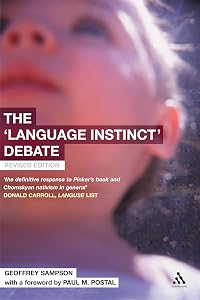
The 'Language Instinct' Debate
by Geoffrey Sampson
On This Page
Description
When it was first published in 1997, Geoffrey Sampson's Educating Eve was described as the definitive response to Steven Pinker's The Language Instinct and Noam Chomsky's nativism. In this revised and expanded new edition, Sampson revisits his original arguments in the light of fresh evidence that has emerged since the original publication. Since Chomsky revolutionized the study of language in the 1960's, it has increasingly come to be accepted that language and other knowledge structures show more are hard-wired in our genes. According to this view, human beings are born with a rich structure of cognition. show lessTags
Recommendations










Member Reviews
There's nothing better than seeing an overconfident favourite getting a proper seeing to from an unfancied underdog.
All the same, when best-selling MIT and Harvard-credentialised psycho-linguist Steven Pinker's book "the Language Instinct" - a work feted far and wide and rarely challenged in polite circles - is subjected to critical treatment by an curmudgeonly British professor from an unfashionable second tier university in the home counties, it is a hopeful chap indeed who thinks an upset might be on the cards.
Pinker, after all, has the weight of Noam Chomsky (self styled most important intellect on the planet) behind him, and rates consistently favourable mentions from the literary review sections of important newspapers and that show more peculiar clique of populist science writers (Dan Dennett, Alan Sokal and Richard Dawkins among others).
The best you could say for Sampson, on the other hand, is that he lacks profile: His tenure is at the University of Sussex - yes, there is one - and the profile he does have isn't the sort most people would want: as far back as 1977, Christopher Hitchens described him as "an academic nonentity who made various other incautious allegations [about Noam Chomsky's political views] and who later ... strolled into the propellers and was distributed into such fine particles that he has never been heard from again." Ouch.
That's all ancient history, though, and the pleasant surprise is that over the last thirty years the plucky little Britisher has made a full recovery from his encounter with the propellers and is in fine enough fettle to give said global linguistic superstar a good old-fashioned intellectual walloping. Even read alone, Pinker's book is built on a wobbly edifice, but with Sampson's expert guide, it looks positively idiotic. Sampson is systematic: he sets up each of Pinker's arguments (such as they are), represents them fairly (I read Pinker's original concurrently to check) and then, like a gentleman cricketer on the village green dispatches each of them deftly to the boundary through extra-cover.
I'm really not sure why Geoffrey Sampson's book hasn't received more attention: possibly the author's history (he seems to made a number of "incautious" political statements over his life and doesn't seem to be the recanting type), but also because it swims bravely against an intellectual tide: Sampson is - though I don't think he expressly says it - a relativist:
"What the language learner is trying to bring his tacit theory into correspondence with is not some single, consistent grammar inhering in a collective national psyche, the sort of mystic entity that a sociologist such as Emile Durkheim would call a "social fact". Rather, he is trying to reconstruct a system underlying the usage of various speakers to whom he is exposed, and these speakers will almost certainly be working at any given time with non-identical tacit theories of their own - so that there will not be any wholly coherent and irrefutable grammar available to be formulated"
Advocating relativism, as I think Sampson coherently and convincingly does, has the misfortune to be about as incautious as criticising Noam Chomsky these days, so perhaps Sampson's card is marked and that's that. All the same, the passage cited above is beautifully put, and by itself is more persuasive than Steven Pinker's whole book.
All the same, who's laughing now? Probably not G. Sampson esq., as he strolls from the wicket at stumps, having carried his bat valiantly, but not having managed to save the innings. But up on the grassy bank, this cricket connoisseur stand to applaud this stylish, defiant knock.
Well batted, sir. show less
All the same, when best-selling MIT and Harvard-credentialised psycho-linguist Steven Pinker's book "the Language Instinct" - a work feted far and wide and rarely challenged in polite circles - is subjected to critical treatment by an curmudgeonly British professor from an unfashionable second tier university in the home counties, it is a hopeful chap indeed who thinks an upset might be on the cards.
Pinker, after all, has the weight of Noam Chomsky (self styled most important intellect on the planet) behind him, and rates consistently favourable mentions from the literary review sections of important newspapers and that show more peculiar clique of populist science writers (Dan Dennett, Alan Sokal and Richard Dawkins among others).
The best you could say for Sampson, on the other hand, is that he lacks profile: His tenure is at the University of Sussex - yes, there is one - and the profile he does have isn't the sort most people would want: as far back as 1977, Christopher Hitchens described him as "an academic nonentity who made various other incautious allegations [about Noam Chomsky's political views] and who later ... strolled into the propellers and was distributed into such fine particles that he has never been heard from again." Ouch.
That's all ancient history, though, and the pleasant surprise is that over the last thirty years the plucky little Britisher has made a full recovery from his encounter with the propellers and is in fine enough fettle to give said global linguistic superstar a good old-fashioned intellectual walloping. Even read alone, Pinker's book is built on a wobbly edifice, but with Sampson's expert guide, it looks positively idiotic. Sampson is systematic: he sets up each of Pinker's arguments (such as they are), represents them fairly (I read Pinker's original concurrently to check) and then, like a gentleman cricketer on the village green dispatches each of them deftly to the boundary through extra-cover.
I'm really not sure why Geoffrey Sampson's book hasn't received more attention: possibly the author's history (he seems to made a number of "incautious" political statements over his life and doesn't seem to be the recanting type), but also because it swims bravely against an intellectual tide: Sampson is - though I don't think he expressly says it - a relativist:
"What the language learner is trying to bring his tacit theory into correspondence with is not some single, consistent grammar inhering in a collective national psyche, the sort of mystic entity that a sociologist such as Emile Durkheim would call a "social fact". Rather, he is trying to reconstruct a system underlying the usage of various speakers to whom he is exposed, and these speakers will almost certainly be working at any given time with non-identical tacit theories of their own - so that there will not be any wholly coherent and irrefutable grammar available to be formulated"
Advocating relativism, as I think Sampson coherently and convincingly does, has the misfortune to be about as incautious as criticising Noam Chomsky these days, so perhaps Sampson's card is marked and that's that. All the same, the passage cited above is beautifully put, and by itself is more persuasive than Steven Pinker's whole book.
All the same, who's laughing now? Probably not G. Sampson esq., as he strolls from the wicket at stumps, having carried his bat valiantly, but not having managed to save the innings. But up on the grassy bank, this cricket connoisseur stand to applaud this stylish, defiant knock.
Well batted, sir. show less
I enjoy looking at both side of an argument; as an introductory linguistics course I am taking has highlighted this book as a good way of looking at the other side of the Chomskyan claims I swiftly ordered my copy, fully expecting several evenings of intellectual challenge and brain stretching. The book has fully disappointed me. It is a pamphlet rather than a scientific work.
I'll propose that the first paragraph of the book is an acid test for the potential reader. It reads as follows: "the English language, and other languages, are institutions like country dancing or the game of cricket: cultural creations that individuals may learn during their lifetimes, if they happen to be born into the appropriate cultures, but to which no one show more is innately predisposed".
If you're struck by the fact you hardly know anybody who doesn't speak a language (I know nobody having chosen to not learn one during her lifetime), but probably know several people who don't play cricket you'll be hard pressed to find a satisfying explanation.
If on the other hand, you find this claim fairly self obvious (maybe you don't know anybody who doesn't play cricket for instance) and are in fact scandalized anybody could think otherwise, you'll probably enjoy the book. show less
I'll propose that the first paragraph of the book is an acid test for the potential reader. It reads as follows: "the English language, and other languages, are institutions like country dancing or the game of cricket: cultural creations that individuals may learn during their lifetimes, if they happen to be born into the appropriate cultures, but to which no one show more is innately predisposed".
If you're struck by the fact you hardly know anybody who doesn't speak a language (I know nobody having chosen to not learn one during her lifetime), but probably know several people who don't play cricket you'll be hard pressed to find a satisfying explanation.
If on the other hand, you find this claim fairly self obvious (maybe you don't know anybody who doesn't play cricket for instance) and are in fact scandalized anybody could think otherwise, you'll probably enjoy the book. show less
'Educating Eve' is a devastating critique of Steven Pinker's 'Language Instinct,' exposing the intellectual flaws in the hypothesis that there is such a thing as Universal Grammar, and that it's innate.
It's written in a style that's just as accessible as The Language Instinct - so if you've read The Language Instinct, this is for you! See also Sampson's slightly more technical book, Empirical Linguistics.
It's written in a style that's just as accessible as The Language Instinct - so if you've read The Language Instinct, this is for you! See also Sampson's slightly more technical book, Empirical Linguistics.
Ratings
Members
- Recently Added By
Author Information
15 Works 451 Members
Geoffrey Sampson is Professor Emeritus at Sussex University and a Research Fellow in the Linguistics Department at the University of South Africa. His most recent book is Grammar Without Grammaticality (2014, with Anna Babarczy).
Classifications
Statistics
- Members
- 96
- Popularity
- 336,193
- Reviews
- 3
- Rating
- (3.29)
- Languages
- English
- Media
- Paper, Ebook
- ISBNs
- 8