In Search of Respect: Selling Crack in El Barrio
by Philippe Bourgois
Structural Analysis in the Social Sciences (10)
On This Page
Description
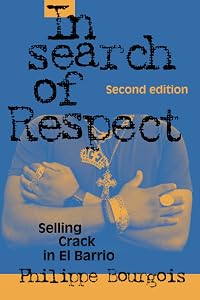
In Search of Respect, Philippe Bourgois's now-classic, ethnographic study of social marginalization in inner-city America, won critical acclaim after it was first published in 1995 and in 1997 was awarded the Margaret Mead Award. For the first time, an anthropologist had managed to gain the trust and long-term friendship of street-level drug dealers in one of the roughest ghetto neighborhoods in the United States - East Harlem. This edition adds a prologue describing the major dynamics in show more America that have altered life on the streets of East Harlem in the six years since the first edition. Bourgois, in a new epilogue, brings up to date the stories of the people - Primo, Caesar, Luis, Tony, Candy - who readers come to know in this remarkable window onto the world of the inner-city drug trade. show lessTags
Recommendations























Member Reviews
After reading that excerpt in my anthropology class lo these many years ago, about Bourgois's confrontation with the crack dealer Ray, I admit I thought of this book as exotic - a travel narrative, a (sympathetic) "your correspondent among the Hottentots". Reading it, though, feels like peeling off a scab in a sense - takes you back to the old wounds of youth, which it feels good to expose to the air. In other words, Bourgois does us a great service in reminding us that East Harlem, for all its particularity, is also just like Esquimalt, or wherever you grew up, only with more institutionalized racism and the inequities of American late capitalism to boot. Are they damaged people? Sure, but so are we all. There's a wealth of show more ethnographic and sociological information here, and there's also a lesson: These are your friends and neighbours, or if they're not, it's probably because you're profiting off their exploitation somewhere along the line, intentionally or unintentionally. Love them. show less
"This book's argument is that people like Primo and Caesar have not passively accepted their structural victimhood. On the contrary, by embroiling themselves in the underground economy and proudly embracing street culture, they are seeking an alternative to their social marginalization. In the process, on a daily level, they become the actual agents administering their own destruction and they community's suffering."
This was a courageous and thoughtful attempt to gain insight into the question of structure versus agency in causing inner-city blight. The author moved to Spanish Harlem in the mid-90s and befriended a gang of crack dealers. The book is worth finding for chapter 4 alone, on the dealers' rancorous attempts to hold onto legal show more office work. Chapter 5 on their failed schooling and, shockingly, on the prevalence of gang-rape is also pretty essential, appalling reading.
The author shows how migration of large numbers of poor Puerto Ricans to New York City during a period of deindustrialization, combined with the rise of crack cocaine and the persistence of racial and cultural barriers, produced a generation of people shut out of dependable avenues for supporting themselves legally. In place of employment and self-respect, came dealing, aggression, poverty, sexual violence and a desperate yearning of the young men to make it big somehow.
The figures in the book could not overcome the structure they were born into, but we get little sense of how typical they were of the community as a whole. It would have been good to have heard from some people who did make it out: how did they overcome the barriers? show less
This was a courageous and thoughtful attempt to gain insight into the question of structure versus agency in causing inner-city blight. The author moved to Spanish Harlem in the mid-90s and befriended a gang of crack dealers. The book is worth finding for chapter 4 alone, on the dealers' rancorous attempts to hold onto legal show more office work. Chapter 5 on their failed schooling and, shockingly, on the prevalence of gang-rape is also pretty essential, appalling reading.
The author shows how migration of large numbers of poor Puerto Ricans to New York City during a period of deindustrialization, combined with the rise of crack cocaine and the persistence of racial and cultural barriers, produced a generation of people shut out of dependable avenues for supporting themselves legally. In place of employment and self-respect, came dealing, aggression, poverty, sexual violence and a desperate yearning of the young men to make it big somehow.
The figures in the book could not overcome the structure they were born into, but we get little sense of how typical they were of the community as a whole. It would have been good to have heard from some people who did make it out: how did they overcome the barriers? show less
This is an incredibly well written ethnography, it's very accessible and could be read by anyone. Really illustrates the problems of people in ghettoised areas, with restricted access to the job market and a stigma attached to them.
A good argument for structure over agency and depressing too, but that's all, with no good conclusion or lasting impression.
I found the introduction wayyy to long. Over all I found the book to be very insightful and informative.l
Ratings
Members
- Recently Added By
Author Information
8+ Works 788 Members
Awards and Honors
Series

Common Knowledge
- Canonical title
- In Search of Respect: Selling Crack in El Barrio
- Original publication date
- 1995
- Important places
- El Barrio, New York, USA
- Epigraph
- Born Anew at Each A.M./
The street's got its kicks, man,/
like a bargain shelf./
In fact, cool-breeze, it's got/
love like anywhere else./
Vaya!/
It's got lights that shine up the dark/
like n... (show all)ew./
It sells what you don't need/
and never lets you forget/
what you blew./
It's got high-powered/
salesmen who push mucho junk,/
and hustlers who can swallow you/
up in a chunk./
Aha, check it out./
It's got our beautiful children/
living in all kinds of hell,/
hoping to survive and making it well,/
swinging together in mist darkness/
with all their love to share/
smiling their Christ-like forgiveness/
that only a ghetto cross can bear./
Oh, yeah vaya, check it out!/
Hey, the street's got life, man./
like a young tender sun,/
and gentleness/
like a long awaited dream to come./
Oye, vaya, check it out./
The children are roses,/
with nary a thorn./
Forced to feel racist scorn./
Ha, ha, vaya, check it out!/
Our children are beauty/
with the right to be born./
Born anew at each A.M./
like a child out of twilight/
flying towards sunlight/
born anew at each A.M/.
Punto!/
-Piri Thomas - Dedication
- For Nano
- First words
- I was forced into crack against my will.
- Publisher's editor
- Granovetter, Mark
- Blurbers
- Wolfe, Tom; Wilson, William Julius; Donaldson, Greg; Massing, Michael; Bernstein, Richard; Scheper-Hughes, Nancy (show all 10); Thomas, Piri; Valbrun, Marjorie; Landas, Marc; Gonzalez, Carolina
- Canonical DDC/MDS
- 363.45097471
- Canonical LCC
- HV5810.B68
Classifications
- Genres
- Anthropology, Nonfiction, General Nonfiction
- DDC/MDS
- 363.45097471 — Society, government, & culture Social problems and social services Public Safety - Police, Crime Investigation Illegal drugs Illegal drugs - subdivisions Illegal drugs - by place
- LCC
- HV5810 .B68 — Social sciences Social pathology. Social and public welfare. Criminology Social pathology. Social and public welfare. Drug habits. Drug abuse
- BISAC
Statistics
- Members
- 542
- Popularity
- 55,109
- Reviews
- 5
- Rating
- (4.08)
- Languages
- English, French
- Media
- Paper, Ebook
- ISBNs
- 6
- ASINs
- 5