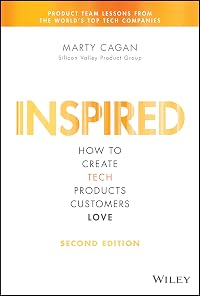
Inspired: How To Create Products Customers Love
by Marty Cagan
On This Page
Description
Learn to design, build, and scale products consumers can't get enough of How do today's most successful tech companies-Amazon, Google, Facebook, Netflix, Tesla-design, develop, and deploy the products that have earned the love of literally billions of people around the world? Perhaps surprisingly, they do it very differently than most tech companies. In "Inspired", technology product management thought leader Marty Cagan provides readers with a master class in how to structure and staff a show more vibrant and successful product organization, and how to discover and deliver technology products that your customers will love-and that will work for your business. With sections on assembling the right people and skillsets, discovering the right product, embracing an effective yet lightweight process, and creating a strong product culture, readers can take the information they learn and immediately leverage it within their own organizations-dramatically improving their own product efforts. Whether you're an early-stage startup working to get to product/market fit, or a growth-stage company working to scale your product organization, or a large, long-established company trying to regain your ability to consistently deliver new value for your customers, "Inspired" will take you and your product organization to a new level of customer engagement, consistent innovation, and business success. Filled with the author's own personal stories-and profiles of some of today's most-successful product managers and technology-powered product companies, including Adobe, Apple, BBC, Google, Microsoft, and Netflix-"Inspired" will show you how to turn up the dial of your own product efforts, creating technology products your customers love.. show lessTags
Recommendations






Member Reviews
Since computers and digital technology have become so ubiquitous in contemporary life, creating good software and technology products has become an important business function. Many (exceeding 50%) technology products fail, despite significant design, engineering, and financial efforts. How can we make this process more efficient and profitable? That’s the job of a relatively new job title: the product manager. In this book, Marty Cagan discusses how to fulfill this role in an organization so that success is realized by all parties.
Of note, this book is in a second edition, a feat that many technical books do not accomplish. And this book offers a more comprehensive and in-depth discussion about the role of product managers than any show more other text I’ve read to date. It discusses the critical tasks of identifying and confronting potential failure points early so that money and effort won’t be wasted. It also explores a cornucopia of niche topics that can polish the skillset of even experienced product managers.
While there is much positive in this book, I simply do not like the title. Professionally, I am a software developer who engages in many business activities, so I see much of product creation in my domain or tangential to my domain. This book talks more about structuring a business so that it can create products. Thus, it’s one step removed and focuses specifically on being a successful product manager. There’s nothing wrong with that approach, but a title about inspiring creativity seems not to correspond with the text of the book. It’s not about product creation directly and more about managing product creation.
All that said, Cagan offers readers a lot in this book. The Silicon Valley Product Group, of which he is a member, does industry-leading work in this space, so anyone interested in learning from the best can benefit from perusing this book. Those organizing a team to create tech products, whether at a small firm or an established venture, can benefit from this work. Indeed, this book is one of the few titles that can raise the game of even experienced product managers. Finally, of course, those who aspire to fill this role will find a helpful introduction here. This field and this new role continue to evolve rapidly, like the technologies, but this description of product management is one of the best, if not the very best, out there. show less
Of note, this book is in a second edition, a feat that many technical books do not accomplish. And this book offers a more comprehensive and in-depth discussion about the role of product managers than any show more other text I’ve read to date. It discusses the critical tasks of identifying and confronting potential failure points early so that money and effort won’t be wasted. It also explores a cornucopia of niche topics that can polish the skillset of even experienced product managers.
While there is much positive in this book, I simply do not like the title. Professionally, I am a software developer who engages in many business activities, so I see much of product creation in my domain or tangential to my domain. This book talks more about structuring a business so that it can create products. Thus, it’s one step removed and focuses specifically on being a successful product manager. There’s nothing wrong with that approach, but a title about inspiring creativity seems not to correspond with the text of the book. It’s not about product creation directly and more about managing product creation.
All that said, Cagan offers readers a lot in this book. The Silicon Valley Product Group, of which he is a member, does industry-leading work in this space, so anyone interested in learning from the best can benefit from perusing this book. Those organizing a team to create tech products, whether at a small firm or an established venture, can benefit from this work. Indeed, this book is one of the few titles that can raise the game of even experienced product managers. Finally, of course, those who aspire to fill this role will find a helpful introduction here. This field and this new role continue to evolve rapidly, like the technologies, but this description of product management is one of the best, if not the very best, out there. show less
Read this book for work, and it really is the best book on how to create products out there. A ton of useful advice encapsulated in a good theoretical framework. Helped crystallize many of my existing intuitions while giving them the rigor and depth needed for actual practice. Recommended if you want to make good things!
More like a series of blog posts than a book, there was lots of great tidbits in this book but no real overarching theme. I'm sure I'll dip back into this book often though, and it was a very worthwhile read.
This book is a checklist for how to create a software product with a lot of good advise. I can really recommend someone with little product development experience to read through it and use as a suggestion list for things to do.
As usual the real world will be messier than the model development described in the book so it can't be taken literally. There will be constraints that force shortcuts, and while the author does suggest shortcuts as well, no two projects will be the same.
I'm a little split on how to grade it. It's not a great book, but it's useful for a small group of people. It's also not that interesting to read since it's mostly a couple of hundred pages of "do this, do that". Not that I would have wanted it to be longer, but show more it makes it a bit uninspiring. show less
As usual the real world will be messier than the model development described in the book so it can't be taken literally. There will be constraints that force shortcuts, and while the author does suggest shortcuts as well, no two projects will be the same.
I'm a little split on how to grade it. It's not a great book, but it's useful for a small group of people. It's also not that interesting to read since it's mostly a couple of hundred pages of "do this, do that". Not that I would have wanted it to be longer, but show more it makes it a bit uninspiring. show less
Title pretty much says it all. Much of this stuff will be helpful in my new career.
Não lido
Great book. I think this will join Accelerate of my go to books for the vision and strategy I see in my workplaces. Not much new for me, but packaged in a accessible way.
And for the content, already In the first pages I find fuel for my questioning of year plans.
And the full width of this book, and the focus around the product role complements a lot of the previous literature I read on organizing teams.
There is some things you should not listen to though. Like the idea of 60h work week and the PM with hero complex. PM should be part of a great team and be able to do its work within working hours with the support of its organization. If that does not work out for you get help from your scrum master or agile coach to find ways of working show more that keeps you alive. :) show less
And for the content, already In the first pages I find fuel for my questioning of year plans.
And the full width of this book, and the focus around the product role complements a lot of the previous literature I read on organizing teams.
There is some things you should not listen to though. Like the idea of 60h work week and the PM with hero complex. PM should be part of a great team and be able to do its work within working hours with the support of its organization. If that does not work out for you get help from your scrum master or agile coach to find ways of working show more that keeps you alive. :) show less
Jan 26, 2021 (Edited)Swedish
Members
- Recently Added By
Author Information
9 Works 695 Members
Classifications
Statistics
- Members
- 536
- Popularity
- 55,569
- Reviews
- 7
- Rating
- (4.01)
- Languages
- English
- Media
- Paper, Audiobook, Ebook
- ISBNs
- 7
- ASINs
- 5